Recommended Reading
Notice
This article is based on the Secure Code Warrior SCW AI Trust Index research and related cybersecurity analysis publicly available as of July 22, 2026. It also includes DANA NOTES’ analysis and interpretation.
What This Article Covers
Generative AI is rapidly evolving beyond a simple chatbot into a tool for developing real software. Developers can describe the features they want in natural language and use AI to write code, fix errors, and improve existing programs.
This shift has significantly increased development productivity, but it has also raised a new question.
“Just how secure is AI-generated code?”
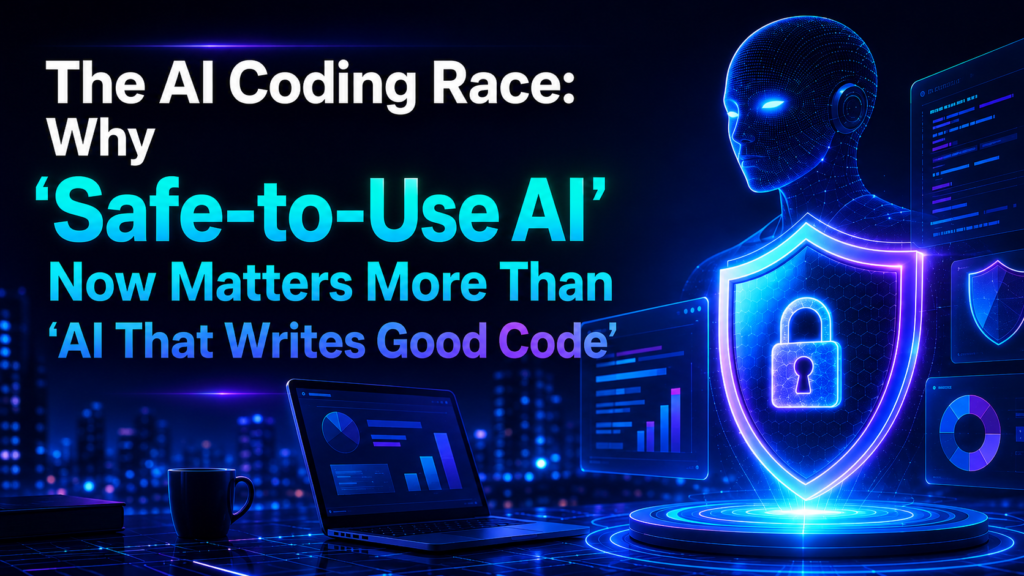
Until now, AI coding tools have primarily been compared based on factors such as code generation speed and accuracy, the programming languages they support, and their ability to solve complex problems. However, as companies begin deploying AI-generated code in real-world services, attention is gradually shifting from productivity to security and reliability.
The recently released SCW AI Trust Index study by Secure Code Warrior illustrates this changing landscape. The study compared the security of 1,760 complete codebases generated by 16 frontier large language models (LLMs) from companies including OpenAI, Anthropic, Google, and Alibaba.
The findings were somewhat unexpected.
AI-generated code contained an average of approximately 15 confirmed security vulnerabilities. However, the researchers focused less on the number of vulnerabilities itself and more on what caused them.
It is easy to assume that more capable AI models will generate more secure code. However, the analysis found that no single AI model delivered consistently superior results across every environment. Security outcomes varied depending on the combination of programming language and development framework used.
This suggests that evaluating the security of AI-generated code requires examining not only the model but also the actual development environment in which it is used.
What Did the SCW AI Trust Index Analyze?
This study differs from conventional benchmarks designed to rank the overall performance of AI models.
Secure Code Warrior identified security trust as one of the most important considerations for companies adopting AI coding tools. Based on an evaluation methodology jointly developed with RMIT University, the company released the SCW AI Trust Index.
The researchers assigned identical or similar development tasks to multiple AI models and analyzed the resulting applications at the codebase level. Rather than comparing a single function or a few lines of code, the study evaluated security vulnerabilities across complete projects structured similarly to real-world services.
The evaluation examined not only security vulnerabilities found in the generated code but also programming languages, development frameworks, code structures, and security risks that could arise in actual enterprise environments.
In other words, the study focused less on “Which AI writes code better?” and more on “Does the AI generate code that is trustworthy enough for companies to use in real-world operations?”
An Average of 15 Vulnerabilities: The Cause Matters More Than the Number
The SCW AI Trust Index found an average of approximately 15 confirmed security vulnerabilities across the 1,760 AI-generated codebases. Of these, an average of 4.3 vulnerabilities were classified as severe, while the overall analysis identified 86 distinct Common Weakness Enumeration (CWE) categories.
The most frequently detected vulnerability was CWE-532, or the insertion of sensitive information into log files. A total of 8,543 true-positive vulnerability detections were recorded across the analysis, making it the most common among the 86 distinct CWE categories.
CWE-532 refers to a vulnerability in which sensitive information, such as authentication credentials, personal data, passwords, or tokens, is recorded in system logs. If an attacker gains access to these log files, the information may be used to compromise accounts or launch additional attacks, making this a significant concern in enterprise environments.
However, the central point of the study was not simply the number of vulnerabilities discovered.
The vulnerabilities were not concentrated in any single AI model. Even when the same AI model was used, the results varied according to the programming language and development framework involved.
In the evaluation, GPT-5.1 achieved the highest score in a Java Enterprise API environment, Claude Sonnet 4.5 performed best in a Java Spring environment, and Claude Opus 4.8 ranked highest in a Python Django environment.
This indicates that no single AI model performed best across every development environment. Instead, security outcomes may vary depending on the combination of the model and its development environment.
These findings suggest that comparing AI coding quality based on the model alone is insufficient. The actual development environment must also be considered.
Why Did the Results Differ by Language and Framework?
This may seem somewhat puzzling to non-developers.
After all, if AI is writing the code, it is natural to assume that the performance of the AI model would have the greatest influence.
An Automotive Analogy
An automotive analogy can make this easier to understand.
Even when the same car is used, the risk of an accident can differ significantly depending on whether it is driven on a well-maintained highway or a rough, unpaved road. The driver’s ability matters, but road conditions and safety systems also have a major impact on overall safety.
The same principle applies to AI-generated code.
Programming languages and development frameworks determine how data is processed, how users are authenticated, how external systems are connected, and which security features are available by default. Some frameworks provide strong built-in security features, while others require developers to configure additional protections manually.
As a result, even when AI generates code of a similar quality, the actual security level may vary depending on the environment in which the code runs.
The study is a meaningful example of how future competition in the AI coding market may depend not only on “which AI model is used” but also on “which development environment is used with the AI.”
AI Coding Competition Is Becoming Platform Competition
As AI coding tools continue to evolve rapidly, the criteria companies use to select them are also changing.
In the early generative AI market, the primary competitive advantage was whether a model could generate code more quickly and accurately. However, as companies begin introducing AI into real development environments, code generation capability alone is no longer sufficient to explain a product’s competitiveness.
Companies must also consider how naturally AI-generated code integrates with their existing development environments, whether it complies with internal security policies, and whether the generated code can be continuously monitored and maintained.
In other words, the AI coding market is rapidly shifting from competition among language models to competition among enterprise development platforms.
Companies Are Buying Development Platforms, Not AI Models
In the enterprise software market, operation and management are just as important as product functionality.
Even if an AI model generates excellent code, it will be difficult to deploy in actual business operations if it cannot integrate with a company’s internal development environment or satisfy its security requirements.
Conversely, even if its code generation performance is slightly weaker, a solution may offer greater value to companies if it integrates naturally with existing development systems and provides security validation and audit capabilities.
For this reason, future AI coding platforms are likely to compete around capabilities such as the following:
- Integration with enterprise development environments
- Automated security validation of generated code
- Open-source and dependency management
- Change history and audit capabilities
- Compliance with internal security policies and regulatory requirements
Ultimately, enterprise customers are likely to adopt integrated development platforms that include AI models rather than purchasing an AI model alone.
Which Industries Could Grow Alongside AI Coding?
As AI becomes more deeply embedded in the development process, related industries are also likely to grow.
One representative area is application security, or AppSec. As the volume of AI-generated code increases, solutions capable of detecting and remediating vulnerabilities are likely to become increasingly important.
DevSecOps, which integrates development and security, software supply chain security for managing open-source software and external libraries, and AI governance for establishing corporate standards for AI use are also considered areas with strong growth potential.
This suggests that the value created by the AI industry may not remain concentrated among large language model companies. Instead, it may spread across a wide range of enterprise software markets that support the practical adoption of AI.
DANA NOTES Commentary
The most important change highlighted by this study is that competition in the AI coding market will not be determined by model performance alone.
What companies actually need is not simply an AI system that can generate code quickly, but a framework capable of validating that code, integrating it with existing development environments, and managing it continuously. In the future, AI coding platforms that combine model performance with security validation, development tool integration, open-source dependency management, and audit capabilities are likely to become increasingly valuable.
This also means that the AI coding market is becoming more similar to the enterprise software market than to the consumer generative AI service market. Platforms that are deeply integrated into corporate development environments require significant time and cost to replace, potentially leading to long-term contracts, recurring revenue, and high customer retention rates.
Investors should therefore look beyond which companies possess the highest-performing models. They should also examine how many enterprise customers a company has secured, how deeply its platform is integrated with existing development systems, and whether it can offer security capabilities as paid services.
AI coding competition is moving beyond “Who can generate better code?” toward “Who can provide a development environment that companies can use with confidence?”
What to Watch Going Forward
- Whether international standards will emerge for evaluating the security of AI-generated code
- Performance variations across combinations of models, programming languages, and frameworks
- Advances in AI-based automated vulnerability detection and remediation technologies
- The competitive landscape of the enterprise AI development platform market
- The expansion of security responsibilities for companies that provide AI coding tools