What This Article Covers
Since the emergence of ChatGPT, people have become accustomed to asking AI questions and receiving answers. AI can be used to explain unfamiliar topics, summarize lengthy texts, and draft emails and reports. AI systems such as ChatGPT, Gemini, and Claude that interact with people through conversation and provide answers or other outputs are known as conversational AI.
Recently, however, the term AI agent has also become increasingly common alongside conversational AI.
AI agents can also understand human language, search for information, and write documents. On the surface, they may not appear very different from conversational AI.
However, there is a clear difference in the roles they perform.
Conversational AI provides outputs that match the user’s questions and requests. An AI agent uses the goal provided by the user to connect with external tools such as email, calendars, document repositories, business systems, and smart home devices, and then carries out the necessary tasks.
Conversational AI Creates Outputs Based on a Request
Conversational AI understands the questions or requests entered by the user and generates an appropriate response.
Users can ask conversational AI to explain a difficult concept, summarize a lengthy document, create an outline for a presentation, or draft an email or report.
For example, imagine that a user makes the following request:
Write an email informing a client that the meeting schedule has changed.
Conversational AI can write an appropriate subject line and email body. The user then reviews the generated content, makes any necessary changes, copies it into an email service, and sends it.
In this process, the task performed by conversational AI is writing the email message.
The user must still confirm the client’s email address, change the actual meeting schedule, and send the completed email.
In this way, conversational AI creates outputs such as explanations, summaries, written content, tables, code, and plans based on the user’s request.
AI Agents Continue Tasks Across Multiple Systems
An AI agent does not stop after generating an answer or document.
When the user provides a goal, the AI agent identifies the necessary information and uses connected tools and systems to carry out multiple tasks in sequence.
The same meeting rescheduling request would be handled differently by an AI agent.
My meeting with the client has been moved to Friday at 3:00 p.m. Update the schedule and inform the attendees.
When the necessary systems and permissions are connected, the AI agent may perform the following tasks:
- Check the existing meeting schedule.
- Change the meeting time in the calendar.
- Find the contact information of the attendees and client.
- Write a schedule change notice.
- Prepare the email for delivery.
- Confirm that the updated schedule has been applied correctly.
For important actions such as sending an email to an external client, the agent can be configured not to execute the action immediately. Instead, it may first show the recipient and message to the user for approval.
While conversational AI writes the email message, an AI agent connects multiple tasks across different systems, including checking and changing the schedule, searching for contact information, writing the notice, and preparing the message for delivery.
Handling a Complex Request Does Not Make an AI System an Agent
The difference between conversational AI and an AI agent cannot be determined by whether a request is simple or complex.
Conversational AI can also combine multiple conditions within a single request.
For example, a user may make the following request:
Create a four-day, three-night travel itinerary, including an estimated budget and a packing list.
Conversational AI can combine the itinerary, budget, and packing list into a detailed travel plan. Handling several items within one request does not automatically make it an AI agent.
Creating a travel itinerary is still the generation of an output. By contrast, checking actual flights and accommodations, comparing options based on the user’s conditions, adding the itinerary to a calendar, or proceeding with the booking process is closer to how an AI agent operates.
The distinction therefore does not depend on the complexity of the task. It depends on whether the AI stops after providing an answer or continues by performing actual tasks within connected systems.
How Are They Different in Everyday Life?
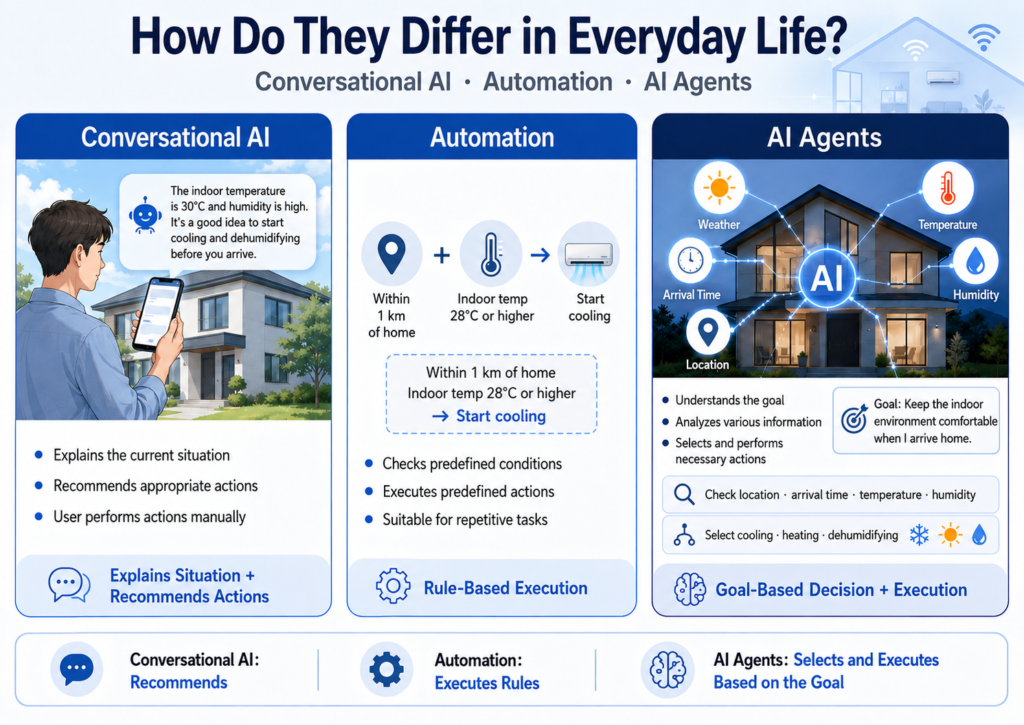
The differences among conversational AI, automation, and AI agents can be understood more easily by comparing how they would control heating and cooling.
Imagine that a user is on the way home. During summer, the home may be hot and humid. During winter, the indoor temperature may be low.
Conversational AI
Conversational AI explains the current situation and recommends an appropriate action.
During summer, it might say:
The current indoor temperature is 30°C, and the humidity is high. It would be a good idea to start cooling and dehumidification before you arrive.
During winter, it might suggest:
The current indoor temperature is 15°C. It would be a good idea to turn on the heating before you arrive.
Conversational AI analyzes the situation and tells the user what action is needed. The user reviews the information and manually activates the cooling, heating, or dehumidification function.
Automation
Automation executes conditions and actions that have been defined in advance.
For example, the following rule could be configured:
If the user comes within one kilometer of home and the indoor temperature is at least 28°C, turn on the air conditioner.
When the condition is met, the predefined action is executed. The system does not separately determine whether indoor humidity is high, whether the user’s arrival has been delayed, or whether dehumidification would be more appropriate than cooling.
Automation is effective for repetitive tasks with clear criteria.
AI Agent
A user may give an AI agent the following goal:
Keep the indoor environment comfortable by the time I arrive home.
The AI agent checks the user’s location and estimated arrival time, as well as the indoor and outdoor temperature, humidity, and season.
During summer, it may choose between cooling and dehumidification. During winter, it may turn on the heating. If the indoor environment is already comfortable, it may decide not to activate any device.
The three approaches can be distinguished as follows:
Conversational AI explains the situation and recommends an action.
Automation performs a predefined action when predefined conditions are met.
An AI agent selects and performs the necessary action based on the goal and current situation.
Neither automation nor AI agents are inherently superior to the other. Automation is suitable for repetitive tasks with clearly defined conditions and procedures, while AI agents are suitable for tasks that require judgment and adjustment based on changing circumstances.
How Is Multimodal AI Different from an AI Agent?
When an AI agent can also understand images and audio, it can be difficult to distinguish it from multimodal AI.
Multimodal AI refers to the ability to understand and process two or more different types of information together, such as text, images, audio, and video.
An AI agent, by contrast, refers to an operational approach in which the AI uses the information it has understood to determine which tasks are necessary and then performs them through connected tools and systems.
In other words, multimodality concerns an AI system’s perception capabilities, while an AI agent concerns its method of performing tasks.
For example, when AI analyzes a photograph of an error message displayed by a heating or cooling device and explains the cause, it is using multimodal capabilities.
When it uses that analysis to check the device’s status, change its settings, or submit a maintenance request, AI agent functionality has also been incorporated.
A single system can be both multimodal AI and an AI agent. Conversely, not every AI agent must have multimodal capabilities. An AI agent may process only text-based emails and scheduling information.
Errors in Earlier Stages Can Affect Later Tasks
AI agents perform tasks by connecting multiple steps and tools. If information is incorrectly recognized or analyzed during an earlier stage, the error may affect subsequent decisions and actions.
For example, if an image is analyzed incorrectly or speech is transcribed inaccurately, an AI agent may plan its next task based on incorrect information.
As a result, it could create a document containing inaccurate information, send an email to the wrong person, or change a setting that the user did not intend to modify.
An error made by conversational AI may appear as an inaccurate response. An error made by an AI agent requires greater caution because it may be reflected in real actions performed through connected tools.
This does not mean that a person must manually review every step performed by an AI agent. The tasks that can be handled automatically and the stages that require human review can be determined according to the importance and risk of each task.
Connecting Multiple Systems Is a Key Advantage of AI Agents
A major advantage of AI agents is their ability to connect independent systems and tools and continue a task across them.
Processes that previously required a person to log in to multiple services, find information, copy the necessary details, and enter them into another system can be connected into a single workflow.
For example, when performing a task manually, a person may need to review a request in an email, find the client’s information in a customer relationship management system, check the schedule in a calendar, prepare a document, and send it by email.
With the necessary permissions, an AI agent can retrieve information from multiple systems, organize it, and enter it in the format required for the next task.
This makes AI agents effective for tasks such as:
- Retrieving information distributed across multiple systems
- Repeatedly checking and entering the same information
- Organizing documents or data according to a predefined format
- Using multiple tools in a specific sequence
However, it is not appropriate to delegate every task in the same way.
Official documents sent to clients, emails delivered to executives, publicly released documents, contracts, payments, and other tasks that directly affect people or organizations should be reviewed by a person before execution.
AI agents can process standard procedures quickly, but in unusual situations that were not anticipated in advance, they may fail to fully reflect the user’s intentions or surrounding circumstances.
When such exceptions occur, the AI agent can be configured to collect the necessary information first and allow a person to make the final decision before any action is taken.
In other words, AI agents are suitable for finding information and processing repetitive tasks, while important tasks and exceptional situations should be executed only after human review.
AI Agents Require Goals and Permissions
For an AI agent to perform actual tasks, the user must define both its goal and the scope of its permissions.
First, the user must clearly specify what the AI agent is expected to achieve. If the goal is unclear, the AI agent may proceed in a direction that differs from the user’s intention.
The user must also determine which information and systems the AI agent can access, which actions it may perform independently, and which stages require approval.
For example, the agent may be allowed to adjust heating and cooling devices automatically within a defined range. However, a separate approval may be required before it purchases a product or makes a payment.
In a business environment, the AI agent may search for materials and draft an email, while the user reviews the recipient and content before the message is sent to an external client.
The following three elements are important when using an AI agent:
- Clearly define the goal you want to achieve.
- Establish the permissions and boundaries within which the AI may access information and perform actions.
- Create review stages for important tasks and exceptional situations.
As the number of tasks an AI agent can perform increases, users must define their desired outcomes and the scope of permitted actions more clearly.
Conversational AI and AI Agents at a Glance
| Category | Conversational AI | AI Agent |
|---|---|---|
| Primary role | Answers questions and generates outputs | Performs tasks to achieve a goal |
| What the user provides | A question or task request | A goal, conditions, and permissions |
| Basic result | Explanations, summaries, documents, code, and plans | Tasks completed within connected systems |
| External tools | May be used to retrieve information and generate outputs | Connects multiple systems to perform tasks |
| Next step | The user applies the output and performs the action manually | Continues with the necessary tasks |
| Business example | Writes an email about a meeting schedule change | Checks and updates the schedule and prepares the notice for delivery |
| Everyday example | Recommends whether heating or cooling is needed | Selects cooling, heating, or dehumidification based on the situation |
| Human review | Reviews the generated output | Focuses review on important tasks and exceptional situations |
What Matters When Using an AI Agent
An AI agent does not simply mean an AI system that communicates well or generates lengthy answers. Nor does it refer to every system that automatically operates according to predefined conditions.
An AI agent is a system that uses the goal provided by the user to connect multiple sources of information and tools, select the tasks required by the current situation, and perform them.
To use this technology effectively, users must clearly define what the AI agent should do, establish the permissions it may use, and create review stages for important tasks and exceptional situations.
The value of an AI agent does not lie in replacing every human judgment. Its value lies in connecting information and tasks distributed across multiple systems and efficiently continuing processes that people previously had to perform repeatedly.
DANA NOTES One-Line Summary
While conversational AI provides answers and outputs based on a request, an AI agent connects multiple systems and tools to carry out the tasks required to achieve a goal.