What This Article Covers
When reading IT-related documents, you often come across terms such as system, service, solution, and platform.
For example, even when referring to the same software, one company may call it a system, another may call it a service, while product materials may describe it as a solution or platform.
Because of this, these four terms can feel like names used to distinguish similar types of IT products.
But in reality, that is not the case.
System, service, solution, and platform are not concepts divided according to the same criteria.
Each term focuses on something different.
Looking at the Criteria First Makes the Terms Less Confusing
The four terms can be summarized very simply as follows.
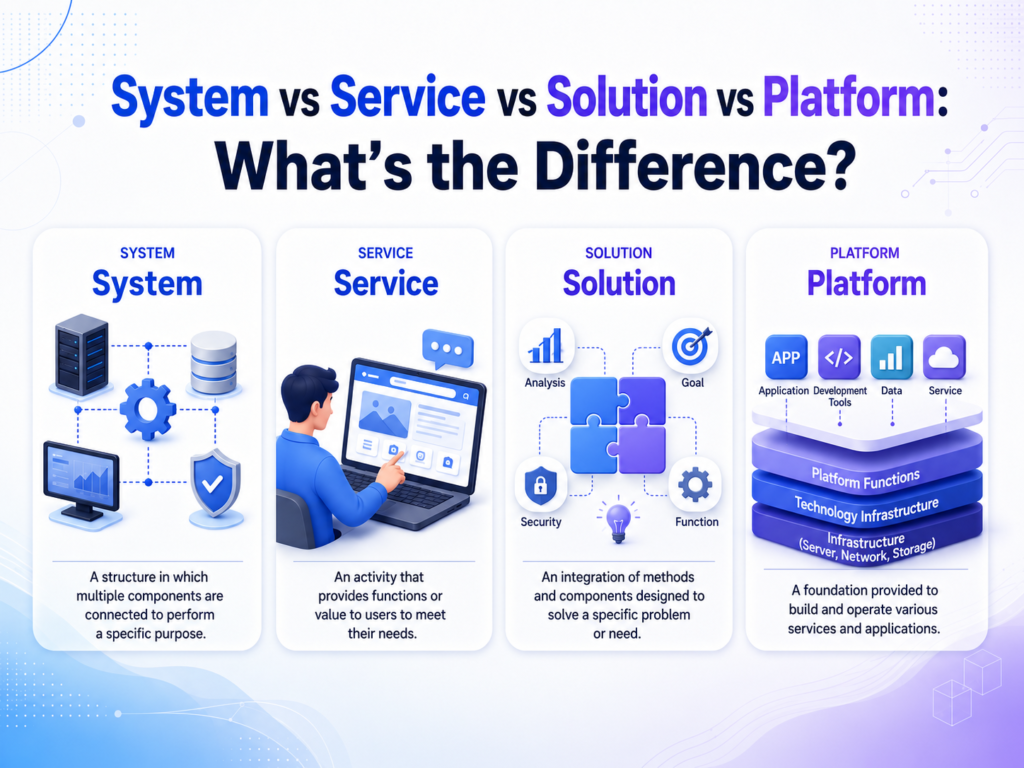
System
→ A structure in which multiple components are connected to perform an overall function
Service
→ A function provided so that users can access and use it
Solution
→ A combination of products, technologies, services, and other elements designed to solve a specific problem
Platform
→ A foundation on which other services or functions can be built and connected
In other words,
a system focuses on structure,
a service focuses on what is provided,
a solution focuses on the problem being solved,
and a platform focuses on the foundation on which other functions can be built.
Understanding these differences also makes it easier to see why multiple terms can be used for the same IT product.
A System Is a Structure in Which Multiple Elements Work Together
When multiple components are connected and work together to achieve a specific purpose, they can be viewed as a system.
For example, consider an online shopping mall.
When a user places an order, several functions operate internally.
- Member information management
- Product information management
- Order processing
- Payment processing
- Inventory checking
- Delivery information management
- Databases
- Servers and networks
Each of these has a different role, but together they operate the shopping mall.
This overall structure can be called an online shopping system.
So, the key question when thinking about a system is:
“What is connected to what in order to perform the overall function?”
The term system is generally used not just to refer to a single program, but to describe how multiple components are connected to achieve one purpose.
A Service Is a Function That Users Actually Use
A service focuses less on the internal structure of a system and more on what is provided to the user.
For example, consider the functions a user can access in an online shopping mall.
A user can search for products, add them to a cart, place an order, make a payment, and check the delivery status.
From the user’s perspective, these functions make up an online shopping service.
Internally, there may be complex components such as servers, databases, payment systems, and inventory management programs, but users do not need to know all of them.
Users interact with the functions being provided, rather than the underlying structure itself.
So, the key question when thinking about a service is:
“What can the user access and use?”
Systems and Services Differ in Perspective
Systems and services are especially easy to confuse.
However, they become easier to distinguish when you think of them as looking at the same thing from different perspectives.
Returning to the online shopping example above, the overall structure in which multiple components are connected and operate together is the system, while the functions that users access through that structure—such as searching, ordering, and paying—are the service.
In other words,
a system is closer to the internal structure that allows functions to operate,
while a service is closer to the functions provided to users through that structure.
A system may be used to provide a service, but a system and a service do not mean the same thing.
A Solution Is Built to Solve a Specific Problem
A solution is less a term for a particular type of program or system and more an expression used from a problem-solving perspective.
For example, suppose a company has the following problem:
There are too many customer inquiries for support agents to handle all of them directly.
To solve this problem, the company might introduce the following components.
- An AI chatbot
- A customer inquiry management system
- A feature that connects users to a human agent
- An inquiry data analysis function
- Implementation and operational support
If these elements are combined and provided to solve the company’s customer support problem, they can be called a customer support solution.
What matters here is not so much what each individual technology is, but why those technologies are being combined.
The purpose is to solve the specific problem of excessive workload in handling customer inquiries.
So, the key question when thinking about a solution is:
“What problem is this designed to solve?”
A single solution may include not only programs, but also systems, services, technologies, consulting, and operational support.
In other words, a solution is closer to a concept in which the elements needed to solve a problem are organized and provided together, rather than a single specific technology.
A Platform Is a Foundation on Which Other Functions Can Be Built and Connected
A platform does more than simply provide one function.
It provides a foundation on which other services or functions can be created or connected.
For example, consider a smartphone operating system.
The operating system provides various functions itself, but it also provides an environment in which different applications can run.
Developers can use that environment to create new apps, and users can install multiple apps to expand functionality.
Cloud platforms work in a similar way.
Companies and developers can use a cloud platform to create servers, store data, run applications, and connect AI functions or external services.
So, the key question when thinking about a platform is:
“What can be built or connected on top of this?”
The key characteristic of a platform is not simply that it provides a function, but that it provides a foundation on which other functions or services can continue to connect and expand.
What Is the Difference Between a Service and a Platform?
The boundary between a service and a platform can also be confusing.
For example, consider a video service.
If users are provided with functions that allow them to search for and watch videos, it is a service.
However, if external creators can upload videos, advertisers can connect advertisements, and developers can integrate separate functions through APIs, it also has the characteristics of a platform.
In other words,
a service focuses on users accessing and using functions,
while a platform focuses on other users, companies, services, and functions connecting and expanding on top of it.
That is why a single company or product can be both a service and a platform.
A platform can also provide services to users, so the two concepts are not completely separate.
What matters is which characteristic is being described.
A Solution and a System Are Not the Same Thing Either
When looking at enterprise IT products, you will often see expressions such as “system implementation” and “solution adoption” used together.
These also differ in perspective.
Suppose a company builds a new inventory management environment.
If an inventory database, servers, inbound and outbound management programs, and user interfaces are connected and actually process work, the overall structure can be called an inventory management system.
On the other hand, suppose the company had the following problem:
“It is difficult to track inventory status in real time.”
If the system, analysis functions, and implementation support are bundled together to solve that problem, they can be described as an inventory management solution.
In other words,
a system focuses on the structure that is actually configured and operating,
while a solution focuses on what problem that configuration is intended to solve.
A system can be part of a solution, but the two terms do not have the same meaning.
A Single IT Product Can Be Described Using Multiple Terms
As we have seen, system, service, solution, and platform are not completely separate categories of products.
That is why a single IT product or technology can sometimes be described using multiple terms.
For example, consider an enterprise cloud product.
If multiple servers, networks, and databases are connected and operated internally, it can be viewed as a system.
If customers use its functions over the internet, it can be viewed as a service.
If multiple functions are organized and provided to solve a company’s infrastructure implementation or operational problems, it can be called a solution.
And if customers or developers can build new applications and connect other services on top of it, it can also be called a platform.
Describing the same thing using different terms is not necessarily incorrect.
The perspective being used to describe it is different.
Summarizing the Four Terms
| Term | Core Criterion | Key Question | In Simple Terms |
|---|---|---|---|
| System | Structure | What is connected and operating together? | The structure that keeps everything running |
| Service | Provision | What can the user access and use? | A function the user uses |
| Solution | Problem solving | What problem does it solve? | A configuration designed to solve a problem |
| Platform | Foundation | What can connect and expand on top of it? | A foundation on which other functions can be built |
When It Gets Confusing, Look at the Criterion Rather Than the Name
In the IT industry, the same technology may be described using different terms because of product naming or marketing language.
So, trying to distinguish the concepts based only on their names can make them even more confusing.
Instead, first look at what is being described.
Is it describing the structure? → System
Is it describing a function provided to users? → Service
Is it describing a configuration designed to solve a specific problem? → Solution
Is it describing a foundation on which other functions or services can be built? → Platform
Ultimately, what matters more than the term itself is the criterion according to which that term is being used.
DANA NOTES One-Line Summary
System, service, solution, and platform are terms that describe an object according to different criteria: structure, provision, problem solving, and foundation, respectively.