What This Article Covers
As generative AI services such as ChatGPT, Gemini, and Claude have become widely used, companies are also adopting AI for a variety of business tasks.
However, not all AI is used in the same way.
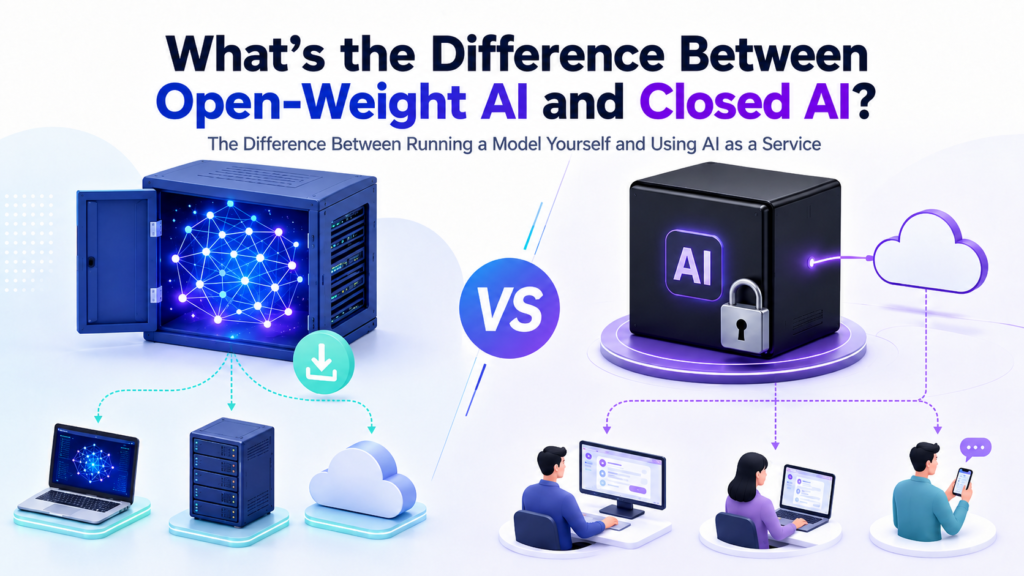
There is the familiar approach of using an AI service such as ChatGPT through a web browser, but there is also a way to download an AI model and run it directly on a personal computer or company server.
More recently, AI that runs directly on smartphones or PCs has also become more common.
So, what is the difference between these types of AI?
To understand this distinction, we first need to understand what open-weight AI and closed AI are, and before that, what role weights play in an AI model.
1. Where Does ChatGPT Actually Run?
Think about using ChatGPT in a web browser.
You enter a question on your own computer, but the AI model itself generally does not run on your computer.
The basic structure looks like this.
User PC → Browser → Internet → AI company’s server → AI model runs → Result returned
Your computer is used to enter questions and display results, while the actual AI model runs on the infrastructure operated by the company providing the service.
In other words, using AI does not mean that you actually have the AI model itself.
Using an AI service such as ChatGPT and downloading an AI model to operate it yourself are two different approaches.
Then what does it mean to download the AI model itself?
To understand that, we first need to understand the concept of weights.
2. What Role Do “Weights” Play in AI?
When an AI model receives input, it performs a large number of calculations internally before producing a result.
One of the key values used in this calculation process is a weight.
Weights can be understood as the many numerical values that are adjusted while the AI is being trained.
In very simplified terms, the process looks like this.
Input → Calculations using learned weights → Decide what output to produce
The many weights adjusted as the AI learns from data reflect patterns and relationships learned by the model.
Therefore, weights are not simply a few configuration values. They are a core part of a trained AI model.
To run an already trained AI model on another computer or server, these weights are needed.
This is where the concept of open-weight AI comes in.
3. What Is Open-Weight AI?
Open-weight AI refers to an AI model whose trained weights are made available for others to download and use.
With the necessary execution environment, the model can be run on your own computer, a company server, or a cloud environment without relying on the AI provider’s servers.
For non-developers, the easiest way to understand it is:
Open-weight AI is a model whose weights are made available so that you can take the AI model and run it directly in an environment of your choice.
OpenAI’s gpt-oss, for example, is also an open-weight model whose weights can be downloaded and run on infrastructure managed by the user. OpenAI distributes gpt-oss separately from the models provided through ChatGPT and the OpenAI API and explains that users can run it in environments they manage themselves.
This is where terms such as on-premises and private cloud often appear.
On-premises simply means an in-house server or data center environment managed directly by a company, while a private cloud is a cloud environment dedicated to a specific company.
Open-weight models can also be operated in these kinds of internal company environments.
The model can also be fine-tuned when needed.
Fine-tuning means taking an AI model that has already been trained and training it further for a specific task or purpose.
For example, a general-purpose AI model can be further adjusted to better fit a company’s specific tasks or a specialized field.
However, making the weights available does not mean that you are free to do anything you want with the model.
Whether the model can be modified, used commercially, or redistributed depends on the license and terms of use for each model.
Therefore, the important point about open-weight AI is not simply that it means “free AI,” but that the core trained weights of the model are made available.
4. What Is Closed AI?
Closed AI, by contrast, refers to an approach in which the model’s core weights are not made available to general users.
Instead of downloading the model’s weights and freely deploying them in their own environment, users generally access AI capabilities through services or APIs operated by the AI provider.
Services such as ChatGPT that we use through a web browser are easy examples to understand.
Users can send questions and receive results, but they cannot download the weights of the model used in ChatGPT and run the same model directly on their own server. OpenAI also currently explains that gpt-oss, its open-weight model, is a separate model that is not provided through ChatGPT.
The difference can be summarized simply as follows.
Open-Weight AI
→ You can obtain the model weights and run the model yourself.
Closed AI
→ The weights are not made available, and you use a model operated by the provider as a service.
However, closed AI does not necessarily mean that the model must run only in an external cloud environment.
The distinction becomes clearer when we look at the next concept.
5. Is AI That Runs Inside a Smartphone Open-Weight AI?
When AI runs directly on a smartphone or PC, it is easy to think:
“If it runs on my device, doesn’t that mean it is open-weight AI?”
Not necessarily.
Two different criteria need to be separated here.
| Criterion | Categories |
|---|---|
| Are the model weights available? | Open-weight / Closed |
| Where does the AI run? | On-device / Cloud |
Open-weight and closed refer to whether the model weights are made available.
By contrast, on-device and cloud refer to where the AI actually runs.
On-device AI literally means running AI functions inside a user’s device, such as a smartphone or PC.
Therefore, a closed AI model can run inside a smartphone, while an open-weight model can be installed and operated on a company’s cloud server.
Samsung’s Galaxy AI also uses a hybrid structure that combines on-device AI and cloud-based AI. Samsung explains that some functions are processed directly on the device, while cloud-based AI is also used when necessary.
In other words,
The fact that an AI runs locally or on a smartphone does not by itself mean that it is open-weight AI.
6. Advantages and Disadvantages of Open-Weight AI
The main characteristic of open-weight AI is that companies or developers can operate the model themselves.
This leads to several advantages.
The Data Processing Environment Can Be Configured Directly
A company can configure the AI to run on internal servers or in a cloud environment managed by the company.
This makes it possible to build an AI system without sending all business data to the servers of an external AI provider.
This can be an important advantage, especially for companies that handle internal documents or sensitive data.
The Operating Environment Can Be Chosen Directly
A company can decide which servers and GPUs to use, which network to deploy the model on, and which cloud environment to use according to its own requirements.
This also provides more options when certain data must be processed in an environment separated from external networks.
The Model Can Be Adjusted for Business Needs
If the license allows it, the model can be further adjusted for a specific industry or task through methods such as fine-tuning.
Instead of using a general-purpose AI model as it is, companies can create a model that better reflects their terminology, business characteristics, or specific objectives.
Dependence on a Specific AI Provider Can Be Reduced
Because the system does not necessarily depend on an external API, reliance on a specific provider’s pricing or service policies can be reduced.
However, operating the model directly also means taking direct responsibility for its operation.
A company must consider not only GPUs and servers, but also model deployment, performance optimization, updates, monitoring, incident response, access control, and security.
Even when an open-weight model itself can be downloaded for free, computing resources, storage, hosting, and operation still cost money. OpenAI likewise explains that when gpt-oss is operated independently, the user is responsible for these execution costs.
The key point is:
With open-weight AI, greater control also means greater operational responsibility.
7. Advantages and Disadvantages of Closed AI
The main advantage of closed AI is that the company using it does not have to operate the model itself.
The AI provider operates the model and the related infrastructure, while the user company can connect to the required functions through a web service or API.
This can reduce the burden of building large-scale GPU infrastructure or directly managing model deployment and updates.
Because new models and features are also applied by the service provider, another advantage is that companies can adopt the latest AI capabilities relatively quickly.
This can be a practical choice, especially for companies that do not have enough specialists to operate their own AI infrastructure or need to introduce AI capabilities quickly.
On the other hand, the range of things the company can control directly becomes smaller.
API pricing or service policies may change, and an outage at a particular provider may also affect the company systems that depend on that service.
In addition, if business data is sent to an external AI service, companies need to review where the data is processed, whether it is stored, who can access it, and whether the system complies with privacy requirements or industry regulations.
Therefore, the characteristics of closed AI can be summarized as follows.
Closed AI reduces the burden of direct operation, but dependence on external services may increase.
8. Why Would a Company’s IT Team Consider Open-Weight AI?
When a company’s IT team introduces AI, it does not simply compare which AI produces better answers.
The AI must be connected to the company’s actual systems and operated continuously.
The first question is whether important internal company data can be sent to an external AI service.
If the company handles customer information, internal business documents, research materials, technical documents, or other information whose external transfer must be strictly controlled, it may consider operating AI in an environment under its own control.
It is also important to determine whether the AI needs to run on an internal network or in a separate security environment.
If AI must be used on a business network isolated from the internet or within a specific cloud environment, external AI services alone may not satisfy the requirements.
Integration with existing systems must also be considered.
If AI needs to be deeply connected with internal systems such as ERP, CRM, groupware, document management systems, or databases, the need to directly control data flows and the AI execution environment may become greater.
The IT team must also decide whether the model itself needs to be adjusted for specific business tasks.
If company-specific terminology or business characteristics need to be reflected in the model, the company may consider fine-tuning or additional training based on an open-weight model.
At the same time, however, the IT team also needs to ask:
Can we continue operating this model ourselves?
Running a model directly does not end with simply preparing GPUs and servers.
The company also needs developers who can manage the model, infrastructure staff, security personnel, incident-response processes, and operational procedures.
9. Then Why Would a Company’s IT Team Consider Closed AI?
Conversely, not every company needs to operate an AI model directly.
An IT team may instead ask:
Do we really need to operate the model and GPUs ourselves just to use AI capabilities?
For example, if the goal is to quickly introduce general-purpose AI capabilities such as document summarization, business writing assistance, development support, search, or simple customer support, operating a model internally may actually be an excessive investment.
With closed AI, the model provider handles much of the operation of the model and AI infrastructure.
This allows a company to adopt the required functions quickly as a service or through an API instead of building a large-scale AI environment from the ground up.
This approach can also be practical for companies that lack specialized operations staff or want to introduce AI first and verify its actual business value.
Ultimately, an IT team needs to consider not only AI performance but also implementation difficulty, integration with existing systems, operational staffing, incident response, and maintenance.
10. What Does a Business Consider When Making the Decision?
An IT team evaluates whether an AI system can be technically built and operated.
From the perspective of the company as a whole, however, the decision goes one step further.
Cost, security, operational burden, control, and dependence on external services all need to be considered together.
Cost — Comparing Model Prices Alone Is Not Enough
Some open-weight models can be downloaded for free.
That does not mean a company can operate AI for free.
Running an open-weight model directly may involve costs for servers and GPUs, cloud infrastructure, development staff, operations staff, security, and model management.
Closed AI, by contrast, can reduce the cost of maintaining internal AI infrastructure, but costs can increase as the number of API calls or the amount of service usage grows.
Therefore, a company should not simply compare whether the model is free or how much an API costs.
It needs to look at the total cost of building and continuously operating the AI system in actual business use, or total cost of ownership (TCO).
Total cost of ownership simply means considering not only the initial cost of adoption but also all of the costs required for ongoing operation and maintenance.
Security — What Needs to Be Protected Is Different
Data security is one of the issues that frequently comes up when comparing open-weight and closed AI.
If an open-weight model is operated inside a company’s own environment, the company can design a structure in which sensitive data does not need to be sent to an external AI provider.
However, there is another point to consider.
When a company operates open-weight AI directly, it may also need to manage not only its data but also the model and the training results it creates.
As explained earlier, weights are a core component of a model that reflects the results of AI training.
However, not all weights automatically become confidential company information.
Original Weights of a Public Open-Weight Model
The original weights of an open-weight model that anyone can download are already publicly available information.
Therefore, simply downloading and using that model does not make the original weights themselves a trade secret of the company using them.
For example, if multiple companies download and use the same public open-weight model, the original model itself cannot easily be considered confidential information held only by a particular company.
Weights Trained or Fine-Tuned by the Company Itself
The situation may change when a company uses its own data and resources to further train or fine-tune a model for a specific task.
This is because the results may reflect the company’s accumulated data and the adjustments it has made to the model.
Models or modified weights created in this way may therefore need to be managed as important internal technology assets.
However, the fact that a company created them itself does not automatically make them legal trade secrets.
Under South Korea’s current 「Unfair Competition Prevention and Trade Secret Protection Act」, a trade secret is defined as technical or managerial information, such as production or sales methods, that is not publicly known, has independent economic value, and is managed as confidential information.
Put simply, the information must not be widely available to outsiders, must have economic value to the company, and must actually be managed by the company as confidential information in order to qualify as a trade secret.
Therefore, models or weights that a company has trained further may also be protected as trade secrets if they meet these conditions.
Adapters, Checkpoints, and Fine-Tuned Models May Also Need Protection
Companies do not always retrain an entire AI model from the beginning.
There are also methods that keep the existing model largely unchanged while managing only the additionally adjusted parts as separate files.
This is where files such as adapters and checkpoints come in.
An adapter can be understood as an additional component attached to an existing AI model to adjust it for a specific task.
Instead of significantly changing the entire model, it allows the required adjustment results to be attached and used separately.
A checkpoint is a file that stores the state of an AI model at a particular point during training or adjustment.
It can be understood as an intermediate save of the training process, similar to saving your progress partway through a game.
Adapters, checkpoints, fine-tuned models, and other additional training results created using internal company data may also contain company-specific model adjustments.
These files may therefore become company assets that need to be managed separately from the original open-weight model that anyone can download.
Ultimately, when a company operates open-weight AI directly, the scope of what must be protected can expand beyond company data to include internally trained models, modified weights, adapters and checkpoints, and the AI infrastructure itself.
With closed AI, by contrast, the user company generally does not need to store and protect the model’s core weights directly.
Instead, different questions become important.
What internal company data is being sent to the external AI service?
Where is the data processed and stored?
Who can access it?
Is it used for model training or service improvement?
Does it comply with relevant laws and industry regulations?
Ultimately, the key point is not that one approach is always safer than the other.
The security difference between open-weight and closed AI is that what the company protects directly and what it entrusts to an external provider are different.
Operational Burden — Who Manages the AI?
With open-weight AI, the company handles a significant part of model operations itself.
This gives the company more freedom to decide how and where the model runs, but it also increases its responsibility for responding to outages or performance problems.
Open-weight AI provides greater operational freedom, but it also increases operational responsibility.
With closed AI, the AI provider operates the model and the core infrastructure.
The user company’s operational burden is reduced, but dependence on the external provider may increase.
Closed AI reduces the burden of direct operation, but dependence on an external provider may increase.
Control — How Much Should the Company Keep In-House?
Ultimately, the decision also comes down to control.
If a company wants to directly control the model, the data-processing environment, and the infrastructure, it must also bear the additional staffing and costs required to do so.
If model operations are entrusted to an external provider, the operational burden is reduced, but the company may be affected by the provider’s pricing policies, service policies, outages, and technology changes.
Therefore, when choosing AI, companies should not focus only on which AI performs better.
They should also consider how much control they need to keep over data, models, infrastructure, and security, and how much cost and operational responsibility they are willing to take on in order to maintain that control.
11. Are Open-Weight and Open Source the Same Thing?
Another term that often appears alongside open-weight is open source.
The two sound similar, but they do not mean the same thing.
With open-weight, the key question is whether the weights of the trained AI model are made available.
With open source, by contrast, the issue is not simply whether a file or source code has been made public. The rights granted by the license, including rights to use, modify, and redistribute the software, are also important.
Therefore, the fact that an AI model’s weights are available does not mean that everything used to create the model has been made public.
The weights may be available while the training data or the full training process remains undisclosed.
In addition, even an open-weight model may have different conditions for commercial use, modification, or redistribution depending on its license.
For example, OpenAI’s gpt-oss is provided under the Apache 2.0 license, which allows broad use, modification, and redistribution, while separate usage policies also apply.
Therefore, with AI, rather than looking only at the word “open,” it is important to check what has actually been made available and what rights are permitted.
12. Open-Weight AI vs Closed AI at a Glance
| Category | Open-Weight AI | Closed AI |
|---|---|---|
| Model weights | Available | Generally not available |
| Direct model execution | Possible | Limited for general users |
| Execution environment | Can be chosen directly | Often uses the provider’s environment |
| Internal infrastructure | Required when self-hosting | Generally not required |
| Model adjustment | Relatively flexible* | Limited |
| Initial setup | Relatively complex | Relatively simple |
| Operational responsibility | Greater responsibility for the company | Largely handled by the provider |
| Data processing | Can be designed for an internal environment | Provider architecture and policies must be reviewed |
| Model asset protection | Internally trained results must also be considered | Core model is managed by the provider |
| Service dependence | Can be relatively reduced | Relatively higher |
| Main costs | Infrastructure, development, staffing, and operations | API and service usage fees |
* The actual scope of modification, commercial use, and redistribution depends on each model’s license.
DANA NOTES One-Line Summary
Open-weight AI makes trained weights available so that users can run the model themselves, while closed AI keeps the weights private and provides access to a provider-operated model through services, APIs, or similar methods.