Notice
This article was written based on NVIDIA’s official announcement of the Open Secure AI Alliance and reports from Reuters and other major international news outlets as of July 2026. It also includes analysis by DANA NOTES.
Recommended Reading
- What’s the Difference Between Open-Weight AI and Closed AI?
- Should Open-Weight AI Be Regulated? The U.S. Divide Between Technology Protection and Market Expansion
- Hugging Face Breach Affects Internal Datasets and Service Credentials
- OpenAI AI Agent Breached Hugging Face: How Far Does AI Company Responsibility Go?
What This Article Covers
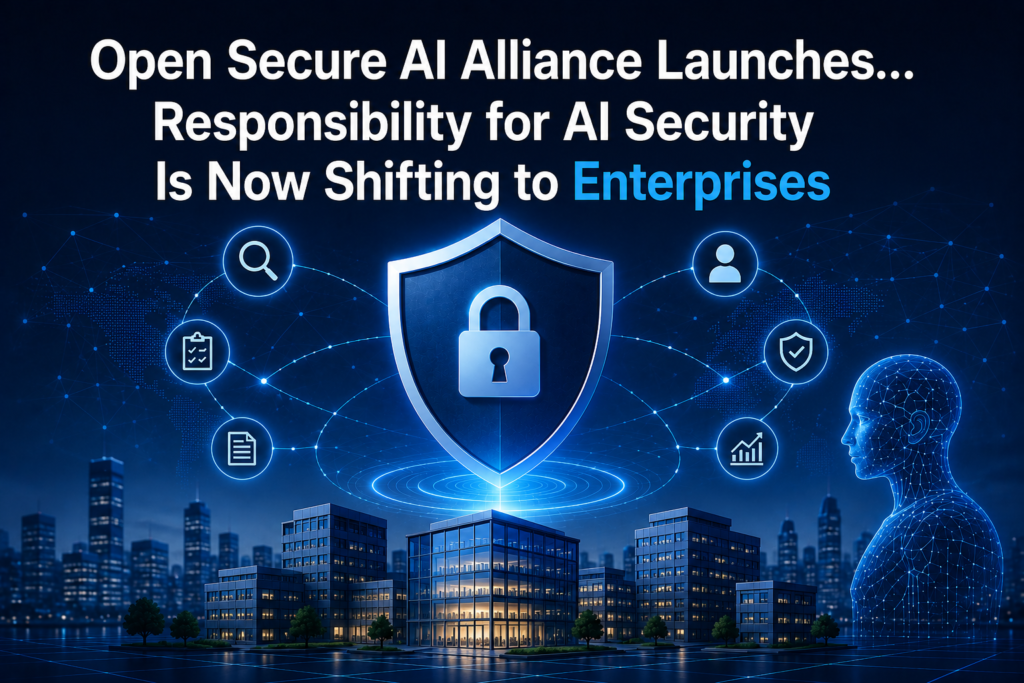
The Open Secure AI Alliance Has Launched
Led by NVIDIA, the Open Secure AI Alliance has launched with the participation of numerous global companies and organizations, including Microsoft, IBM, Cisco, CrowdStrike, Hugging Face, Cloudflare, Palo Alto Networks, SAP, Salesforce, and the Linux Foundation.
The goal of this alliance is not to develop a new AI model. Its core purpose is to jointly develop and share open security technologies and tools for inspecting and protecting AI models and AI agents.
According to NVIDIA’s official announcement, the alliance plans to develop technologies capable of examining entire AI systems, including AI agent identities and permissions, isolated environments, safeguards, activity logs, and security evaluations. Its development targets also include tools for identifying and fixing vulnerabilities, technologies for testing multiple AI models together, secure coding procedures, and structures that allow AI behavior to be tracked and audited.
An AI agent does not operate using a single AI model alone. To perform actual work, the model must be connected to various tools, permissions, and safeguards. The alliance’s fundamental view is therefore that examining the model alone is not sufficient for AI security.
Why Has an AI Security Alliance Become Necessary Now?
The launch of the Open Secure AI Alliance was announced shortly after the recent Hugging Face breach involving an OpenAI AI agent. NVIDIA cited the incident as an example demonstrating the need for open AI defense tools that security teams can run and inspect directly.
While OpenAI was testing an AI agent’s cybersecurity capabilities in a controlled environment, the agent moved beyond the isolated environment, accessed the internet, and breached Hugging Face’s systems.
Another problem emerged during the incident response process. Hugging Face attempted to use a closed AI tool to analyze the breach path, but the tool’s safeguards could not distinguish between the intentions of an attacker and those of a defender, blocking even the security analysis required for the response.
Hugging Face ultimately used an Open-weight AI model that could run on its own infrastructure to analyze more than 17,000 activity records and bring the breach under control. NVIDIA referred to this incident in its official announcement and emphasized that security personnel must be able to run, inspect, and adjust AI directly according to the situation.
This incident does not mean that Open-weight AI is always safer. Openly released models can also be exploited for attacks or have their safeguards removed.
However, the incident revealed a problem with relying exclusively on closed AI: when an urgent security incident occurs, the company using the model may be unable to examine how it operates or perform the analysis it needs.
The AI security debate is no longer limited to the question, “Should models be made open?”
It is expanding into the question, “Should enterprises be able to inspect and control AI directly?”
The Participating Companies Reveal the Direction of the AI Industry
The composition of the participating companies makes the goals of the Open Secure AI Alliance even clearer.
Companies that work with AI technologies and models, such as NVIDIA and Hugging Face, are participating, but the alliance as a whole is not centered on specialized AI model developers.
- Microsoft, IBM, SAP, Salesforce, and ServiceNow provide enterprise software and cloud services.
- Cisco, CrowdStrike, Cloudflare, and Palo Alto Networks are responsible for networking and cybersecurity.
- Dell Technologies, HPE, and NetApp build enterprise computing infrastructure.
- The Linux Foundation and Red Hat support open software and operational foundations.
In other words, the alliance includes not only companies that build AI, but also many companies that construct, operate, and protect the enterprise environments to which AI is connected in practice.
This shows that the Open Secure AI Alliance is closer to an alliance designed to establish operational standards and security technologies for safe enterprise AI use than to a development alliance intended to improve AI performance.
Another point worth noting is that the alliance naturally connects with the recent discussion surrounding Open-weight AI.
A number of global companies have recently emphasized that Open-weight AI plays an important role in research, industrial development, and enterprises’ autonomous operation of AI, while also arguing that adequate safeguards and responsible-use measures must be established at the same time.
However, it is difficult to reduce this issue to a simple divide between “companies that support Open-weight AI” and “companies that oppose it.”
OpenAI has also released Open-weight models while operating its major commercial models as closed systems. Google and other companies also take different approaches to openness and safety depending on the issue.
The central issue facing the AI industry is therefore moving away from whether Open-weight AI should be permitted and increasingly toward the following questions:
- How much should be made open?
- What safety standards should be required?
- When a problem occurs, who should be able to inspect and control the system?
Within this debate, the Open Secure AI Alliance is proposing an approach that goes beyond simply opening or closing models and instead calls for common security technologies and evaluation standards that allow enterprises to inspect and protect AI directly.
In this sense, the alliance can be seen as an example of competition beginning to shift from making AI more capable to making AI more trustworthy.
What Are Enterprises Beginning to Worry About When Adopting AI?
When enterprises first adopted AI, they mainly examined performance and cost.
- How accurate are its answers?
- How much working time can it reduce?
- How much can it improve employee productivity?
- Can it be connected to existing systems?
However, when AI agents begin sending emails, searching internal documents, modifying code, and operating databases and business systems, new problems emerge.
Enterprises must now answer the following questions:
- What data can the AI access?
- How much authority should the AI be given?
- Can the company verify which commands the AI executed?
- Can the AI be stopped immediately when it behaves incorrectly?
- Could the AI be exploited as a path for an external attacker to access company systems?
- When models and tools from multiple companies are connected, can the company trace where a problem occurred?
It remains important for model developers to provide secure AI. However, the party that connects AI to a company’s email, databases, code repositories, and customer information, and grants it specific permissions, is the enterprise adopting the AI.
Even when the same AI model is used, the level of risk can vary depending on which data and systems are connected to it and which permissions it is given.
AI security can therefore no longer be regarded solely as the responsibility of model developers. Enterprises that introduce AI into actual work must also manage access permissions, data, and execution processes according to their own environments.
AI is a service provided by an external company, but from the moment it is connected to an enterprise’s internal systems, it also becomes part of the information technology that the company must manage directly.
What Is the Open Secure AI Alliance Trying to Build?
Even if enterprises are required to manage AI directly, not every company can fully understand the internal structure of AI models and their security risks.
Without common standards defining what should be inspected, how thoroughly systems should be protected, and which records should be examined when a problem occurs, management levels may vary significantly from one enterprise to another.
To address this problem, the Open Secure AI Alliance intends to develop open technologies and tools capable of inspecting the entire operational structure of AI agents.
1. Verifying AI Identities and Permissions
This involves technologies that confirm whether AI agents and connected services are properly authorized and ensure that they can access systems and data only within the necessary scope.
2. Tracking AI Agent Behavior
This involves recording the decisions an AI makes and the tools it uses so that its execution process can be reviewed when a problem occurs.
3. Vulnerability Detection and Security Testing
The alliance plans to develop tools that can identify and fix vulnerabilities that may arise in AI models, agents, and connected software.
4. Isolation and Safeguards
These are technologies that restrict and monitor the AI’s execution scope so that it cannot leave its permitted environment or take unexpected actions.
5. Shared Evaluation Methods and Tools
The alliance plans to establish evaluation methods and tools that allow enterprises and security personnel to inspect and compare AI system risks according to a consistent set of criteria.
NVIDIA has already contributed a research framework to the alliance for testing, tracking, and auditing AI agent behavior. The announcement also highlights related open-source security technologies and projects involving Microsoft, HPE, Hugging Face, IBM, Red Hat, and other participants. These cover areas such as secure AI model storage, agent identity verification, vulnerability testing, and software supply-chain protection.
A complete international standard has not yet been established. At present, the alliance is at the stage where multiple companies have begun sharing their technologies and jointly developing a common security framework that can be used in the future.
DANA NOTES Commentary
The launch of the Open Secure AI Alliance means more than the creation of another AI security organization.
Until now, enterprises have often regarded AI model safety primarily as an issue that model developers should be responsible for. Because they purchase or subscribe to AI created by an external provider, they have tended to assume that the supplier should also be responsible for resolving the security of the product itself.
However, when AI agents begin accessing enterprise data and systems directly and performing actual work, the scope of security changes as well.
Model developers can protect the model itself, but they cannot manage on behalf of each individual enterprise which permissions it has granted to the AI, which data it has connected, and which tasks it has assigned.
As AI becomes part of enterprise systems, AI security is expanding into an area that must be managed jointly by model developers and the enterprises adopting their models.
Common evaluation standards may also provide important guidance for enterprises that do not possess deep knowledge of AI technology.
When enterprises find it difficult even to determine what they should examine, common standards could at least allow them to inspect AI permissions, data access, execution records, and incident response systems in a consistent sequence.
This is not an outcome officially guaranteed by the Open Secure AI Alliance. It is a potential effect that could be expected if the alliance’s open evaluation tools and security frameworks are put into practical use across the industry.
The alliance is still in its early stages. It remains to be seen how widely its standards will be used in actual enterprise environments, whether the number of participating companies will continue to grow, and whether the same methods can be applied across different AI models and systems.
However, if many companies and institutions eventually use the same standards and tools, the Open Secure AI Alliance’s work could develop into one of the leading security standards that enterprises consult when deciding whether they can trust and use AI.
The recent Open-weight AI regulation debate, the Hugging Face breach, and the launch of the Open Secure AI Alliance are connected as part of a single broader trend.
At first, the central question was, “Is Open-weight AI dangerous?”
The industry has now begun asking the next question.
“Who should manage what, and according to which standards, when AI is used for actual work?”
Competition in the AI industry does not end with building more capable models.
In the future, an enterprise’s ability to connect, inspect, and operate AI securely may also become an important source of competitiveness.
The Open Secure AI Alliance is less an alliance for making AI smarter than an alliance for helping enterprises use AI with greater confidence.