Notice
This article is based on materials released by the government and the AIDC Alliance as of July 29, 2026. The 18.4GW figure does not represent data center capacity that has already been built, but rather a long-term target to be pursued through 2035. The investment scale, construction schedules, participating companies, power procurement methods, and other details of individual projects may change as the projects move forward. This article also includes analysis by DANA NOTES.
What This Article Covers
Bringing semiconductors, power, cooling, and cloud together, and pursuing everything from domestic deployment to overseas exports
On July 29, the “AIDC Alliance,” a large-scale public-private partnership for the AI data center industry, was officially launched in South Korea.
Relevant government ministries, the Institute for Information & Communications Technology Planning & Evaluation (IITP), the National IT Industry Promotion Agency (NIPA), and the Korea Association for ICT Promotion (KAIT) brought together not only companies that build and operate AI data centers, but also equipment, materials, and software suppliers, as well as academia and research institutions, under a single cooperative framework.
The alliance was established with a co-chair structure led jointly by the government and the private sector.
On the government side, Deputy Prime Minister and Minister of Science and ICT Bae Kyung-hoon serves as co-chair, while on the private-sector side, KAIT Chairman and SK Telecom CEO Jung Jai-hun serves as co-chair.
Official AIDC Alliance materials describe a structure in which a secretariat, three divisions for demand, supply, and foundations, an Export Industrialization Task Force, and a dedicated support team operate under the government-private sector co-chairs. Official materials also confirm that Deputy Prime Minister Bae Kyung-hoon currently serves as Minister of Science and ICT and that SK Telecom CEO Jung Jai-hun serves as Chairman of KAIT.
The goal is not simply to build more data centers.
The key is to apply and verify technologies from South Korean companies in domestic AI data centers, develop them into an industrial ecosystem, and then expand into overseas markets.
In other words, South Korea has begun to view AI data centers not as individual facilities, but as a single industry connecting semiconductors, servers, power, cooling, telecommunications, and cloud.
A Term to Know First — What Is an AIDC?
AIDC stands for AI Data Center and refers to a data center designed to handle large-scale AI computing.
Conventional data centers also operate large numbers of servers and networking equipment.
However, AI data centers use large numbers of AI accelerators such as GPUs and NPUs to train or serve large-scale AI models.
This computing equipment consumes large amounts of electricity while also generating substantial heat.
Therefore, building an AI data center requires more than simply preparing servers and a data center building.
AI semiconductors
→ AI servers
→ High-performance networks
→ Large-scale power supply
→ Cooling
→ Data centers
→ Cloud
must all be connected.
This is why, as AI data centers grow larger, not only the semiconductor industry but also power, telecommunications, cooling, construction, cloud, and operational software must move together.
In the AIDC Alliance as well, the government views AI data centers as national strategic infrastructure spanning data, power, cooling, semiconductors, and cloud.
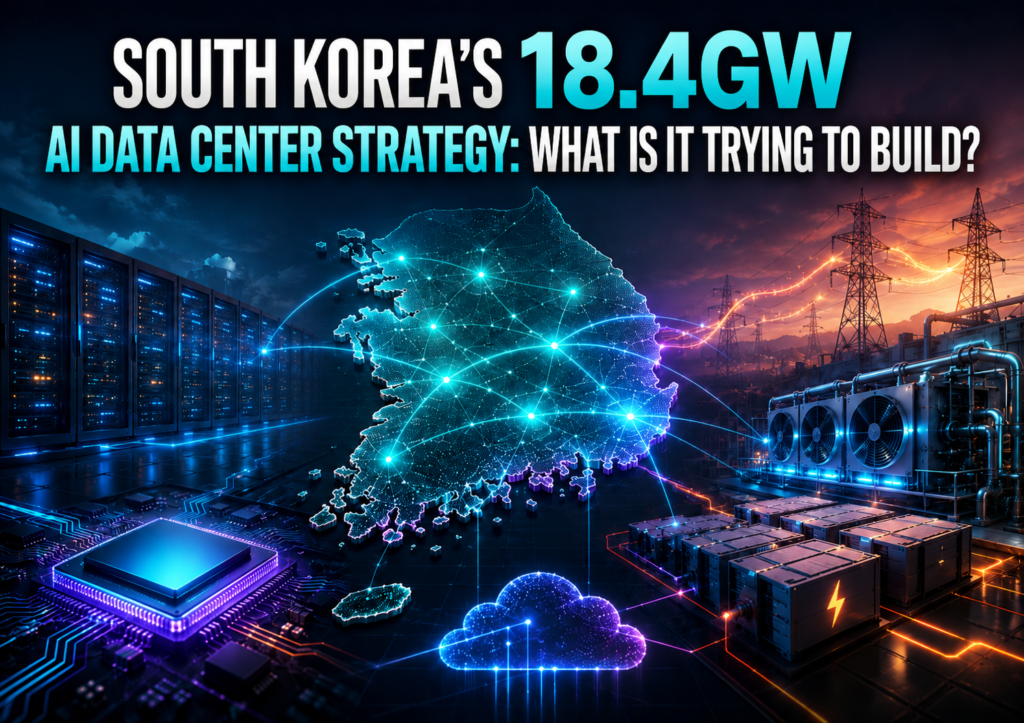
South Korea Is Planning 18.4GW of AI Data Centers
The AIDC Alliance is not a policy initiative that appeared suddenly.
It is a follow-up move intended to connect the AI data center project to actual industry as part of the “Three Mega Projects for South Korea’s Great Leap Forward,” announced by the government on June 29.
The government selected AI data centers as one of the three mega projects, alongside semiconductors and physical AI.
The AIDC plan will proceed in two stages.
The first stage is to build a total of 8.4GW of AI data centers by 2029.
This consists of 5GW from SK, 2.4GW from GS, and 1GW from NAVER.
In the second stage, SK will expand the 5GW planned in the first stage to a total of 15GW by 2035.
In other words, SK will build an additional 10GW.
The overall calculation is therefore as follows.
Stage 1: 8.4GW
= SK 5GW + GS 2.4GW + NAVER 1GW
plus
an additional 10GW from SK
bringing the total to
18.4GW by 2035.
It is important to distinguish the figures in this way.
SK’s 15GW is not a separate figure from the 5GW in the first stage. It is SK’s own final target, including the original 5GW.
The government also presented a plan under which SK, GS, and NAVER will invest approximately KRW 550 trillion, including funds raised from investors, to build the 8.4GW in the first stage.
18.4GW Is Not Simply a Measure of IT Equipment
GW is a unit used to measure power capacity.
The fact that AI data center plans are being discussed in units of several gigawatts means that data centers are no longer simply an IT equipment issue involving the addition of a few more servers.
Operating large-scale AI servers first requires enormous amounts of electricity.
But having sufficient power generation alone does not solve the problem.
Transmission grids and substations are needed to deliver the electricity that is generated to the data centers, along with large-scale electrical equipment and stable power management systems.
Large sites for the data centers and high-speed telecommunications networks are also required.
Cooling systems capable of handling the enormous amount of heat generated by high-density GPU servers must be considered, as well as water infrastructure in some cases.
That is why 18.4GW is not simply a number representing the construction of a few more data centers.
It is a scale that requires the expansion of power grids, regional infrastructure, and related industries together in order to support the AI industry.
The government’s official plan also presents a direction of building hyperscale AI data centers across five regions.
Materials from the public briefing on the Three Mega Projects released by the Presidential Office on June 29 explicitly describe this as the “construction of hyperscale AI data centers (AIDCs) across five regions.”
The strategy therefore also includes distributing AIDCs across regions rather than concentrating large-scale data centers in the Seoul metropolitan area, and connecting them with regional industries.
However, 18.4GW is not the current scale of AIDCs operating in South Korea.
Because it is a long-term construction plan targeting 2029 and 2035, the announced targets need to be distinguished from the actual scale of projects that begin construction, are completed, and enter operation.
But South Korea Is Not Trying to Build Only Data Centers
There is something in this policy that is just as important as the figure of 18.4GW.
While building large-scale AI data centers, the government is also trying to develop domestic industries that supply the technologies and equipment used inside those data centers.
This is an important reason why the AIDC Alliance was created.
AI semiconductor companies develop NPUs and various AI accelerators.
Server companies supply AI servers and systems that use these semiconductors.
Power companies supply transformers, electrical equipment, and power management technologies.
Cooling companies provide technologies for handling the heat generated by high-density AI servers.
Telecommunications companies build high-performance networks connecting data centers to other data centers and data centers to users.
Cloud companies turn the computing resources of data centers into services that companies and developers can actually use.
Operational software companies help operate enormous numbers of servers, power systems, and cooling facilities efficiently.
Ultimately, multiple industries are involved simultaneously in a single AIDC project.
That is why, instead of supporting only the construction of individual companies’ data centers, the government is trying to connect this entire supply chain through a single cooperative framework.
The Government and the Private Sector Lead the Alliance Together
The organizational structure of the AIDC Alliance makes this direction even clearer.
The alliance operates under a government-private sector co-chair system.
The government co-chair is Deputy Prime Minister and Minister of Science and ICT Bae Kyung-hoon, while the private-sector co-chair is KAIT Chairman and SK Telecom CEO Jung Jai-hun.
Under them are a secretariat involving IITP and NIPA, three divisions covering demand, supply, and foundations, an Export Industrialization Task Force, and a dedicated support team.
Rather than a structure in which the government simply announces policy and leaves the project to companies, this structure reflects an intention for the government and the private sector to address industrial ecosystem issues and problems in the field together within the same cooperative framework.
Demand Division
Companies that build and operate AIDCs, along with cloud companies, form the core of this division.
Its role is to apply and demonstrate domestically produced IT equipment and solutions in actual large-scale AI data centers, creating deployment cases and references.
Supply Division
ICT equipment, power, cooling, and operational software companies participate in this division.
It is responsible for promoting the localization, advancement, and standardization of core technologies required for AIDCs.
Foundations Division
This division addresses industrial development, talent development, laws, and institutions.
It deals with regulatory and workforce issues that are difficult for individual companies to resolve from the perspective of the industry as a whole.
In addition, an Export Industrialization Task Force and a dedicated support team are operated separately.
The Export Industrialization Task Force is responsible for securing overseas export references through cooperation with global companies, while the dedicated support team works with relevant institutions to resolve licensing, permitting, regulatory, and other difficulties that companies encounter at actual project sites.
The government is also operating an inter-ministerial comprehensive support task force to support large-scale private investment in AIDCs.
In other words, the current AIDC policy is moving in a direction that addresses power, land, water, finance, licensing and permitting, and industrial ecosystem issues through the inter-ministerial task force, the alliance, and the dedicated support team.
There Is “Team Play” in AI Data Centers Overseas as Well
The model of multiple companies working together to build AI data centers is not unique to South Korea.
In the United States, the Middle East, and other regions, AI companies, cloud companies, data center operators, semiconductor companies, and investment firms are also working together on large-scale AI infrastructure projects.
This is because, as AI data centers become larger, it becomes difficult for a single company to handle all of the technologies and infrastructure involved.
The role of governments in different countries is also growing.
As AI data centers consume enormous amounts of electricity, power grids, energy policy, licensing, and permitting have become more important. At the same time, AI semiconductors and computing infrastructure have become connected to national competitiveness and supply chain issues, leading governments to strengthen their support.
Therefore, cooperation among multiple companies or government support for AI infrastructure cannot itself be regarded as something unique to South Korea.
What is noteworthy in South Korea is the scope of cooperation and the coordinating role played by the government.
In many overseas projects, individual companies or private-sector consortia create projects while governments support them through power supply, taxation, regulation, licensing, and permitting.
South Korea’s current strategy is broader than support for individual projects.
The government first sets a national AIDC construction target and seeks to place the entire industry,
Semiconductors
→ Servers
→ Power
→ Cooling
→ Telecommunications
→ Cloud
→ Data center operations
within a single cooperative structure.
And it aims to connect domestic construction and joint demonstration to overseas exports as one continuous process.
Simply put, rather than having each company move separately within its own field, the strategy is closer to making South Korea’s entire AIDC industry operate as one team.
In Fact, This Approach Is Not Unfamiliar to South Korea
Looking at South Korea’s economic development, this kind of state-led industrial strategy is not an entirely new approach.
During industrialization, South Korea repeatedly adopted policies in which the government selected industries to develop strategically and concentrated financial resources, infrastructure, human resources, technology development, and export foundations needed by those industries.
In economics and political economy, South Korea’s development process is also sometimes explained in connection with the concept of the “Developmental State.”
The state-led industrial strategy discussed here does not mean that the government directly owns every company or controls all production.
Most actual investment, production, technology development, and overseas competition were carried out by private companies.
The government actively played the role of setting long-term industrial directions and creating the foundations needed for companies to make large-scale investments.
South Korea’s rapid industrialization was driven by multiple factors, including education and human capital, an export-oriented economic structure, the international economic environment, and corporate investment. However, industrial policy in which the government selected strategic industries and concentrated resources on them is also regarded as one of the important factors.
Steel and Shipbuilding Were Not Industries That a Single Company Could Build Alone
Representative examples are heavy and chemical industries such as steel and shipbuilding.
Building a large steel mill requires more than factory buildings and steelmaking equipment.
Ports are needed to bring in iron ore and raw materials and ship products out.
Large amounts of electricity are needed, as well as railways and roads.
A financial system capable of funding the enormous initial investment is also necessary.
Shipbuilding likewise requires large shipyards and ports, related industries such as steel plate and engines, and skilled technical workers.
It is difficult for a single company to create all of these foundations on its own.
Through economic development plans and policies to promote heavy and chemical industries, the South Korean government selected strategic industries and expanded infrastructure such as industrial complexes, roads, ports, and power facilities.
Policy financing, technology introduction, workforce development, and export support policies were also used.
Companies built large-scale production facilities in that environment and improved productivity and technology.
But the process of securing competitiveness in the global market afterward was a different matter.
The government did not manufacture ships or steel products on behalf of South Korean companies and sell them to overseas customers.
Ultimately, it was the capabilities of individual companies that allowed them to compete with established global companies from Japan and Europe, reduce production costs, and improve quality and technological capabilities.
The Roles of Government and Companies Were Different in Semiconductors as Well
This distinction is even clearer in the semiconductor industry.
The most direct actors in securing South Korean companies’ competitiveness in the global memory semiconductor market were companies such as Samsung Electronics and SK hynix.
Semiconductors are an industry in which technology changes rapidly and continuous large-scale investment is required.
Incorrect decisions on technology and investment can result in enormous losses.
Long-term research and development, the accumulation of process technologies, large-scale facility investment, securing global customers, and competing in the market are areas that the government cannot perform on behalf of companies.
But semiconductor fabs cannot exist on their own either.
They require large industrial complexes, stable supplies of electricity and water, specialized personnel, materials, components, and equipment companies, and a research and development ecosystem.
The government has supported the construction of these foundations, corporate research and development, talent development, and investment in industrial infrastructure.
In other words, companies have created actual competitiveness, while the state has played the role of creating an industrial environment in which multiple companies can grow.
South Korea’s Rapid Growth Is Difficult to Explain Through Companies Alone or Government Alone
There is no single explanation for how South Korea became a major industrial country in a short period of time.
Educational attainment and human capital,
high investment rates,
an export-oriented economic strategy,
growth in the global economy,
the use of overseas markets and technologies,
and active corporate investment and technology development
all played roles together.
Among these factors, industrial policy in which the state set long-term industrial directions and concentrated limited resources on strategic industries also played an important role.
The government built roads and ports.
It expanded the power grid and developed industrial complexes.
It established policy financing and export support systems and supported specialized personnel and research and development.
Companies built factories and developed technologies on that foundation.
They then entered overseas markets and competed with global companies.
Therefore, it is not appropriate to explain all of the success of South Korean companies as an achievement of the government.
Conversely, it is also difficult to explain South Korea’s rapid industrialization as a whole solely through the capabilities of individual companies.
At the final stage of becoming global companies, the technological capabilities and management abilities of individual companies were decisive.
But the government also played an active role in creating the industrial environment and social foundations in which multiple companies could grow simultaneously.
South Korea’s state-led industrial strategy was closer to a combination of these two areas.
And Now South Korea Is Trying to Apply That Approach to AI Data Centers
When the AIDC Alliance is viewed within this historical context, an interesting similarity emerges.
In the past, the strategic industries were steel or shipbuilding.
This time, it is AI data centers.
The government has first defined AIDCs as national strategic infrastructure and presented a long-term direction for large-scale construction.
It coordinates issues involving power, land, water, licensing and permitting, and finance at the inter-ministerial level.
At the same time, it connects companies that actually build data centers with semiconductor, server, power, cooling, and cloud companies through a single alliance.
The structure in which the government and the private sector serve as co-chairs also reflects the nature of this policy.
The government coordinates the industrial foundations and institutional framework, while the private sector carries out actual investment and business activities.
The government also aims to use domestic hyperscale data centers as demonstration sites for South Korean technologies, build actual deployment experience and references, and then connect them to overseas markets.
If past industrial policy is simplified, it followed a process of:
Selecting strategic industries
→ Building industrial infrastructure
→ Private-sector investment
→ Creating domestic supply chains
→ Securing technological competitiveness
→ Overseas exports
The current AIDC strategy is structured as:
Making AI data centers a strategic industry
→ Building large-scale AIDCs
→ Connecting semiconductor, power, cooling, and cloud companies
→ Joint demonstration of domestic technologies
→ Creating a domestic AIDC supply chain
→ Overseas exports
The industries themselves are completely different, but there are similarities in the way the state creates the foundations for an industry and supports private companies in developing competitiveness within them.
This Time, the Goal Is to Export “AIDC Solutions” Beyond Individual Products
The fact that the alliance has a separate Export Industrialization Task Force is also important.
If the government’s goal ended with building many data centers inside South Korea, there would be little reason to create a dedicated export organization.
The government aims to turn domestic AIDCs into large-scale demonstration spaces for South Korean technologies and connect the references secured there to overseas markets.
This is somewhat different from exporting a single semiconductor or one server.
AI semiconductors and servers
High-performance networks
Power systems
Cooling technologies
Cloud
Data center design and construction
Operational software and operational experience
can all bring technologies from multiple companies into a single large project.
This creates the possibility that South Korean companies could go beyond exporting their individual products and enter overseas markets in the form of an AIDC solutions industry that combines technologies and services from multiple companies.
The construction of hyperscale AIDCs in South Korea could also become a massive testbed for this purpose.
Experience applying equipment and technologies from South Korean companies in actual large-scale data centers can become an important reference that can be presented to overseas clients.
Ultimately, the long-term picture is as follows.
Build AI data centers in South Korea.
It does not end there.
Build an AIDC industrial ecosystem within South Korea.
And then,
have that ecosystem participate in AI data center projects overseas.
That is the direction the strategy is trying to connect.
A State-Led Strategy Does Not Necessarily Guarantee Success
The fact that South Korea has past examples of successful state-led industrial policies does not guarantee the success of this strategy.
Industrial policy always carries risks.
The government may select the wrong promising industry or technology for the future.
Policy support may protect companies that lack market competitiveness for too long.
It may also distort competition between companies that receive government support and those that do not.
Large-scale investment occurring all at once could also lead to oversupply.
AI data centers face even more specific challenges.
First, Can the Necessary Power Actually Be Secured?
To actually pursue a plan on the scale of 18.4GW, enormous amounts of electricity must be supplied reliably.
Not only generation facilities but also transmission grids and substations are required to deliver electricity to data centers.
If the pace of data center construction and the pace of power infrastructure expansion do not match, data centers could be completed without being able to receive the electricity they require.
Second, Can They Be Connected With Regional Infrastructure?
Because the government has presented a direction of building hyperscale AIDCs across five regions, it is important to determine where the data centers will be located and how regional power, telecommunications, and water infrastructure will be secured.
The arrival of a data center in a region does not automatically cause the regional economy to grow.
It is also necessary to determine whether the data centers can actually be connected with regional companies, workers, and industrial complexes.
Third, Can GPUs and AI Accelerators Be Secured?
No matter how large a data center is built, it has little meaning if there is no AI computing equipment to put inside it.
The current AI computing market remains highly dependent on NVIDIA GPUs.
Therefore, along with the challenge of securing large quantities of GPUs reliably, it is also important to determine how extensively domestic NPUs and AI accelerators can actually be used in commercial data centers.
This is also connected to why the government is pursuing large-scale demonstrations of domestically produced IT equipment and solutions.
Fourth, Domestic Technologies Must Have Actual Global Competitiveness
Simply being used in domestic data centers does not mean a technology will be selected in overseas markets.
It must be competitive in areas such as:
performance and price,
power efficiency,
reliability,
maintenance,
and compatibility with global standards.
Domestic demonstration is only the beginning, and the final evaluation will take place in the global market.
Fifth, Private Companies Must Be Able to Continue Investing
AIDCs are a capital-intensive industry.
Even if the government resolves power and licensing issues and supports investment, investment will be difficult to sustain if companies cannot generate profits over the long term.
Ultimately, what matters is:
how much actual demand for AI computing grows,
how extensively domestic and overseas AI and cloud companies use South Korean data centers,
and whether business models can be created that can bear electricity costs and capital expenditures.
The government can help accelerate the beginning of an industry.
However, for it to be considered a sustainable industry, it must eventually be able to operate in the market without government support.
What Should We Watch Going Forward?
The performance of the AIDC Alliance is likely to be judged less by the launch ceremony itself than by the actual results that emerge over the next several years.
First, it will be necessary to determine whether the first-stage 8.4GW plan for 2029 actually leads to construction and operation.
It will be important to see whether the announced large-scale investment plans translate into actual construction starts and capital deployment.
Second is the additional expansion plan extending through 2035.
In particular, whether SK can expand the scale planned in the first stage over the long term will be an important criterion for judging the feasibility of the final 18.4GW target.
Third is how power will be secured.
It will be important to determine whether the construction of power generation sources, transmission grids, and substations can keep pace with data center construction.
Fourth is how the plan to build AIDCs across five regions is translated into actual location policy.
It will be necessary to see which regions receive AIDCs, at what scale, and how they are connected with regional power, telecommunications, and industrial infrastructure.
Fifth is the actual participation of the domestic supply chain.
It will be necessary to determine how extensively South Korean AI semiconductor, server, electrical equipment, cooling, networking, and operational software companies actually participate in large AIDC projects.
Sixth is private-sector demand and investment execution.
It will be necessary to see whether announced investment plans translate into actual capital deployment and whether enough customers can be secured to use the computing resources that are created.
Finally, there is overseas export.
Whether the Export Industrialization Task Force actually creates overseas projects and whether multiple South Korean companies can participate together in an AIDC project beyond exporting individual products will be an important criterion for evaluating this strategy.
DANA NOTES Commentary — Can South Korea’s Growth Model Work in the AI Era?
If the AIDC Alliance is viewed simply as the creation of another data center-related cooperative body, an important part of the story can be missed.
What is more interesting is the way South Korea is trying to develop the AI infrastructure industry.
There were many reasons for South Korea’s rapid economic growth.
One of them was industrial policy in which the state selected strategic industries and actively built the industrial foundations and institutional systems that companies needed in order to grow.
The government set the direction of industry and built infrastructure.
Companies developed actual products and technologies on top of that foundation and entered overseas markets.
The fact that South Korean companies grew into global companies ultimately resulted from each company’s long-term investment, technological capabilities, productivity, and management capabilities.
The government did not compete in global markets on their behalf.
But individual companies did not independently create all of the industrial environment and social infrastructure that allowed multiple companies to grow at the same time either.
The state actively developed environments that were difficult for a single company to create, including power grids, roads, ports, industrial complexes, technical personnel, and research and development foundations.
The combination of these two roles was one of the important characteristics of South Korea’s industrialization.
A similar structure can be seen in the current AIDC strategy.
The government is not directly manufacturing AI servers or operating data centers.
It presents a long-term direction for AIDC construction and coordinates issues involving power, land, licensing and permitting, and institutional systems.
It also creates a cooperative structure that allows companies from different industries, including semiconductors, power, cooling, and cloud, to move together.
The organizational structure of the AIDC Alliance, in which the government and the private sector serve as co-chairs, also symbolically illustrates this division of roles.
Developing actual technologies, building data centers, and securing customers in the global market are responsibilities of companies.
In that sense, this policy is closer not to “the government building data centers,” but to a structure in which the government creates the industrial playing field and multiple private companies build their own competitiveness within it.
And this approach resembles methods South Korea used repeatedly during its industrialization process.
Of course, past success does not guarantee success this time.
The AI industry changes much faster than the industries of the era when steel and shipbuilding were growing.
Global AI companies already possess enormous amounts of capital and technology.
AI data centers require enormous amounts of electricity, and within just a few years, GPUs, cooling technologies, AI model architectures, and computing demand itself may change.
Therefore, what matters going forward is not simply the fact that a figure of 18.4GW has been announced.
Can South Korea actually build a competitive AIDC supply chain?
Can large-scale domestic projects become demonstration stages that verify and develop technologies from South Korean companies?
And finally,
Can South Korean companies move beyond the industrial foundations created by the government and build an AIDC industry that is chosen on its own merits in the global market?
These three questions are likely to determine the success or failure of this strategy.
During South Korea’s past industrialization, a model in which the state created the foundations for industries to grow and companies then secured competitiveness in global markets worked on multiple occasions.
It remains to be seen whether this approach can work again for data centers in the AI era.