Notice
This article was written based on official announcements and documents published by GitHub and Microsoft as of July 30, 2026.
GitHub has announced the shutdown schedule for GitHub Models and provided information about alternative services, but it has not disclosed the specific business reasons for shutting down the service.
Therefore, the interpretations in this article regarding the background behind the shutdown of GitHub Models, AI cost structures, and the platform strategies of Microsoft and GitHub include the personal opinions and analysis of DANA NOTES.
Officially confirmed facts and DANA NOTES’ interpretations are presented separately, and the content may change depending on additional announcements from the companies involved.
What This Article Covers
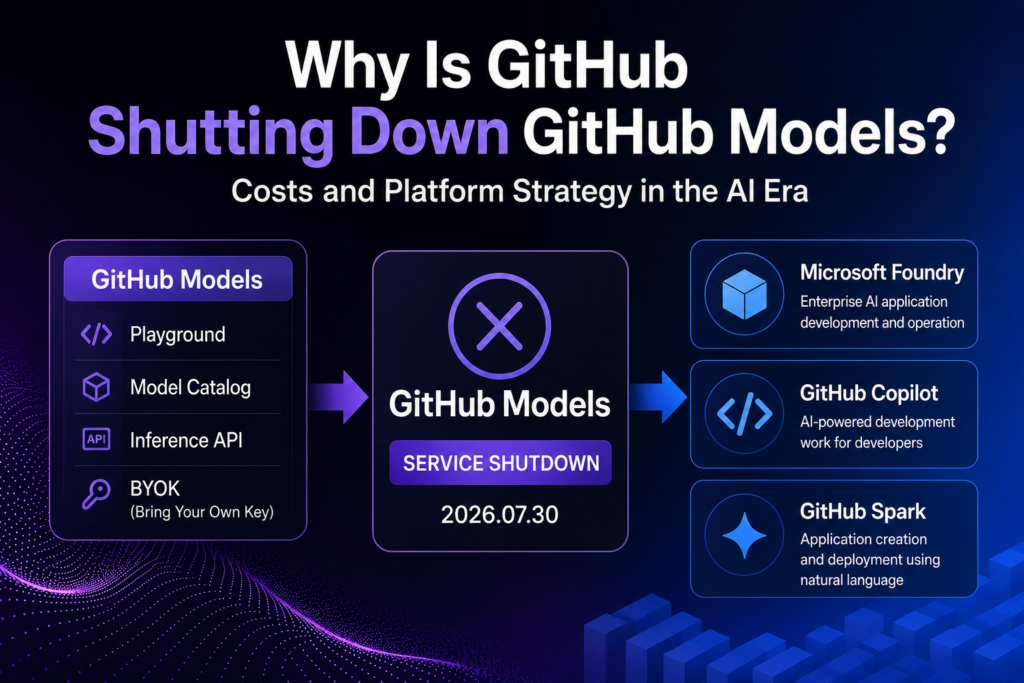
GitHub Models will be completely shut down on July 30, 2026.
After stopping access to GitHub Models for new customers on June 16, GitHub announced on July 1 the full shutdown schedule, including for existing users.
As a result, major GitHub Models features such as Playground, Model Catalog, Inference API, and BYOK (Bring Your Own Key) will no longer be available.
What is interesting is the timing of the shutdown.
The use of generative AI continues to expand, and particularly in software development, AI-based code writing and review, testing, and agent-based work are growing rapidly.
GitHub is also continuing to expand GitHub Copilot.
Yet the same GitHub is shutting down GitHub Models, which allowed users to compare multiple AI models and use them through APIs.
At a time when AI is becoming increasingly important, why is GitHub eliminating an AI model platform?
This decision can be viewed not simply as the shutdown of a service, but as an example of how Microsoft and GitHub’s AI business structure is changing.
What Was GitHub Models?
GitHub Models does not refer to a single AI model developed by GitHub itself.
It was a development platform that allowed users to find, compare, and use AI models provided by various companies and developers, including OpenAI, Meta, Microsoft, and DeepSeek, within the GitHub environment.
Developers could find the models they needed in the Model Catalog and test prompts or compare results from multiple models in the Playground.
Using the Inference API, they could also connect selected models to programs or AI applications they were developing.
The structure can be simplified as follows.
AI models from various companies
↓
GitHub Models
↓
Developers
↓
AI applications
GitHub Models was closer to a platform connecting various AI models with developers than to a service that created AI models itself.
Here, it is necessary to distinguish it from GitHub Copilot.
While GitHub Models was a platform that allowed developers to select and experiment with AI models or connect them to their own applications, GitHub Copilot is an AI product that developers use directly in actual development work.
With Copilot, developers can write or modify code, conduct code reviews, or use AI agents to carry out multi-step development tasks.
In other words, while GitHub Models was closer to infrastructure for developers building AI applications, GitHub Copilot is closer to a product for users performing development work with AI.
GitHub Models Was Not Simply a Testing Service
GitHub Models initially stood out as a way to easily try various AI models.
However, the scope of the service gradually expanded.
In addition to model comparison and prompt testing, GitHub supported model calls through APIs, and in June 2025, it added Pay-as-you-go and BYOK so users could go beyond the free usage limits.
At the time, GitHub explained that this allowed developers who started in the free environment to use production-grade AI models when they needed higher usage levels.
In other words, the direction of GitHub Models did not remain limited to a Playground where users briefly tested AI models.
It also attempted to support the process from creating ideas and prototypes to actual AI application development.
For that reason, this shutdown cannot be viewed simply as the disappearance of a feature for testing models.
GitHub is shutting down a platform that it once attempted to expand into actual AI application development.
Yet Large, Representative Commercial Cases Are Difficult to Find
This raises one question.
If GitHub Models supported actual AI application development, how many commercial services were operated based on it?
It was not that GitHub Models could not be used for commercial services.
GitHub provided paid inference for higher usage levels and also offered features that could be connected to actual application development.
However, based on publicly available information, it is difficult to clearly identify representative companies known to operate large-scale commercial services using GitHub Models as a core inference path.
This does not mean that GitHub Models had no commercial users.
Companies may have used GitHub Models in internal systems or services that were not publicly disclosed.
However, considering that GitHub Models supported production environments, the fact that there are not many representative large-scale commercial cases that can be publicly identified is worth noting.
What Will Happen to GitHub’s Own Service, Spark?
There are also cases in which GitHub Models was used in actual products.
One representative example is GitHub’s own service, GitHub Spark.
GitHub Spark is a service that allows users to create and deploy web applications using natural language.
GitHub’s official documentation explains that Spark is integrated with GitHub Models, allowing users to add AI features to applications without having to configure separate AI infrastructure themselves.
Because of this, the shutdown of GitHub Models leaves one additional question.
If GitHub Models is completely shut down, what will happen to the AI features in GitHub Spark that used it?
GitHub has not announced the shutdown of Spark itself.
Spark continues to be offered, and the GitHub Models shutdown announcement does not indicate that Spark will also be shut down or that its service will be interrupted.
However, GitHub has not specifically disclosed what model-provisioning structure Spark’s AI features will use after GitHub Models is completely shut down on July 30, 2026.
GitHub’s current documentation still contains descriptions of the integration between Spark and GitHub Models, so how the internal model-provisioning structure will change after the service shutdown remains something that requires further confirmation.
Therefore, it is difficult to interpret the shutdown of GitHub Models as meaning that GitHub itself is stopping the use of AI models.
Even if the standalone GitHub Models service provided to external developers is shut down, there is a possibility that AI model capabilities required by individual GitHub products such as Spark will be provided in another way.
However, this is only a possibility based on the currently disclosed service structure, and GitHub has not officially announced a new model-provisioning structure for Spark.
Microsoft Had Already Created a Path Toward Foundry
One important clue in understanding the shutdown of GitHub Models is Microsoft Foundry.
In February 2026, Microsoft officially provided documentation explaining how to transition from GitHub Models to Microsoft Foundry Models.
In this document, Microsoft describes GitHub Models as an environment where developers can find and experiment with AI models for free while developing generative AI applications.
It then directs users to transition to Microsoft Foundry Models when they are ready to move their applications into an actual production environment.
In simplified terms, the roles can be viewed as follows.
GitHub Models
→ AI model exploration, experimentation, and early-stage development
Microsoft Foundry
→ Actual enterprise AI application development and operation
This makes the position of GitHub Models somewhat ambiguous.
GitHub Models was also expanding toward supporting paid inference and production-level usage, but Microsoft already has Foundry, which handles the development and operation of enterprise AI applications.
In fact, when GitHub announced the shutdown of GitHub Models, it recommended Microsoft Foundry as an alternative for new and existing projects that require access to AI models.
For users who want to build AI-based development workflows within GitHub, it suggested GitHub Copilot.
GitHub’s own shutdown guidance effectively distinguishes the roles of these two services.
AI models and application development
→ Microsoft Foundry
AI-powered development work within GitHub
→ GitHub Copilot
The independent role of GitHub Models, which sat between them, may therefore have become smaller than before.
GitHub Copilot, by Contrast, Is Expanding as a Full Commercial Product
While GitHub Models is being shut down, GitHub Copilot continues to expand.
For individual users, GitHub Copilot offers paid plans such as Pro, Pro+, and Max.
Pro costs $10 per month, Pro+ costs $39 per month, and Max costs $100 per month. Max, in particular, is designed for high-usage users who use AI extensively.
Not only the pricing but also the billing method has changed.
In April 2026, GitHub announced that Copilot’s billing system would transition to a usage-based model using GitHub AI Credits, and the new billing structure took effect on June 1.
Copilot’s AI usage is no longer calculated simply by the number of requests.
AI Credits are consumed based on input tokens, output tokens, cached tokens, and the price of the AI model being used.
Each plan includes a certain amount of AI Credits, and once the included usage has been exhausted, the structure allows users to use additional usage.
In other words, Copilot is developing beyond a simple AI coding feature into a full commercial AI product structure in which costs are managed according to usage.
At the same time that GitHub Models is being shut down, Copilot is becoming more differentiated as a product that can be offered directly to users and charged for.
The More AI Is Used, the Larger the Cost Issue Becomes
Generative AI services have a different cost structure from ordinary software services.
When users ask AI to perform tasks, the AI model must actually carry out computation.
As the number of users grows and requests become more complex, the number of tokens and the amount of computation that models must process can also increase.
In particular, recent AI coding tools are moving beyond simply recommending the next piece of code.
AI agents are evolving to read multiple files, modify code, execute commands, check the results, and then continue working.
A single development task can therefore involve multiple model calls.
GitHub’s explanation that aligning actual usage with pricing is important for creating a sustainable Copilot business and user experience when changing Copilot’s billing policy is also related to this.
As AI usage increases, inference costs and usage management become important business issues for the companies providing these services.
However, one point must be clearly distinguished here.
GitHub has not announced that it is shutting down GitHub Models because of cost issues.
The change in Copilot’s billing structure shows GitHub’s strategy for managing AI usage and costs, but it cannot be concluded that this was the direct cause of the GitHub Models shutdown.
Are the GitHub Models Shutdown and Copilot Billing Changes Connected?
Looking at when these changes occurred reveals an interesting sequence.
February 2026
Microsoft provided a transition path from GitHub Models to Microsoft Foundry Models.
April 27, 2026
GitHub announced that Copilot would transition to usage-based billing.
June 1, 2026
The new Copilot billing system using GitHub AI Credits took effect.
June 16, 2026
GitHub Models stopped accepting new customers.
July 1, 2026
GitHub announced the full shutdown schedule for GitHub Models.
July 30, 2026
GitHub Models is completely shut down.
This timeline does not allow us to say that GitHub Models was shut down because of Copilot’s cost issues.
However, it does show that Microsoft and GitHub are reorganizing the roles and billing structures of their AI products during the same period.
There are three main possibilities to consider.
The first is reducing overlap between platform roles.
Microsoft Foundry can take responsibility for the area in which companies use AI models to build and operate actual applications.
The second is focusing on AI products that can be monetized directly.
GitHub Copilot is a product for which users pay subscription fees, and it also has a structure in which AI usage costs can be managed.
The third is improving the efficiency of AI inference and service operating costs.
As AI usage increases, separating roles may be more efficient from a business perspective than operating multiple model-provisioning platforms with similar functions.
However, the third interpretation is DANA NOTES’ analysis based on publicly available cost structures and service changes, and it is not a reason that GitHub has officially given for the shutdown of GitHub Models.
Microsoft’s AI Platform Structure Is Becoming Clearer
Looking only at GitHub Models, it may appear that Microsoft and GitHub are reducing their AI services.
However, the overall structure shows a different picture.
Microsoft Foundry covers the area in which companies use AI models to build and operate applications.
GitHub Copilot covers the area in which developers use AI in actual development work.
GitHub Spark covers the area in which users create and deploy applications using natural language.
And GitHub Models, which allowed users to directly explore, compare, and use multiple AI models through APIs within GitHub, is being shut down.
The structure can be summarized as follows.
Microsoft Foundry
→ Enterprise AI application development and operation
GitHub Copilot
→ AI-powered development work for developers
GitHub Spark
→ Application creation and deployment using natural language
GitHub Models
→ Standalone platform for directly exploring, comparing, and calling multiple AI models → Shut down
From this perspective, it is difficult to say that Microsoft and GitHub are reducing their AI business itself.
Instead, they can be seen as shutting down the standalone model-provisioning platform, GitHub Models, while differentiating roles around products with clearer purposes: Foundry for enterprise AI development, Copilot for developers’ AI work, and Spark for AI application creation.
Therefore, what matters in this change is less whether AI functionality itself is disappearing and more which products Microsoft and GitHub will use to provide and monetize AI functionality.
DANA NOTES Commentary — What the Shutdown of GitHub Models Shows About the Changing AI Business
In the early stages of the AI industry, an important competitive factor was how many AI models a platform could provide and how easily users could access them.
However, as AI becomes deeply integrated into actual work and products, new issues are becoming more important.
Every use of an AI model involves computation costs, and cost management becomes more important as more powerful models and more complex AI agents are used.
For companies, simply providing good AI features is not enough.
They must create pricing structures that can remain sustainable as usage increases and decide through which platforms and to which customers they will provide AI.
The shift to usage-based billing for Copilot, which took place around the same period as the shutdown of GitHub Models, reflects this change.
GitHub Models is being shut down, but GitHub Copilot is expanding, and Microsoft provides the environment for building enterprise AI applications through Foundry.
GitHub Spark also continues to operate as a separate AI product.
Therefore, the shutdown of GitHub Models can be viewed not as a decision to withdraw from the AI business, but as a process in which Microsoft and GitHub are redistributing the roles of their AI platforms.
In particular, it can be interpreted as a shift toward concentrating roles in products with clearer use cases and revenue structures, rather than maintaining a standalone platform such as GitHub Models that provides multiple AI models in the middle.
At the same time, it also shows that competition in the AI market is moving beyond simply offering more models and features.
For AI companies, the important question is no longer only which models they will provide.
In an era when users are using AI more heavily, how will companies absorb rising computation costs through product structures and pricing policies?
The shutdown of GitHub Models is an example of the new business challenges platform companies face as AI moves from an experimental technology into an actual industry.