Notice
This article is based on Oracle’s official website and official materials publicly available as of July 31, 2026.
The company’s products and business structure may change in the future.
Some parts of this article include DANA NOTES analysis and commentary based on publicly available materials.
What This Article Covers
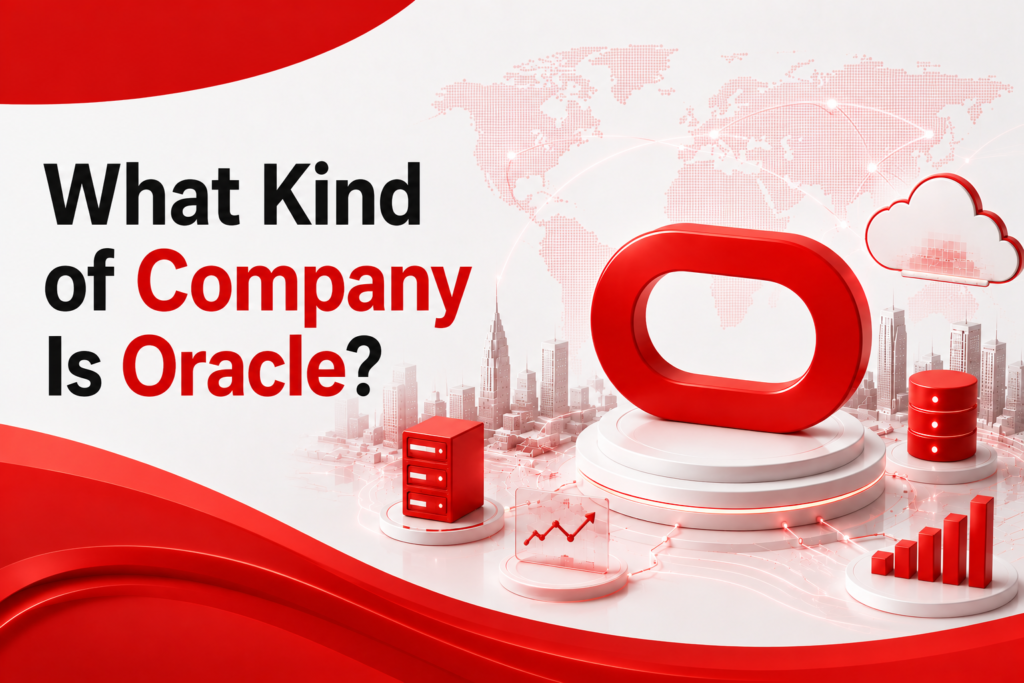
Oracle Corporation is a U.S.-based global IT company that provides databases, cloud infrastructure, enterprise applications, and other technologies.
Founded in 1977, Oracle grew around relational database technology.
When people hear the name Oracle, Oracle Database is often the first thing that comes to mind.
Database technology was, in fact, the business that provided the foundation for Oracle’s growth into a global IT company.
However, Oracle’s business today is not limited to databases.
The company provides everything from databases that store and manage enterprise data to cloud infrastructure that provides servers and networks, as well as enterprise applications used for finance, human resources, and supply chain management.
Oracle Company Overview
| Category | Details |
|---|---|
| Company | Oracle Corporation |
| Founded | 1977 |
| Headquarters | Austin, Texas, United States |
| Listed on | New York Stock Exchange (NYSE) |
| Ticker | ORCL |
| Company Type | Global enterprise IT company |
| Major Businesses | Cloud and software, hardware, services |
| Core Technologies | Databases, cloud infrastructure, enterprise applications |
| Major Products and Services | Oracle AI Database, OCI, Fusion Cloud Applications, NetSuite, Oracle Health, Exadata |
| Major Customers | Companies, government organizations, educational institutions, and others |
| Major Markets | Databases, cloud, enterprise software, IT infrastructure |
| Proprietary Technology | Oracle Database, Oracle Exadata, and OCI-based database and cloud infrastructure technologies |
Oracle was listed on Nasdaq in 1986 but moved to the New York Stock Exchange in 2013.
Its current ticker is ORCL.
What Kind of Company Is Oracle?
Oracle started with databases.
Companies continuously generate data such as customer information, order records, accounting data, inventory, production information, and employee information.
A database is a system that stores this data and manages it so that it can be used in the necessary business operations.
Oracle Database has long been used in the enterprise database market.
Oracle’s database technology is used not only by organizations such as financial institutions and telecommunications companies that need to process large amounts of data reliably, but also in manufacturing, retail, and the public sector.
However, as enterprise IT environments shifted toward the cloud, Oracle’s business expanded as well.
Today, Oracle provides computing, storage, networking, databases, and AI infrastructure through Oracle Cloud Infrastructure.
It also directly provides the software that companies use in their actual business operations.
Oracle Fusion Cloud Applications can be used to manage areas such as finance, human resources, supply chains, and sales.
NetSuite is a cloud ERP product used mainly by small and midsize businesses.
Oracle also provides hardware such as servers and storage, along with consulting and technical support services.
Oracle started with databases, but today it has become a company that covers enterprise data, business operations, and IT infrastructure.
Major Business Areas
Databases and Data Management
Databases are Oracle’s oldest core business.
Oracle provides various database products and technologies that allow companies to store, process, and manage the data they generate.
One of its major products is Oracle AI Database.
Oracle Database is used in enterprise systems that continuously process large amounts of data, including ERP systems, financial systems, and customer management systems.
In the past, it was mainly installed and used directly on servers inside companies, but today it can also be used in cloud environments.
Oracle also owns various data management technologies beyond relational databases, including MySQL.
Cloud Infrastructure
Oracle’s cloud infrastructure platform is Oracle Cloud Infrastructure, or OCI.
Companies can use OCI to access computing resources, storage, networking, databases, and other resources without purchasing servers directly.
More recently, OCI has also begun providing GPU-based infrastructure required for AI model training and inference.
Like AWS, Microsoft Azure, and Google Cloud, OCI is a cloud infrastructure service that companies can use to build and operate IT systems.
One characteristic of Oracle is that it provides OCI together with the database business it has operated for many years.
It also supports companies that want to continue using their existing Oracle Database while moving to the cloud, or that want to use their existing data centers and cloud environments together.
Enterprise Applications
Oracle also provides software used in companies’ actual business operations.
Its major product suite is Oracle Fusion Cloud Applications.
It includes ERP for managing finance and accounting, HCM for managing employees and organizations, and SCM for managing supply chains.
From a company’s perspective, having a database or servers alone is not enough to run its business.
Finance teams need financial systems, HR teams use human capital management systems, and manufacturing companies need to manage purchasing, inventory, and supply chains.
Oracle directly provides software for these business functions as well.
In this area, its business overlaps significantly with SAP.
Hardware
Oracle is known as a software company, but it also provides enterprise hardware.
One of its major products is Oracle Exadata.
Exadata is a system that combines servers, storage, and software for environments that run Oracle Database at scale.
Rather than simply selling general-purpose servers, it is closer to a product in which hardware and software are designed together so that Oracle’s database can operate efficiently.
The fact that Oracle owns database, cloud, and hardware businesses at the same time is one area that distinguishes it from other software companies in the enterprise IT market.
Services
Oracle also provides consulting and technical support services for companies that adopt and operate Oracle products.
Enterprise IT systems do not end with installation.
Existing data may need to be migrated, multiple systems may need to be connected, or systems may need to be configured to fit a company’s business processes.
Oracle provides consulting and support services required during the implementation and operation of its products.
Major Products and Services
Oracle AI Database
Oracle AI Database is Oracle’s flagship database product.
It stores, processes, and manages enterprise data.
It has long been used under the name Oracle Database, and more recently, as AI-related capabilities have expanded, Oracle has been using the name Oracle AI Database.
It can be used both on servers inside companies and in cloud environments.
Oracle Cloud Infrastructure
OCI is Oracle’s cloud infrastructure platform.
It provides computing, storage, networking, databases, AI infrastructure, and other resources required for companies to operate IT systems.
Companies can use OCI on its own or together with Oracle Database and enterprise applications.
Oracle Fusion Cloud Applications
Oracle Fusion Cloud Applications is a suite of cloud applications used in companies’ actual business operations.
It includes ERP, HCM, SCM, and other systems needed to run a business.
For example, a finance team can use ERP to manage accounting and finance, while an HR team can use HCM to manage employee and organizational information.
Companies can manage supply chains, purchasing, and inventory through SCM.
NetSuite
NetSuite is cloud-based business management software.
Centered around ERP, it provides functions needed to operate a business, including accounting, finance, orders, inventory, and customer management.
It is a product that shows Oracle operates in the enterprise application market not only for large enterprises but also for small and midsize businesses.
Oracle Health
Oracle Health is Oracle’s healthcare IT business for hospitals and healthcare organizations.
Oracle significantly expanded its healthcare IT business by acquiring U.S. healthcare IT company Cerner in 2022.
It provides systems for managing electronic health records, clinical information, patient data, and other information used in hospitals.
It is an example of Oracle expanding from enterprise data and business systems into healthcare data and healthcare organization systems.
Oracle Exadata
Oracle Exadata is a system designed to run Oracle Database at scale.
It combines servers, storage, networking, and database technologies with a focus on operating Oracle Database efficiently.
Its defining characteristic is that it is designed specifically for Oracle database environments rather than as a general-purpose server.
What Problems Does Oracle Solve?
An enterprise IT environment is not made up of a single system.
There is an ERP system for managing accounting and finance, and an HR system for managing employee information.
There are customer data and order data, and manufacturing companies also need systems for managing production, inventory, and supply chains.
For these systems to operate properly, a database is needed to store the data.
Servers and networks are also required to run the systems.
Oracle does not provide only one of these areas.
Oracle AI Database manages enterprise data.
OCI provides cloud infrastructure for processing data and running systems.
Fusion Cloud Applications handles actual business operations such as finance, human resources, and supply chains.
When necessary, companies can also use hardware such as Exadata.
Companies can choose and use Oracle products individually or combine multiple products.
This is also why Oracle’s business appears so broad.
It started as a database company but developed into a structure that directly provides multiple areas of enterprise IT systems.
Business Structure and Major Customers
Oracle’s official business structure is broadly divided into Cloud and Software, Hardware, and Services.
Cloud and Software includes databases, OCI, and enterprise applications.
Hardware includes enterprise systems such as Exadata, as well as server and storage products.
Services provides consulting and technical support for customers implementing and operating Oracle products.
Oracle’s customers are not limited to a specific industry.
Companies across a wide range of industries, including finance, manufacturing, telecommunications, retail, and healthcare, use Oracle products.
Government organizations and educational institutions are also among its major customers.
In particular, Oracle has long been used in systems that handle companies’ core business operations, giving the company strong recognition in the enterprise IT market.
DANA NOTES Commentary
The first thing to keep in mind when understanding Oracle is its database business.
Oracle Database was the foundation that allowed Oracle to grow to its current position.
However, calling today’s Oracle simply a database company leaves out a significant part of its business.
Oracle has OCI, Fusion Cloud Applications, NetSuite, and Oracle Health.
Its business extends from technologies that store enterprise data to the infrastructure that processes that data and the software used in actual business operations.
This structure is important when understanding Oracle.
While SAP grew in the enterprise business software market around ERP, Oracle expanded from its database business into enterprise applications and cloud infrastructure.
Like AWS and Microsoft, Oracle provides cloud infrastructure, but at the same time, it also has a database business that has long been used in companies’ core systems.
For this reason, when looking at Oracle’s competitiveness, it is not enough to describe it simply as “a company with a strong position in the database market.”
What matters more is how Oracle connects its existing database business, enterprise applications, and OCI.
In the next article, we will look at what makes Oracle competitive.