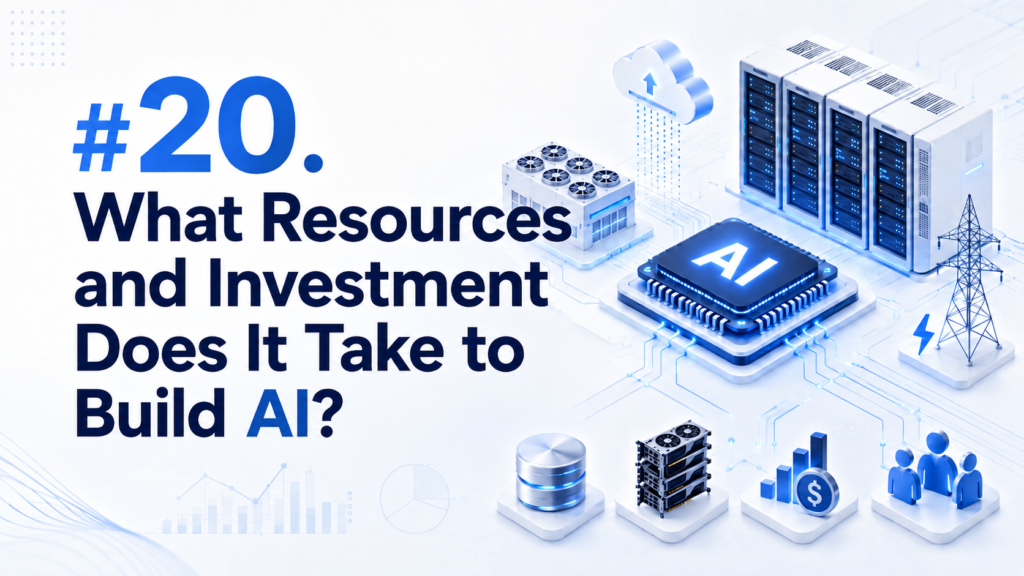
1. What Does an AI Model Company Prepare In-House, and What Does It Obtain Externally?
Developing an AI model does not mean that a company builds everything it needs on its own.
There are core capabilities that the company needs to build internally, and there are also resources that it needs to purchase or rent from external companies.
Broadly, these can be divided into two areas.
- What is prepared in-house: data, model development, specialized personnel, evaluation, security, and more
- What is obtained externally: computing resources, data centers, power, cooling, networks, and more
Actual AI development is the process of connecting these two areas to create a single development environment.
2. What Needs to Be Prepared In-House?
Data
Data for training the AI model needs to be prepared.
Simply collecting a large amount of data is not enough.
- Decide what data to use
- Collect or purchase the necessary data
- Clean up erroneous or duplicate data
- Process the data into a form that can be used for training
- Check data quality and usage rights
Data can be obtained externally, but deciding what data to use and how to use it for training is a core task of an AI model company.
Model Development
The structure of the AI model and the training method need to be designed, and the actual training needs to be carried out.
It is not something that is completed after being built once.
Development → Training → Evaluation → Modification → Retraining
This process is repeated.
Specialized Personnel
Having only AI researchers is also not enough to build a model.
Although this varies depending on the size of the model and the company, people in multiple fields are generally needed, including:
- AI research and development
- Data
- Software
- Infrastructure
- Evaluation and safety
- Security
3. How Are the Computing Resources Needed for AI Training Secured?
Training an AI model requires computing resources capable of processing a very large amount of computation.
Representative examples are GPUs and AI accelerators.
However, an AI model company does not have to purchase all of this equipment itself.
- It can purchase servers and GPUs directly
- It can rent what it needs from the cloud
- It can enter into long-term contracts with external infrastructure companies
- It can build dedicated AI infrastructure together with specific companies
Therefore, what matters is not simply whether the company owns the equipment, but whether it can reliably secure the computing capacity needed while training the model.
4. Does a Company Need to Build Its Own Data Center?
As the amount of computing equipment increases, space is also needed to install and operate that equipment.
However, an AI model company does not necessarily need to own its own data center.
Depending on the situation, a company can:
- Operate its own data center
- Use another company’s data center
- Use a cloud provider’s data center
- Build dedicated facilities together with an infrastructure company
In other words, the company developing the AI model and the company that actually builds and operates the data center do not have to be the same company.
5. Why Are Power, Cooling, and Networks Also Needed as Computing Equipment Increases?
Training a large-scale AI model requires many computing devices to operate at the same time.
As a result, the resources needed also increase.
Computing equipment
→ Servers
→ High-speed networks
→ Power
→ Cooling
→ Data centers
Computing equipment requires power, and the heat generated while the equipment is operating needs to be cooled.
A fast network is also needed so that multiple devices can exchange data while performing computations together.
This is why large-scale AI development goes beyond software development and becomes connected to the need to secure physical IT infrastructure.
6. Is Security Handled In-House or Outsourced?
Security is also often divided between the company itself and external providers, rather than being handled entirely by one side.
Within an AI model company, responsibilities can include:
- Managing access to training data
- Protecting models and source code
- Managing employee permissions
- Securing services and models
- Preventing AI misuse and managing safety
External providers, meanwhile, can provide:
- Physical security for data centers
- Cloud infrastructure security
- Network and security equipment
- External security assessments and specialized services
Using external services does not eliminate the AI company’s security responsibilities.
7. Where Do the Costs of AI Model Development Come From?
All of the elements discussed above lead to costs.
In-House
- Data preparation and management
- Model research and development
- Specialized personnel
- Repeated training and evaluation
- Safety and security
- Time required for development
External
- Computing resources
- Servers and cloud services
- Data centers
- Power and cooling
- Networks
- External data
- Specialized services
Therefore, the investment required for AI model development should be viewed not as the price of a single piece of equipment, but as the cost of creating the entire environment needed to develop, train, and operate the model.
8. Do All AI Companies Need This Many Resources?
No.
This is because the phrase “building AI” can refer to several different levels.
For example:
- A company developing a large-scale AI model from scratch
- A company further training and using an existing model
- A company building a service using an AI model that has already been created
require very different levels of resources.
The more a company develops a large-scale model directly from scratch, the greater its investment in data, computing, infrastructure, and personnel. The more it uses existing models, the fewer areas it needs to bear directly.
Therefore, not every AI company needs the same level of investment simply because it is an AI company.
DANA NOTES in One Line
Developing an AI model requires not only internal capabilities such as data and specialized personnel, but also external infrastructure such as computing resources, data centers, power, cooling, and networks. The greater the scope of direct development, the greater the investment required.