What This Article Covers
Ransomware is a type of malicious software that makes files stored on a computer or server inaccessible and then demands payment in exchange for restoring them. The word “ransom” means money demanded for the release of someone or something, while “software” refers to a computer program. As the name suggests, ransomware is a cyberattack that holds data and business systems hostage and demands money.
In the past, ransomware mainly encrypted personal files such as photos and documents stored on individual computers. Today, however, it has evolved into an organized form of cybercrime that infiltrates corporate servers and databases, disrupts business operations, steals important information, and threatens to release it publicly.
A new criminal structure known as RaaS is also one of the factors behind the rapid spread of ransomware attacks.
How Does Ransomware Work?
When a computer is infected with ransomware, files such as documents, photos, videos, business files, and databases may be encrypted. Encryption is a technology that transforms data into an unreadable form according to a defined set of rules.
Legitimate encryption is used to protect personal information and financial data. Ransomware attackers, however, misuse this technology. They prevent victims from opening their files and then demand payment in exchange for providing the decryption key needed to restore access.
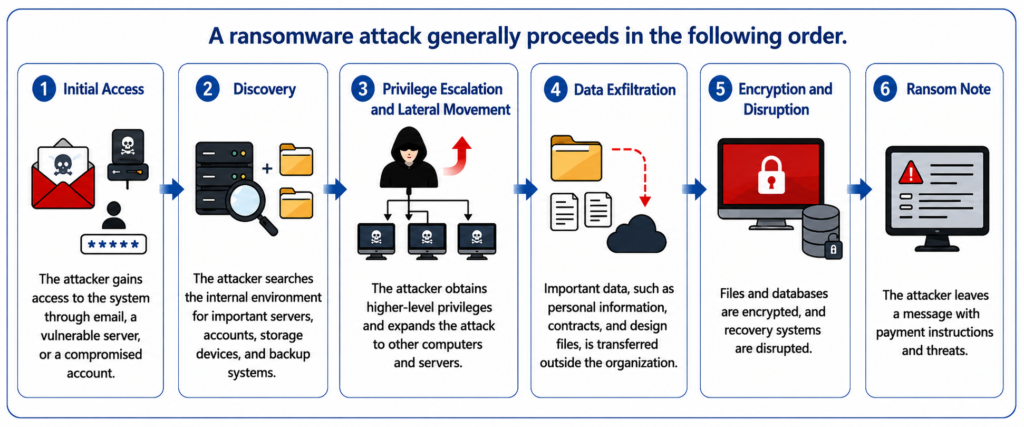
A ransomware attack generally proceeds as follows.
- The attacker gains access to the system through email, a vulnerable server, or a compromised account.
- The attacker searches the internal environment for important servers, accounts, storage devices, and backup systems.
- The attacker obtains higher-level privileges and expands the attack to other computers and servers.
- Important data, such as personal information, contracts, and design files, is transferred outside the organization.
- Files and databases are encrypted, and recovery systems are disrupted.
- The attacker leaves a message containing payment instructions and threats.
Attackers often demand payment in cryptocurrency because such payments can be difficult to trace and are easy to transfer across borders. However, paying the ransom does not guarantee that the files will be restored. The decryption tool may not work properly, or the attacker may demand additional payment.
How Does Ransomware Infect a System?
Ransomware does not enter a system through only one specific method. Attackers use various routes, including human error, security vulnerabilities, and compromised accounts.
- Email Attachments and Links
Attackers disguise emails as messages from business partners, public institutions, or employees within the company. Files presented as invoices, résumés, contracts, or delivery notices are often used because recipients are likely to open them.
- Operating System and Software Vulnerabilities
Servers and programs that have not received security updates may still contain publicly known vulnerabilities. Attackers can exploit these weaknesses to enter a system without requiring any additional action from the user.
- Compromised or Weak Passwords
Using the same password across multiple services or choosing a password that is easy to guess increases the risk of a ransomware attack. Attackers may also take passwords leaked from other websites and try them on corporate accounts.
- VPNs and Remote Access Systems
VPNs and remote desktop systems allow users to access company systems from outside the organization. If the related accounts are compromised, attackers can log in as though they were legitimate employees and gain access to the internal network.
- Pirated Software and Files from Untrusted Sources
Ransomware may be hidden in software activation tools, cracked programs, or files disguised as free applications. Programs downloaded from unofficial websites require particular caution.
- Compromised Websites and Online Advertisements
Malicious code may be inserted into poorly secured websites, or malicious advertisements may be disguised as legitimate ones. Attackers may also trick users into installing fake updates or fraudulent security software.
Why Is Ransomware More Dangerous Than Other Malware?
Many types of malware secretly collect personal information or reduce computer performance. Ransomware, by contrast, directly prevents users from accessing files and systems, immediately disrupting operations.
When a company is hit by ransomware, employees may be unable to open work files, while customer management or production systems may stop functioning. Hospitals may lose access to patient records, and manufacturers may be forced to halt factory operations.
In recent years, double extortion has become widely used in ransomware attacks. In this type of attack, criminals steal data before encrypting it. Even if the victim organization restores its system from backups, the attackers demand payment again by threatening to publish the stolen personal information or confidential data.
Some attackers also contact the victim company’s customers or business partners directly or launch additional attacks against its website. As a result, ransomware damage can extend beyond file loss to include data breaches, business interruption, legal liability, and loss of trust in the company.
How Has RaaS Expanded Ransomware Attacks?
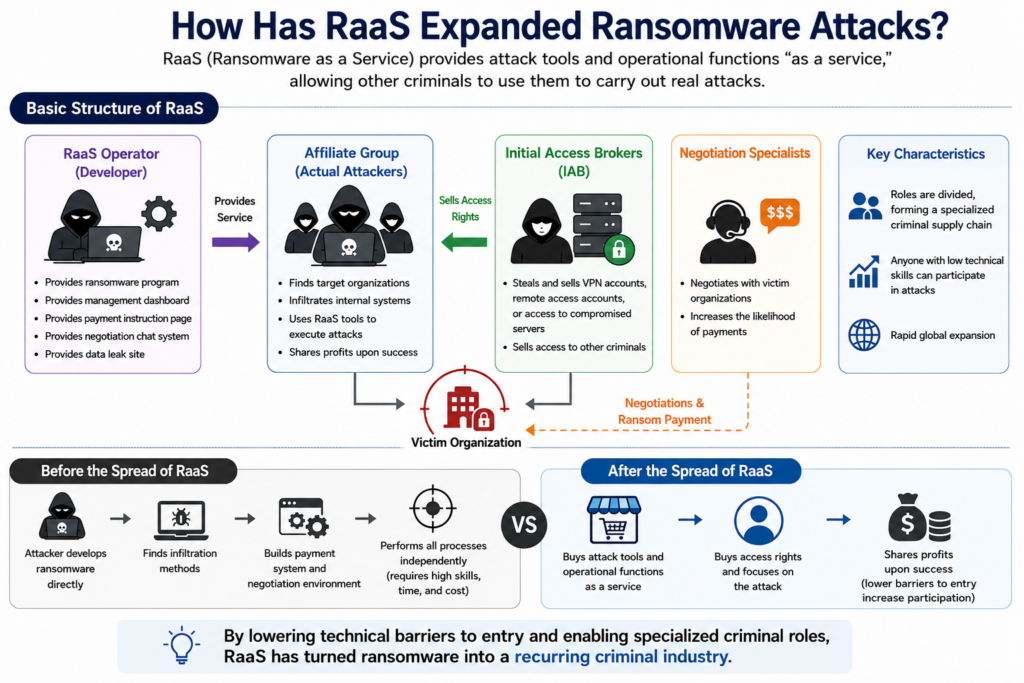
RaaS stands for “Ransomware as a Service.” It is a structure in which ransomware developers provide the programs and management functions needed for an attack, while other criminals use them to carry out the actual attack.
Just as SaaS provides legitimate software as a service, RaaS also provides attack tools as a service. However, RaaS is an illegal structure operated for the purpose of cybercrime.
RaaS operators may provide not only file-encrypting ransomware but also dashboards used to manage victim organizations, payment instruction pages, negotiation chat systems, and leak sites used to publish stolen data.
The criminals who carry out the actual attacks are known as affiliate groups, or affiliates. They identify target companies, infiltrate their internal systems, and deploy ransomware provided by the RaaS operator. If the attack succeeds and a ransom is paid, the operator and the affiliate group divide the proceeds.
Initial access brokers also participate in this structure. These brokers steal and sell corporate VPN accounts, remote access credentials, or access rights to servers that have already been compromised. Ransomware attackers can therefore begin an attack by purchasing existing access without having to gain initial access themselves.
Some criminals specialize in negotiating payment with victim organizations. As ransomware development, internal network intrusion, account trading, data theft, and negotiation are divided among different participants, a criminal supply chain is formed.
Before RaaS became widespread, attackers had to develop ransomware themselves and prepare intrusion methods and payment systems. Today, they can obtain ready-made attack tools and operational functions, allowing criminals with limited malware development skills to participate in ransomware attacks.
Ultimately, RaaS has lowered the technical barriers to carrying out ransomware attacks and increased specialization among criminal groups. This is one of the main reasons ransomware has expanded beyond attacks by individual hackers into an organized criminal industry built around repeatable operations.
How Can Ransomware Be Prevented?
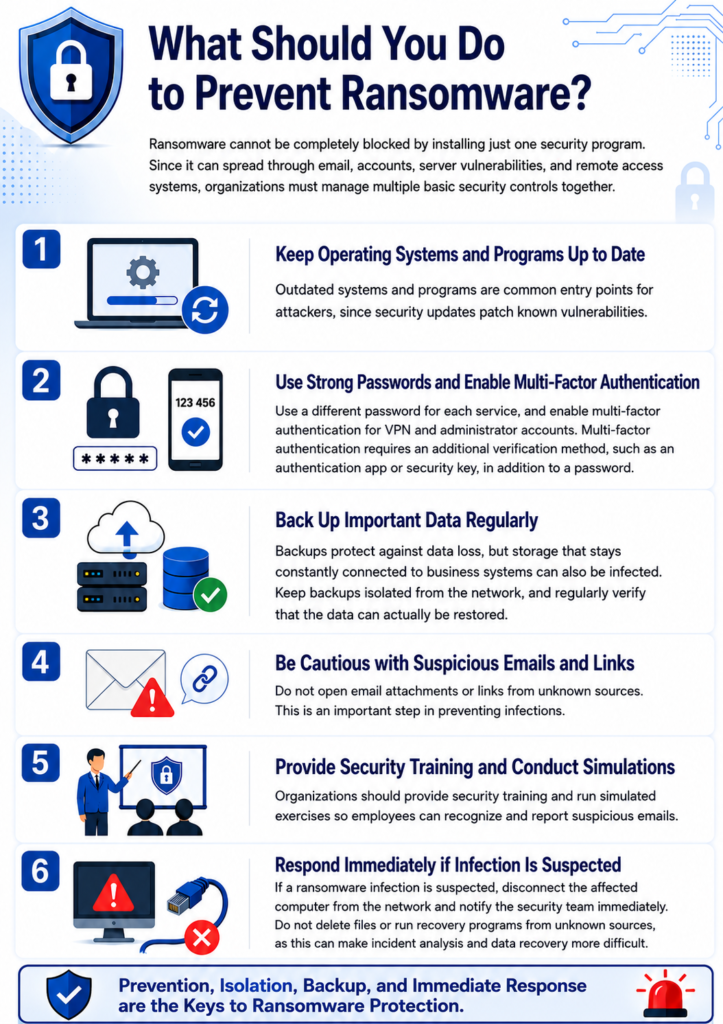
Ransomware cannot be completely prevented by installing a single security program. Because attackers use multiple routes, including email, user accounts, server vulnerabilities, and remote access systems, organizations must manage multiple basic security controls together.
Operating systems and software should be kept up to date. Security updates include fixes for vulnerabilities that attackers could exploit.
Different passwords should be used for different services, and multi-factor authentication should be applied to VPN and administrator accounts. Multi-factor authentication requires an additional verification method, such as an authentication app or security key, in addition to a password.
Important data should be backed up regularly. However, backup storage that remains continuously connected to business systems may also be infected with ransomware. Organizations should maintain backups that are isolated from the network and regularly verify that the data can actually be restored.
It is also important not to open email attachments or links from untrusted sources. Companies should provide security training and conduct simulated exercises so employees can recognize and report suspicious emails.
If a ransomware infection is suspected, the affected computer should be disconnected from the network and reported to the security team immediately. Deleting files or running recovery tools from untrusted sources may make incident analysis and data recovery more difficult.
DANA NOTES Commentary
If ransomware is understood only as malicious software that locks files, it is difficult to fully explain the current structure of ransomware attacks. Today’s ransomware is an organized form of cybercrime that combines system intrusion, account compromise, data theft, file encryption, and ransom negotiation.
RaaS, in particular, has transformed ransomware attacks into a business structure based on a division of labor. Attackers no longer need to possess every technical capability themselves. They can purchase ransomware programs or access to corporate systems and divide the required roles among other criminals.
For this reason, corporate ransomware defenses cannot stop at detecting malicious files. Organizations must manage multi-factor authentication, security updates, administrator account controls, remote access management, network segmentation, data backups, and recovery exercises together.
The central objective of ransomware security is not to expect an environment in which attacks never occur. It is to build a system that can quickly detect an intrusion, limit the spread of the attack to other systems, and safely restore disrupted business operations.