
What This Article Covers
What Is a Sandbox?
(An Isolated Space for Running Programs Safely)
Multiple programs run at the same time on computers and smartphones. You may use a messenger while keeping a web browser open, or work on a document while listening to music.
For various programs to run together on a single device, each program must be managed so that it does not improperly affect the others.
If an error in one program spreads to another program, or if a certain app can freely open a user’s photos and files, the device could become highly unstable.
The technology used to reduce these problems is called a sandbox.
What Is a Sandbox?
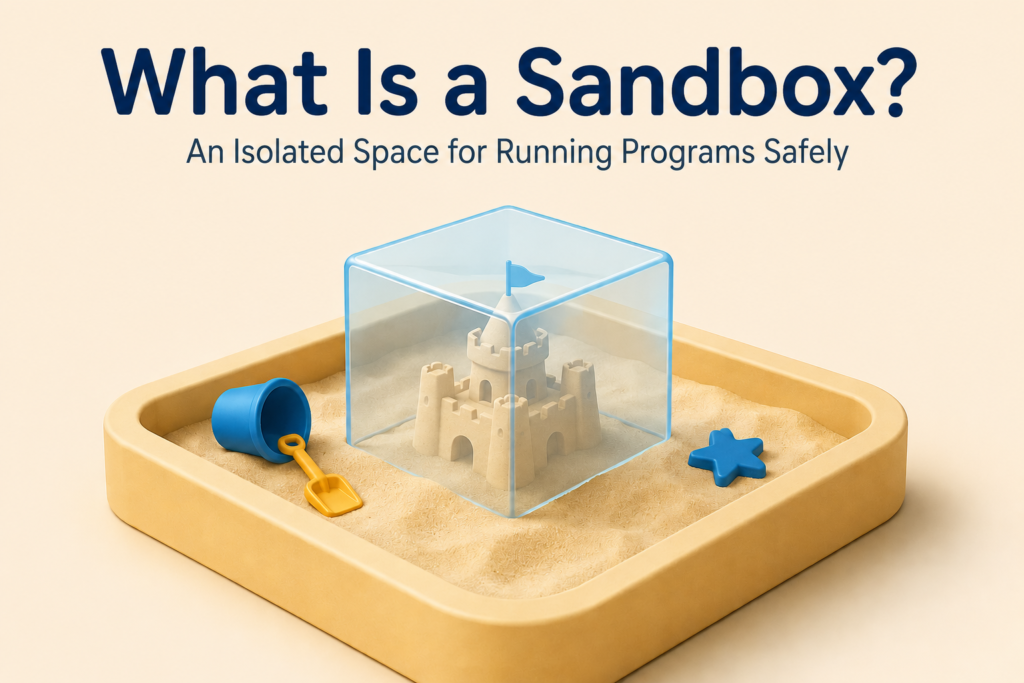
A sandbox is a technology that runs a program in a restricted space separated from the outside environment.
A program can use only the functions and resources defined within the sandbox. Actions such as reading files, accessing the internet, and using the camera or microphone are also possible only within the permitted scope.
In English, a sandbox refers to a play area where children play with sand. Children can play freely within the designated space, but boundaries are created to keep the sand from spreading outside the play area.
A computer sandbox works in a similar way.
It allows a program to perform the tasks it needs within a defined space while limiting its actions so that they do not affect other programs or the operating system as a whole.
Why Is a Sandbox Necessary?
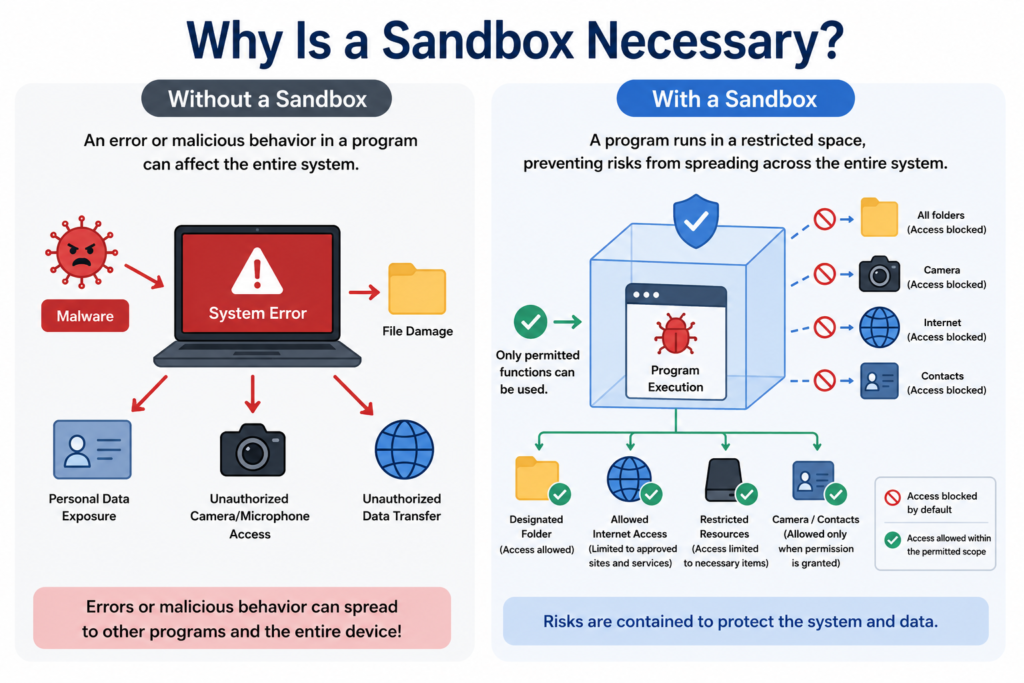
Programs may experience errors or behave in unexpected ways. Some programs, such as malware, are created from the beginning to attack a user’s information or system.
If a program could access every file and function on a device without any restrictions, even a small error could affect other programs or the entire operating system.
A malicious program could read a user’s photos and documents, activate the camera and microphone, or transmit stored information externally.
A sandbox separates in advance the range of resources that a program can access, preventing these risks from spreading across the entire device.
In other words, a sandbox is a security technology, but it is also a technology for reducing interference between programs and operating a system more reliably.
We Are Already Experiencing Sandboxes
A sandbox is a structure that defines the range of spaces and functions a program can use. A program runs only within the scope permitted to it and cannot freely access information from other programs or major functions of the device.
Smartphone apps operate in a similar way.
Installing a new app does not mean that the app can immediately open all of a user’s photos or freely use the camera and microphone. Because an app runs only within its own space by default, it cannot access external functions and information such as photos, the camera, the microphone, or location data.
However, some apps need this type of access to perform their functions. A photo-editing app needs to load a user’s photos, a video-conferencing app needs to use the camera and microphone, and a map app needs to check the user’s current location.
In this case, the app requests the necessary permission from the user through the operating system. If the user allows it, the operating system enables the app to access the permitted function. If the user denies it, the operating system blocks access.
Therefore, an app permission request is not the sandbox itself. It is a process in which an app restricted by a sandbox receives the user’s permission to access a necessary function, while the operating system controls that access within the permitted scope.
However, not all operating systems and programs configure sandboxes in exactly the same way. The scope of isolation and the way permissions are managed may vary depending on the operating system, the type of program, and the security purpose.
What Is Restricted Inside a Sandbox?
A sandbox is not a technology that prevents a program from running.
It allows the program to perform the tasks it needs while preventing it from freely accessing information or functions that have not been permitted.
Photos and Files
The range of access can be restricted so that an app cannot freely open or modify all of a user’s photos and files.
A program that needs access to photos, such as a photo-editing app, can request permission from the user and access photos only within the scope the user allows.
Camera and Microphone
The camera and microphone are functions that can collect a user’s image and voice.
Therefore, an app must request permission from the user to use these functions. If the user does not allow it, the app cannot use the camera or microphone.
Location and Contacts
An app needs permission to access a user’s current location or saved contacts.
If the user determines that the information is unnecessary for the app’s function, the user may refuse the permission or revoke a permission that was previously granted.
Internet Connection
The range within which a program can access the internet or exchange information with an external server can also be restricted.
A program that does not need external communication may be blocked from connecting to the internet or configured to connect only to necessary servers.
However, preventing children from accessing adult websites or harmful websites is considered a parental control or content-filtering function rather than a sandbox function.
A sandbox’s network restrictions do not determine which websites a user can view. They restrict how far a program can communicate through the internet.
In this way, a sandbox defines the range of information and functions a program can use so that it has only the permissions it needs.
What Would Happen Without a Sandbox?
Without a sandbox, the boundaries around the spaces and functions a program can use would become weaker.
For example, a newly installed photo-editing app could open all of a user’s photos without permission. An app such as a flashlight app, which does not need contacts or a microphone, could also access the user’s contacts and voice information.
An error in one program could affect files used by another program, and a malicious program would be more likely to read or modify information stored on the device without restriction.
If a program could access the internet freely, it could transmit user information externally or receive and execute new commands from an external source.
A sandbox cannot completely prevent every error or security problem. However, by restricting a program’s range of actions in advance, it reduces the possibility that errors or dangerous behavior will spread to other programs or the entire device.
Why AI Also Needs a Sandbox
Modern AI does more than simply answer questions.
It can read and analyze files, write and execute code, and use the internet and external tools. Systems such as AI agents, which connect multiple tasks and perform actual actions, are also emerging.
If this type of AI could access computers and networks without any restrictions, unexpected problems could occur.
For example, AI might misunderstand a user’s request and read or modify files that are not needed. It may also execute an incorrect command and delete files, or transmit information to an external service even though the information should not be sent.
For this reason, sandboxes are also important when AI handles files, executes code, or uses external tools.
AI performs necessary tasks inside a sandbox while being restricted in the files and functions it can access and in the scope of its internet connection.
For example, AI may be allowed to read files only within a specific folder, or it may be restricted to saving new files only in a designated space. Internet access may be blocked, or the AI may be configured to use only approved services.
As AI performs more functions, a sandbox becomes more than a simple security measure. It becomes a control technology that manages how far AI is allowed to act.
Why Sandboxes Are Important
The core of a sandbox is giving a program or AI only the permissions it needs.
Even a legitimate program can experience errors, and a file that appears safe may contain dangerous code. AI also cannot always be guaranteed to behave only in the way the user expects.
Therefore, the types of information a program or AI can access and the functions it can use must be defined in advance.
A sandbox is not a technology that eliminates every risk before a problem occurs.
It is a technology that limits the scope of the impact so that, even if a problem occurs, it does not spread to other programs or the operating system as a whole.
Ultimately, a sandbox is a basic isolation structure that allows programs and AI to perform necessary tasks within a defined space while protecting the device and the user’s information.
DANA NOTES in One Sentence
A sandbox is a technology that isolates programs or AI so that they operate only within permitted spaces and functions, preventing errors and risks from spreading across the entire device.