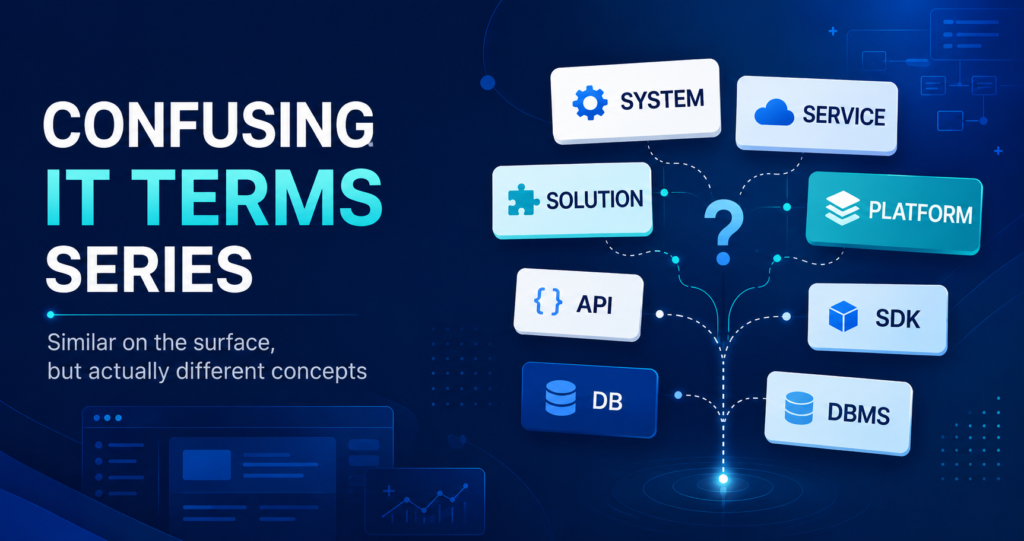
We compare IT terms that may sound similar but actually differ in their criteria and roles.
The series is organized to help non-developers understand where and how each concept is used.
Confusing IT Terms #01 Algorithm vs Program vs Module vs Model: What’s the Difference?
(Differences in processing methods, executable code, functional components, and learned structures)
Confusing IT Terms #02 System vs Service vs Solution vs Platform: What’s the Difference?
(Four concepts that are often used interchangeably when discussing IT)
Confusing IT Terms #03 Application vs Program vs Software vs Service: What’s the Difference?
(The difference between what users use, executable code, software as a whole, and functionality provided to users)
Confusing IT Terms #04 Server vs Client vs Frontend vs Backend: What’s the Difference?
(The difference between who sends and handles requests, and between user-facing and internal processing)
Confusing IT Terms #05 Database vs DBMS vs Data Warehouse vs Data Lake: What’s the Difference?
(The difference between storing data, managing it, integrating it for analysis, and accumulating raw data)
Confusing IT Terms #06 API vs Interface vs Protocol vs SDK: What’s the Difference?
(Different ways systems and programs connect, exchange functionality, and communicate)
Confusing IT Terms #07 Server vs Host vs Instance vs Virtual Machine: What’s the Difference?
(Distinguishing similar server-related terms from an infrastructure and runtime environment perspective)
Confusing IT Terms #08 Library vs Framework vs Module vs Package: What’s the Difference?
(The difference between the units and methods used to organize, reuse, bundle, and distribute code)