Recommended Reading
- Confusing IT Terms #01 Algorithm vs Program vs Module vs Model : What’s the Difference?
- Confusing IT Terms #02 System vs Service vs Solution vs Platform: What’s the Difference?
What This Article Covers
“We developed our own AI model.”
“We launched a new AI service.”
“We provide AI solutions for enterprises.”
When reading AI-related news, terms such as model, service, and solution frequently appear.
Because they are all related to AI, they may seem similar, but they actually refer to different scopes.
In the previous article(#16. How Are AI Agents Different from ChatGPT?), we classified AI according to its functions and how it operates. In this article, rather than classifying AI by its functions, we distinguish models, services, and solutions based on the product structure through which AI technology is provided to users.
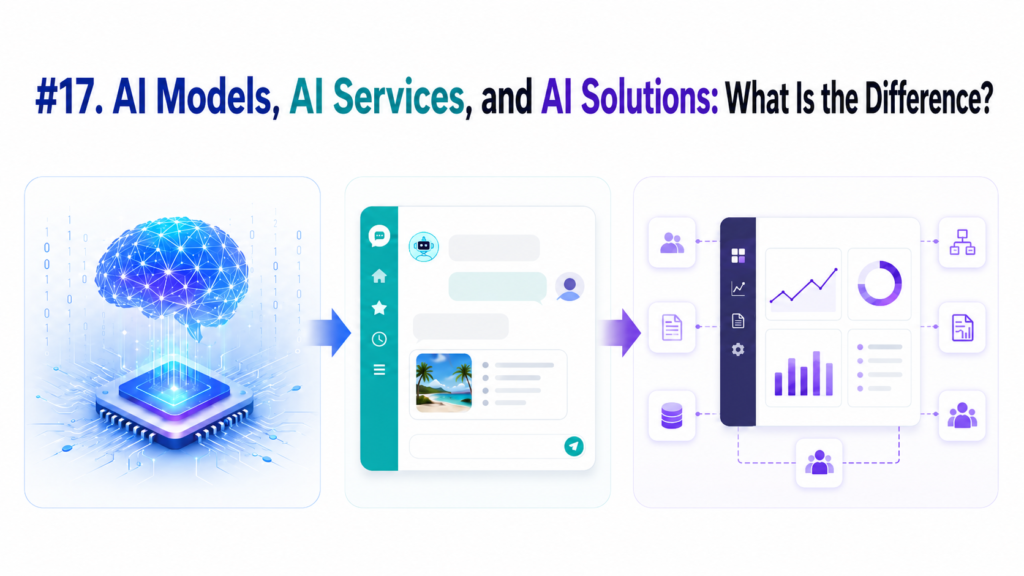
They can be distinguished simply as follows.
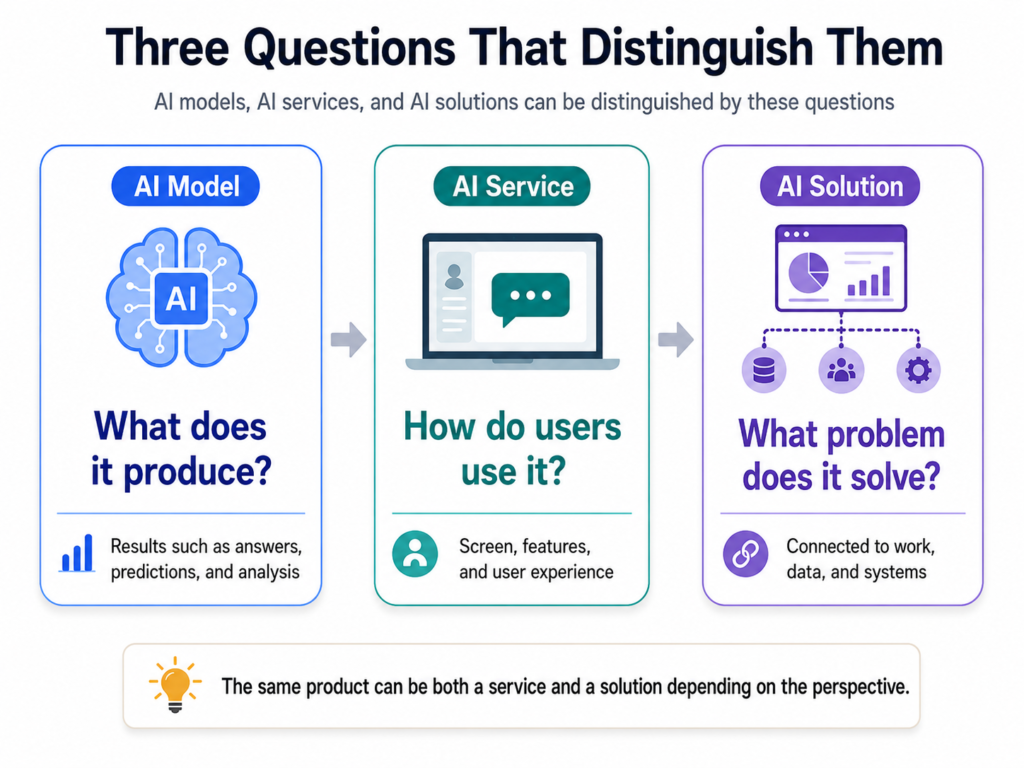
An AI model is the technology that produces results.
An AI service is a product that allows users to use that technology.
An AI solution is a product or system configured to solve a specific problem using AI.
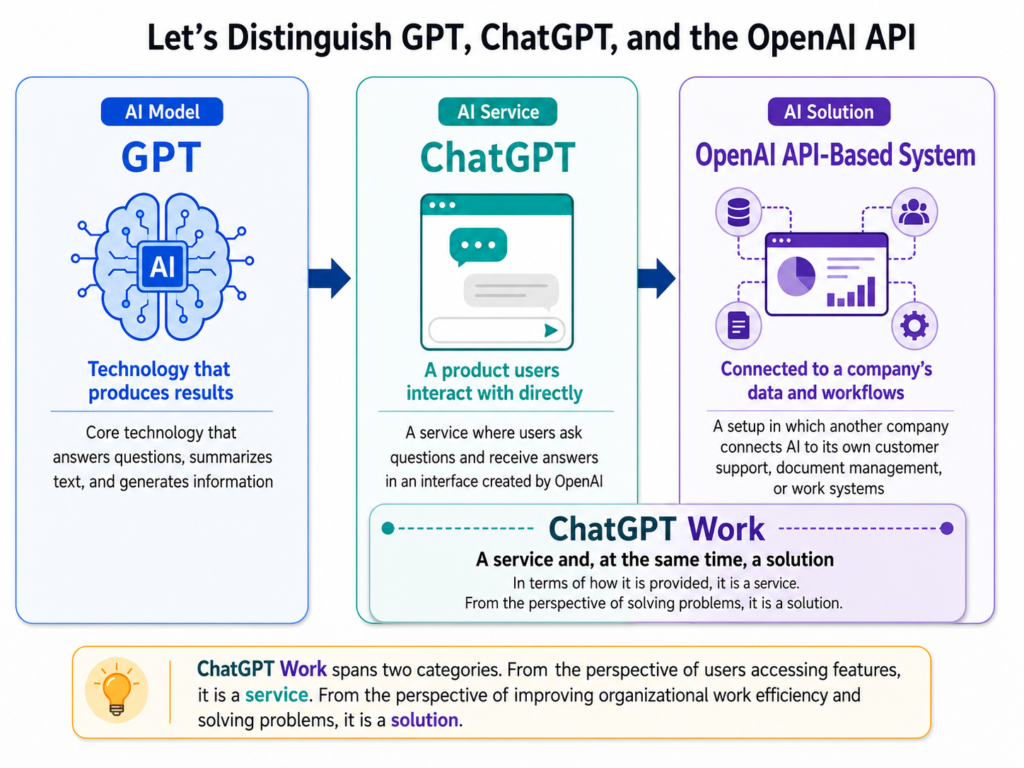
Using OpenAI’s products as examples, GPT is an AI model, while ChatGPT is an AI service.
When another company uses the OpenAI API to connect AI capabilities to its customer service center or document management system, it can create an AI solution.
A product such as ChatGPT Work, which is designed to help users carry out multi-step tasks more efficiently, can also serve as an AI solution for work.
An AI Model Is Technology That Produces Results
An AI model learns from data and then produces results when it receives new input.
When a user enters a sentence, it generates a response, and when a user enters an image, it identifies what is in the image. It can also convert speech into text or predict future demand based on past sales records.
For example, an AI model can perform the following tasks.
- Generate answers to questions
- Summarize long documents
- Find people or objects in images
- Convert speech into text
- Recommend products or content
- Detect unusual transactions or security threats
The core function of an AI model is to receive input and produce a result.
However, being able to produce results does not automatically make it a product that ordinary users can use conveniently.
Users need a screen where they can enter questions, as well as functions for uploading files and saving results. Features such as user registration, access permissions, and pricing plans are also needed.
When various features that users can access are added to an AI model, it becomes an AI service.
The differences between an AI model and an algorithm, program, or module are explained in more detail in “What Is the Difference Between an Algorithm, a Program, a Module, and a Model?”
An AI Service Is a Product Made Available to Users
An AI service is a product that allows users to directly use the capabilities of an AI model.
AI chatbots, translation apps, image-generation websites, and voice-conversion services are representative examples.
An AI service does not contain only an AI model.
It also requires a screen where users can enter text, a function for uploading files, a function for saving work results, accounts and pricing plans, and privacy protection features.
Even when the same AI model is used, different services can be created depending on which features are added and how they are presented.
For example, one language model can be used to create a document summarization service or a foreign-language learning service. It can also be used to create a customer support service that answers customer questions.
Therefore, the performance of an AI model and the completeness of an AI service do not mean the same thing.
Even when a high-performing model is used, it is difficult to create a good service if the interface is inconvenient, responses are excessively slow, or work results are not saved properly.
Creating an AI Service Does Not Mean Owning a Proprietary Model
When a company launches an AI service, it does not necessarily mean that the company developed the AI model itself.
A company can also create a new service by connecting an AI model provided by another company.
For example, a company may use an external AI model while developing the service interface, search functions, and data management functions itself.
In this case, the company can create an AI service that users can access even without its own proprietary AI model.
Therefore, when evaluating an AI service, it is necessary to consider not only whether the company owns its own model but also what functions and value the service provides to users.
An AI Solution Is Configured to Solve a Specific Problem
An AI solution does not stop at showing AI capabilities.
It focuses on actually solving a specific problem.
For example, suppose an online shopping mall introduces AI to reduce the number of customer inquiries.
Simply connecting an AI model that can answer questions does not immediately solve customer support operations.
The AI must be able to check the shopping mall’s product information and delivery policies. It may also need to retrieve customers’ order histories, while important requests such as refunds or changes to personal information must be forwarded to an employee in charge.
A procedure is also needed to review and correct incorrect answers produced by the AI.
When AI is connected to a company’s data, existing programs, employees, and workflow in this way, it becomes an AI customer service solution.
An AI solution also includes functions that are not AI.
A database for storing customer information, employee access permissions, a screen showing work status, and functions for connecting to existing systems are also required.
Therefore, the quality of an AI solution is not determined by model performance alone.
The ability to properly understand a company’s problems and connect AI appropriately to actual work is also important.
Understanding the Difference Through GPT, ChatGPT, and the OpenAI API
The differences among an AI model, an AI service, and an AI solution can be easily understood by using GPT and ChatGPT as examples.
AI Model: GPT
GPT is an AI model that processes inputs such as text and images and produces responses or analysis results.
It performs core tasks such as answering questions, writing text, summarizing documents, and classifying information.
However, GPT itself does not refer to all the features that users interact with, such as the chat interface, accounts, conversation history, and file management functions.
In other words, GPT is the core technology that produces results.
AI Service: ChatGPT
ChatGPT is an AI service designed to allow users to directly use the capabilities of an AI model.
Users can access ChatGPT, ask questions, and receive answers without developing a separate program. They can also upload files and analyze their contents or create text and images.
The core task of generating answers during this process is performed by the AI model.
However, the chat interface, file uploads, conversation history, voice features, accounts, and pricing plans that users interact with are functions that make up the ChatGPT service.
Therefore, GPT and ChatGPT do not mean the same thing.
GPT is the AI model that produces results, while ChatGPT is the service that allows users to use that model and various related features.
What Is the Difference Between ChatGPT and the OpenAI API?
ChatGPT is a complete service that users access and use within an environment created by OpenAI.
It is not a system in which another company takes ChatGPT itself and inserts it into its own shopping mall or app.
In contrast, the OpenAI API allows other companies to connect the capabilities of AI models to their own programs.
A shopping mall can connect the API to its customer service system, while a financial company can connect it to a document analysis program. An education company can also use it to create an AI learning service.
OpenAI also operates ChatGPT workspaces for business use and its API platform separately. Using a company’s ChatGPT workspace does not automatically provide access to the API platform.
It can be summarized simply as follows.
ChatGPT is a complete service used directly by people.
The OpenAI API is a development tool that other companies use to connect AI capabilities to their own products or systems.
However, an API itself is not a complete AI solution.
An API is a means of connecting an AI model to another program. A company must add its own data, work interfaces, permissions, security policies, and business processes to create an actual solution.
For example, suppose an online shopping mall uses an API to create an AI customer service system.
The AI must be configured to check product information and delivery policies, retrieve a customer’s order status, and forward inquiries that are difficult to handle to a customer service agent.
The completed system as a whole is an AI customer service solution.
The OpenAI API is also provided so that companies can connect their own information and tools to create AI capabilities and workflows.
It can be summarized as follows.
- GPT: An AI model that generates answers
- ChatGPT: A service that people use directly to access AI capabilities
- OpenAI API: A development tool that other companies use to connect AI capabilities
- API-based customer service system: An AI solution completed to address a company’s specific problem
Is ChatGPT Work a Service or a Solution?
ChatGPT Work is an AI product for work that performs multi-step tasks and uses the user’s apps and files to turn a goal into a completed deliverable.
Then, is ChatGPT Work a service or a solution?
The answer is that it can be both.
AI services and AI solutions are not necessarily mutually exclusive concepts.
A single product can be provided as a service while also serving as a solution that addresses a specific problem.
The term service focuses on which functions are made available for users to access.
The term solution focuses on which specific problem the product is configured to solve.
ChatGPT Work is a service in the sense that users can access it online or through an app.
At the same time, it can also be viewed as an AI solution for work because it uses multiple sources and tools, continues long-running tasks, and helps users complete work deliverables.
In other words, the difference between a service and a solution is not determined by whether the product is provided online.
It is a service from the perspective that functions are made available for users to access, and it is a solution from the perspective that it is configured to solve a specific problem.
The general differences among systems, services, solutions,and platforms are explained in more detail in “System vs Service vs Solution vs Platform: What’s the Difference?”
Comparison of AI Models, AI Services, and AI Solutions
| Category | AI Model | AI Service | AI Solution |
|---|---|---|---|
| Most important question | What result does it produce? | How does the user access it? | What problem does it solve? |
| Core role | Generates results such as answers, recognition, and predictions | Provides AI capabilities as a usable product | Applies AI to actual work or problems |
| What it includes | Trained AI technology | Model, interface, accounts, and storage functions | Model, data, system connections, permissions, and business processes |
| Examples | GPT | ChatGPT, ChatGPT Work | API-based customer service system, ChatGPT Work |
| Main users | Developers and companies developing products | Individual or corporate users | Specific companies or institutions |
ChatGPT Work is included in both columns because services and solutions are not mutually exclusive categories. It is a service from the perspective that users access its functions online, and it is a solution from the perspective that it addresses the problem of improving organizational work efficiency.
What to Check When Reading Announcements from AI Companies
When an AI company announces that it has “developed AI,” it is necessary to check exactly what it has developed.
If It Developed an AI Model
It is necessary to examine what kind of results the model produces from its inputs.
It is also necessary to distinguish whether the model was developed independently from the beginning, whether an existing model was further trained, or whether an external model was connected.
If It Launched an AI Service
It is necessary to check which functions users can actually access.
In addition to whether the company uses its own model, it is also important to determine whether the service is convenient, whether its responses are stable, and how personal information is managed.
If It Provides an AI Solution
It is necessary to examine which problem it solves for which company.
It is also necessary to check whether it can connect to existing business systems, use company data, and manage security and access permissions.
In enterprise AI, not only model performance but also the ability to apply and operate AI in actual work is important.
DANA NOTES One-Line Summary
An AI model is the technology that produces results, an AI service is a product made available for users to access, and an AI solution is configured to solve a specific problem. A single product can be both a service and a solution at the same time.