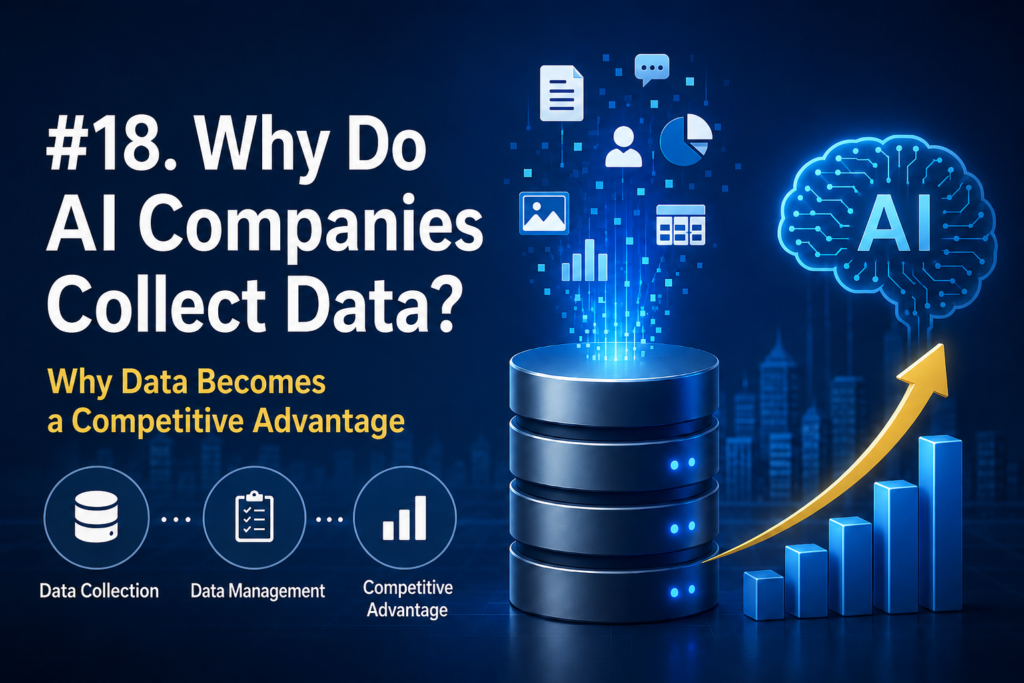
When you read news about AI companies, the word data appears frequently.
Companies secure large amounts of data to develop AI models, or they enter into agreements with other companies to use data from specific fields.
Why do AI companies pay so much attention not only to models and semiconductors, but also to securing data?
The most basic reason is that AI learns patterns through data.
But there is one more thing to consider.
Does having more data automatically mean that a company can build better AI?
Not necessarily.
No matter how much data there is, it may be difficult to actually use if the information is incorrect, necessary information is missing, or the data has been recorded according to different standards.
That is why, in the AI era, just as important as how much data a company has is what kind of data it has and whether that data is in a state that can actually be used.
Then what kind of data is considered good data that can become a competitive advantage in AI?
AI Learns Patterns Through Data
AI models learn recurring characteristics and relationships through data.
For example, language models learn how words and sentences are related to one another by training on large amounts of text.
An AI system that classifies images learns the characteristics needed to distinguish particular objects by training on many images.
An AI system that determines whether a product is defective can learn the differences that repeatedly appear between normal and defective products through data from both conditions.
In this way, when AI learns recurring characteristics and relationships through data, we can describe it as learning patterns.
Therefore, data is an important resource needed to build AI models and improve their performance.
Does that mean securing more data is always an advantage?
More Data Is Not Necessarily Better Data
Suppose a company has one million customer consultation records.
At first glance, it may appear to have a considerable amount of data.
However, when the consultation records are examined, half of them do not include the final processing result.
Some records still contain old customer information even though the customer information has changed, and some contain incorrectly recorded dates.
There may also be cases where the same customer has different identification numbers in different systems, making the records difficult to connect.
In this condition, simply having one million records does not mean that the company has good data.
Before the data can be analyzed or used with AI, the company must first check incorrect values, fill in missing information, and organize the data so that it can be connected.
Ultimately, with data, quality matters along with quantity.
Then What Is Good Data?
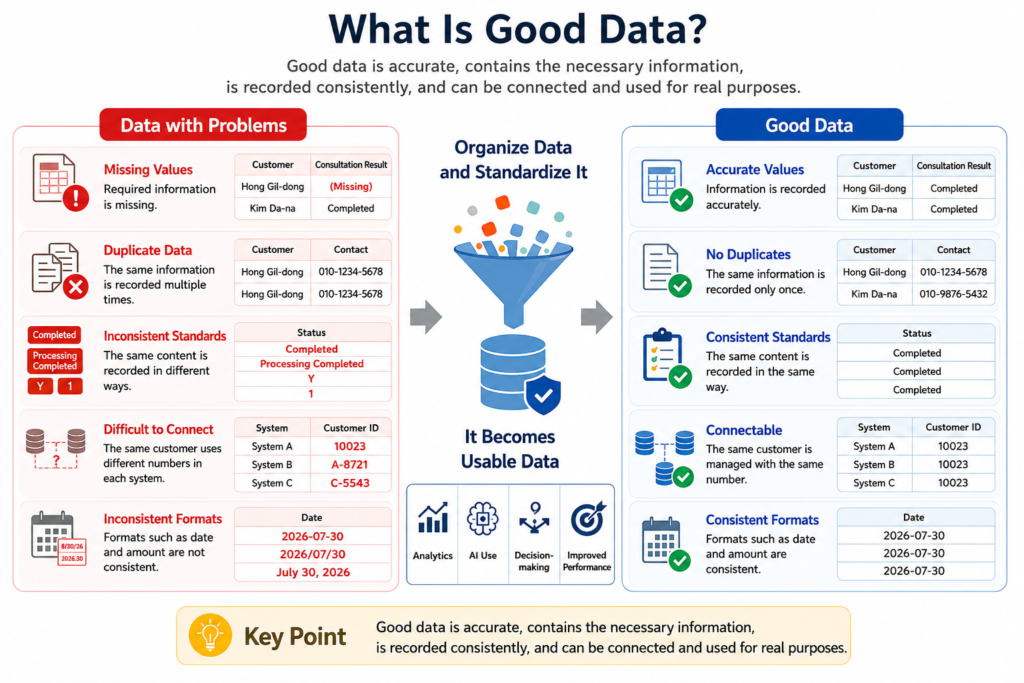
When describing good data, various criteria such as accuracy, completeness, and consistency are used.
However, these terms alone can feel somewhat abstract.
In actual work, the condition of data can be checked through questions like the following.
| Question for Checking Whether Data Is Good | Example of Problematic Data |
|---|---|
| Is the actual information accurate? | A contract that has already been terminated is still recorded as “active.” |
| Is the necessary information present? | The consultation details exist, but the final processing result has not been entered. |
| Is the same thing recorded in the same way? | The same processing status is recorded as “Completed,” “Processing Completed,” “Y,” and “1.” |
| Can you understand what the data means? | The record says “Status 3,” but only the person in charge knows what 3 means. |
| Can different data be connected? | The same customer has a different customer identification number in each system. |
| Is the same standard maintained over time? | Product classification standards differ by department or period. |
| Is the data related to the actual work that needs to be done? | There is a large amount of data, but it is unrelated to the task the AI is intended to solve. |
In other words, good data is not simply data that has been accumulated in large quantities.
Good data is accurate, contains the necessary information, is recorded according to the same standards, and can be connected and used for an actual purpose.
Companies Generate Data Every Time They Work
When people think of data, they may first imagine large amounts of information from the internet or special forms of big data.
However, companies continuously generate data through their everyday work.
When a customer makes an inquiry, the consultation details and processing results are recorded.
When a product is sold, information about which product was sold, when it was sold, and how much was sold is recorded.
In warehouses, incoming and outgoing goods and current inventory are recorded.
In manufacturing, production volume, equipment status, and whether products are defective may be recorded.
Within companies, various types of data are also continuously generated through contracts, approvals, processing times, and system incident records.
In other words, companies were already generating large amounts of data through their work before they began using AI.
What has become important in the AI era is not simply collecting new data.
How companies have recorded and managed the data generated through their work has also become important.
The Same Data Should Be Managed According to the Same Standards
Suppose a company records the result of a customer consultation after the consultation is completed.
One employee enters:
Completed
Another employee enters the same situation as:
Processing Completed
Another system may store it as:
Y
or
1
If a person looks directly at only a few records, they can probably guess that all of these have similar meanings.
But the situation changes when hundreds of thousands of records have accumulated and data from several systems needs to be analyzed together.
The company must first confirm that “Completed,” “Processing Completed,” “Y,” and “1” have the same meaning and align them under one standard.
Addresses are another example.
If “Seoul,” “Seoul City,” and “Seoul Metropolitan City” are all used to refer to the same region without any standard, the values must first be organized before the company can analyze data by region.
The same applies to dates. One system may record a date as “2026-07-30,” another as “2026/07/30,” and another as “July 30.”
Managing data with the same meaning according to the same names, formats, and standards is called Data Standardization.
Data standardization makes it easier to compare and connect data generated at different times, in different departments, and across different systems.
The Idea That Data Is a Competitive Advantage Does Not Apply Only to AI Companies
AI companies need data to build and improve models.
However, the idea that data is a competitive advantage does not apply only to companies that build AI.
Business data is also important for ordinary companies that use AI in actual work.
In the previous article, we looked at how an AI model is the technology that produces results, while an AI solution is a product or system configured to solve a specific problem using AI.
Simply bringing in an AI model does not automatically make it AI that fits a particular company.
A general AI model does not initially know what products a specific company sells, how it manages customers, what business rules it follows, or what procedures it uses internally to carry out its work.
Therefore, for a company to use AI in actual work, the AI must be able to use the necessary business data.
For example, if AI is used for customer consultation, the company may need product information, consultation guidelines, and customer support documents.
If AI is used for inventory management, data such as products, incoming and outgoing inventory, and sales volume may be necessary.
If AI supports internal business operations, work rules, documents, and data accumulated through business processes may become important.
Data Management Also Affects AI Use
But what happens if the data a company has has been recorded according to different standards for a long time?
If the same product has different names across systems,
necessary fields are frequently left empty,
the same customer is managed according to different standards,
and even the meaning of a work status differs by department,
the company must first check and organize the data before using it with AI.
On the other hand, if the data generated through business operations has been managed accurately and according to consistent standards, it becomes easier to find, connect, and use the necessary data.
That is why a company’s level of data management also affects how effectively it can use AI in actual work.
Companies Can Use the Same AI Differently
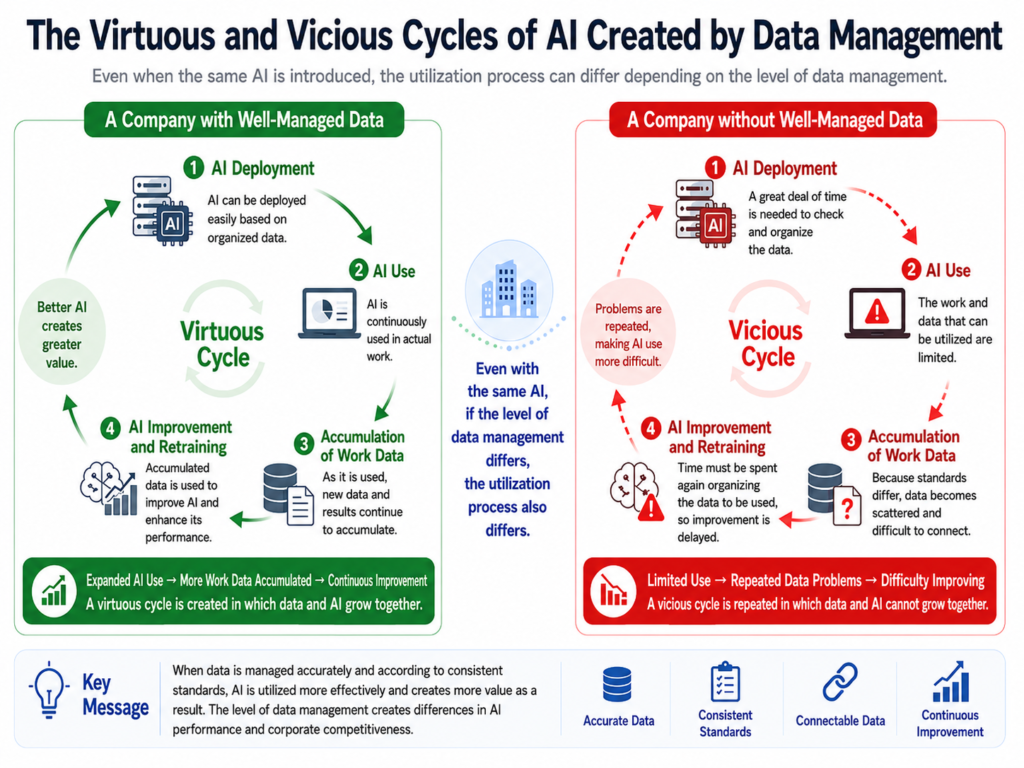
Suppose two companies use the same AI model.
The AI model used by the two companies is the same.
However, Company A has managed its customer, product, sales, and consultation data according to consistent standards for a long time.
The meaning of each type of data is clearly defined, and the company also has standards that allow different types of business data to be connected.
Company B, on the other hand, has recorded the same information differently across departments.
Much of the information is missing, and data standards also differ across systems.
Even if the two companies use the same AI model, differences can arise when they try to use their own business data with AI.
What matters here is not only which company uses a better AI model.
It also matters whether the company has managed the data it has in a state that can actually be used.
For this reason, competitiveness in the AI era cannot be explained only by AI models or computing resources.
Data is also an important competitive factor.
That Is Why Data Becomes a Competitive Advantage
For AI companies, data is an important resource needed for AI models to learn patterns and improve their performance.
However, the competitive value of data does not apply only to companies that build AI.
Data is also important for ordinary companies that use AI.
Companies have already spent years generating various types of data through customers, products, sales, production, consultations, incidents, contracts, and other business activities.
If this data is recorded accurately,
contains the necessary information,
uses the same standards for the same meanings,
and allows necessary data to be connected,
it becomes easier to use not only with AI but also with other technologies.
On the other hand, even if a large amount of data has accumulated, significant organization may be required before it can be used if its meaning is unclear, standards differ, or the data cannot be connected.
Therefore, data competitiveness is not simply a matter of who has more data.
It also depends on who has accumulated the necessary data accurately and according to consistent standards, and who manages it in a state that can actually be used when needed.
DANA NOTES in One Sentence
In the AI era, data competitiveness begins not with how much data a company has, but with how accurately and consistently it accumulates the data it needs and whether it can actually use that data.
Next Article
#19. Why Does AI Performance Keep Changing?
In this article, we looked at why data is important in AI.
In the next article, we will look at why the AI performance we experience can change depending on AI model updates, service usage conditions, user context, and the usage environment.