Notice
This article is based on U.S. government materials and Reuters reports publicly available as of August 8, 2026. Restrictions on imports of Chinese data center equipment are still under consideration, and whether the regulations will actually be introduced and the scope of their application may change. Some parts concerning the meaning of the policy and its potential impact include DANA NOTES analysis.
What This Article Covers
The United States is considering Chinese AI data center equipment as a new target for regulation.
Until now, advanced semiconductors have received the most attention in U.S. AI-related restrictions on China. This time, however, the direction is different.
Rather than restricting U.S. technology from going to China, there is now a move to restrict Chinese equipment from entering AI data centers in the United States.
The measure has not yet been finalized. However, considering that the United States defines AI as a technology important to national security, this move has significance beyond simply regulating data center components.
The U.S. Is Considering Restrictions on Imports of Chinese Data Center Equipment
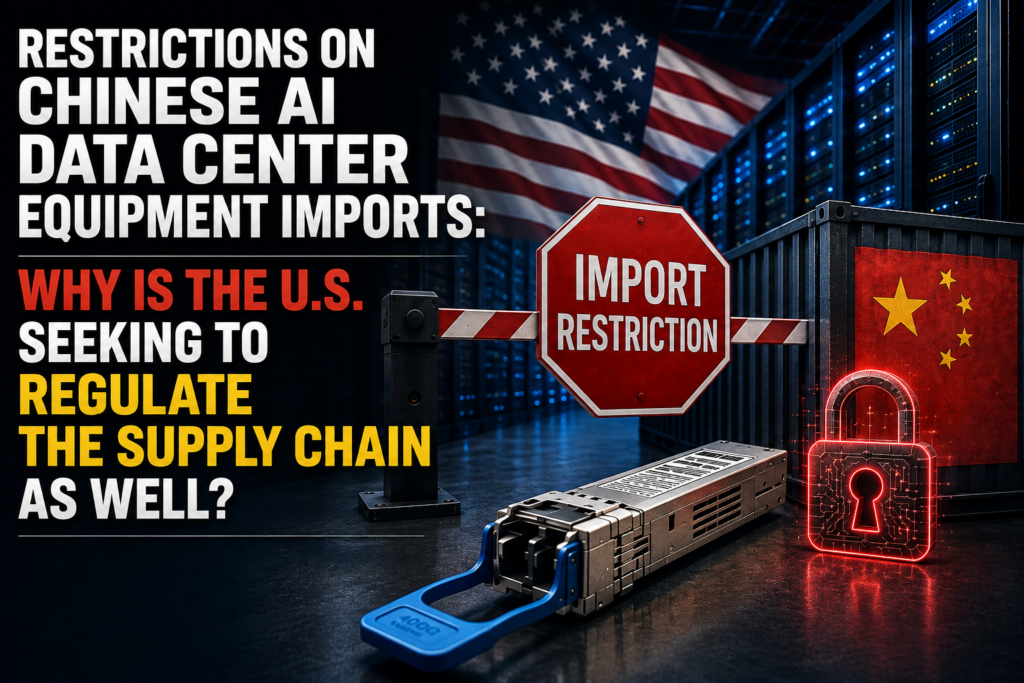
Reuters reported on August 4 that the U.S. administration was preparing measures to restrict imports of new models of Chinese data center components.
The U.S. Federal Communications Commission (FCC) is currently leading the review, and the key target being discussed is optical transceivers.
An optical transceiver is a device that converts electrical signals into optical signals and vice versa, allowing data to be transmitted quickly through optical fiber.
In AI data centers, large amounts of data must be exchanged quickly among numerous GPUs and servers, making this type of high-speed optical communications equipment important.
According to Reuters, the U.S. government is concerned about the possibility that Chinese companies could use such equipment to steal data, install malware, or disrupt data center services.
The regulation has not yet been finalized. The FCC could change the proposal or discontinue the regulatory effort itself.
Semiconductor Export Controls and This Regulation Move in Different Directions
This move needs to be distinguished from existing U.S. semiconductor export controls on China.
Since 2022, the United States has restricted China’s ability to obtain advanced computing semiconductors and semiconductor manufacturing technologies.
Through these export controls, the U.S. Department of Commerce’s Bureau of Industry and Security (BIS) has sought to limit China’s ability to acquire advanced semiconductors and AI and computing capabilities that could be used for military purposes.
The direction of the data center equipment regulation now under consideration is the opposite.
| Category | Advanced Semiconductor Export Controls | Data Center Equipment Import Restrictions Under Consideration |
|---|---|---|
| Direction | United States → China | China → United States |
| Main targets | Advanced semiconductors, semiconductor manufacturing equipment, etc. | New models of Chinese data center optical transceivers, etc. |
| Main concern | Growth of China’s advanced AI and military capabilities | Security risks inside critical U.S. AI infrastructure |
| Control logic | Restricting the transfer and acquisition of strategic technologies | Blocking risky equipment from entering the U.S. supply chain |
| Common factor | National security | National security |
While semiconductor export controls are closer to limiting the development of China’s advanced AI and military capabilities, the data center equipment regulation under consideration is closer to protecting AI infrastructure inside the United States.
The two types of regulation differ in both direction and immediate purpose.
However, they also have something in common.
In both cases, the United States views AI and related technologies as national security issues.
The U.S. Defines AI as a Technology Important to National Security
In June 2026, the White House issued National Security Presidential Memorandum 11, or NSPM-11, on AI and national security.
In the document, the United States described AI as one of the technologies that will bring the greatest changes to national security in U.S. history.
What matters is that the United States is not treating only AI models as a national security concern.
NSPM-11 called for the development of highly secure advanced computing facilities capable of operating next-generation AI systems at scale.
It also called for cooperation with private companies to strengthen the physical and cyber security of U.S. data centers.
In other words, the United States is treating not only AI models but also the computing facilities and data centers used to train and operate them as assets that need to be protected from a national security perspective.
As AI becomes more important, the infrastructure that actually powers AI is becoming more important as well.
The U.S. Does Not Want to Repeat the Huawei Experience
The U.S. experience with regulating Chinese telecommunications equipment in the past is also influencing the current review.
Huawei is a representative example.
National security concerns were raised after Huawei telecommunications equipment had already been installed in parts of U.S. communications infrastructure.
The United States later pursued what became known as “rip-and-replace,” removing that equipment and replacing it with other products.
However, removing equipment after it had already become deeply embedded in infrastructure was not easy.
It required considerable time and money, and the equipment replacement process has still not been fully completed.
According to Reuters, China hawks within the U.S. administration are seeking to avoid a similar situation in AI data centers.
Rather than removing Chinese equipment after it has become widely used in U.S. AI data centers, the aim is to block potential risks before the equipment becomes more deeply embedded in the supply chain.
This is why the regulatory review can be seen as having a preemptive character.
Chinese Equipment Is Already Part of the Data Center Supply Chain
Chinese companies already occupy an important position in the global market for data center optical communications equipment.
According to Counterpoint Research data cited by Reuters, China’s Zhongji Innolight is a major company with about a 27% share of the global data center optical transceiver market.
According to TrendForce data cited by Reuters Breakingviews, Chinese companies accounted for more than half of global optical transceiver shipments in 2025.
This means that restricting Chinese equipment does not allow the United States to immediately replace all of it with other products.
U.S. companies such as Coherent and Lumentum could serve as alternative suppliers, but whether they have enough production capacity to replace Chinese suppliers is a separate question.
For this reason, supply chain regulation is not only a security issue.
Where equipment will be sourced, whether sufficient supply can be secured, and how much costs may increase must also be considered.
The AI Infrastructure Supply Chain Is Also Becoming More Important
GPUs are the equipment that receive the most attention in AI data centers.
However, AI data centers cannot operate with GPUs alone.
Servers equipped with GPUs are needed, and large amounts of data must be transmitted quickly between servers. Large amounts of power must also be supplied reliably, and the heat generated by servers must be managed.
AI data centers therefore operate through the connection of many different types of infrastructure, including semiconductors, servers, networking and optical communications, power, and cooling.
The optical transceivers currently being considered as a direct regulatory target fall within the networking and optical communications area.
For this reason, the current move should not be interpreted as the United States beginning to regulate all Chinese data center equipment.
However, it is important that the components of the infrastructure that powers AI are beginning to be viewed from a national security perspective as well.
Changing the Supply Chain Also Creates Cost and Speed Issues
Reducing dependence on Chinese equipment could also create costs for the United States.
If imports of new models of Chinese optical transceivers are actually restricted, U.S. cloud and data center companies will need to find other suppliers.
If alternative suppliers do not have sufficient production capacity, equipment prices could rise or procurement could take longer.
In AI competition, how quickly data centers can be built and the necessary computing resources secured is also important.
The United States therefore needs to achieve two goals at the same time.
It needs to expand AI infrastructure quickly while reducing security risks in the supply chain.
Because stronger supply chain security could create pressure on costs and construction speed, the scope of the regulation the United States ultimately chooses will be important.
This Is Also an Important Change for Korean Companies
If the United States reduces the share of Chinese equipment in the AI data center supply chain, new markets could emerge for suppliers from other countries.
South Korea also has a range of industries connected to AI data centers, including semiconductors, power equipment, cooling, networking, cloud services, and data center construction and operations.
In particular, South Korea recently launched the AIDC Alliance and is pursuing a strategy of using domestic AI data centers as demonstration sites for Korean technology before connecting those technologies to overseas markets.
If the nationality and security of supply chains become more important in the AI data center market, not only technological performance and price but also which country’s supply chain a company can become part of could affect its competitiveness.
However, the proposed U.S. regulation has not yet been finalized.
It is therefore too early to conclude that Korean companies will directly benefit.
Whether actual opportunities emerge will depend on which equipment is included in the restrictions and which suppliers U.S. companies choose.
DANA NOTES Commentary
This move is difficult to view simply as an attempt to block imports of certain Chinese data center equipment.
Existing U.S. export controls on advanced semiconductors and the current review of restrictions on data center equipment imports differ in direction and immediate purpose.
However, both policies share the fact that they treat AI and the technologies surrounding it from a national security perspective.
In particular, in June 2026, the United States described AI as one of the technologies that will bring the greatest changes to national security in U.S. history.
If AI is expected to play an increasingly important role in national competitiveness and national security, then not only AI models and semiconductors but also the data centers and supply chains that actually operate them will inevitably become more important.
If the United States wants to avoid repeating a situation like the Huawei telecommunications equipment case, in which equipment from a competing country became deeply embedded in critical infrastructure and then had to be removed at enormous cost, managing the supply chain now, while AI data centers are expanding rapidly, could be more advantageous.
This move can be seen as a signal that U.S. policy is moving toward avoiding excessive dependence on the supply chains of competing countries for AI infrastructure that is expected to become strategically more important.
AI competition may no longer be only about who can build better AI models and secure more GPUs.
As AI becomes a national strategic technology, the ability to reliably secure the infrastructure and supply chains that actually power it could also become a factor determining the competitiveness of countries and companies.
What to Watch Going Forward
First, it will be important to see whether the United States actually finalizes restrictions on imports of new models of Chinese data center optical transceivers.
Second, it will be necessary to watch whether the scope of the restrictions expands from optical transceivers to other types of data center equipment.
Third, whether U.S. companies can secure sufficient supply chains to replace Chinese suppliers will be important.
Fourth, it will be necessary to see what impact supply chain changes actually have on the cost and speed of building U.S. AI data centers.
Finally, it will be worth watching whether the restructuring of the U.S. AI infrastructure supply chain creates actual business opportunities for companies in South Korea and other countries.