Notice
This article is based on Uber’s corporate materials and financial results publicly available as of August 8, 2026. It also includes DANA NOTES analysis.
What This Article Covers
Company Overview
| Category | Details |
|---|---|
| Company | Uber Technologies, Inc. |
| Stock Exchange | New York Stock Exchange (NYSE) |
| Ticker | UBER |
| Business Area | Mobility, delivery, and logistics platform |
| Main Businesses | Mobility, Delivery, Freight |
| Key Products and Services | Uber, Uber Eats, Uber Freight, Uber for Business, Uber Health, and others |
| Proprietary Technology | Multisided platform operations, supply-demand matching, mapping and location, payments, and platform infrastructure technologies |
Uber is widely known for its ride-hailing service, but the company describes itself as a technology company.
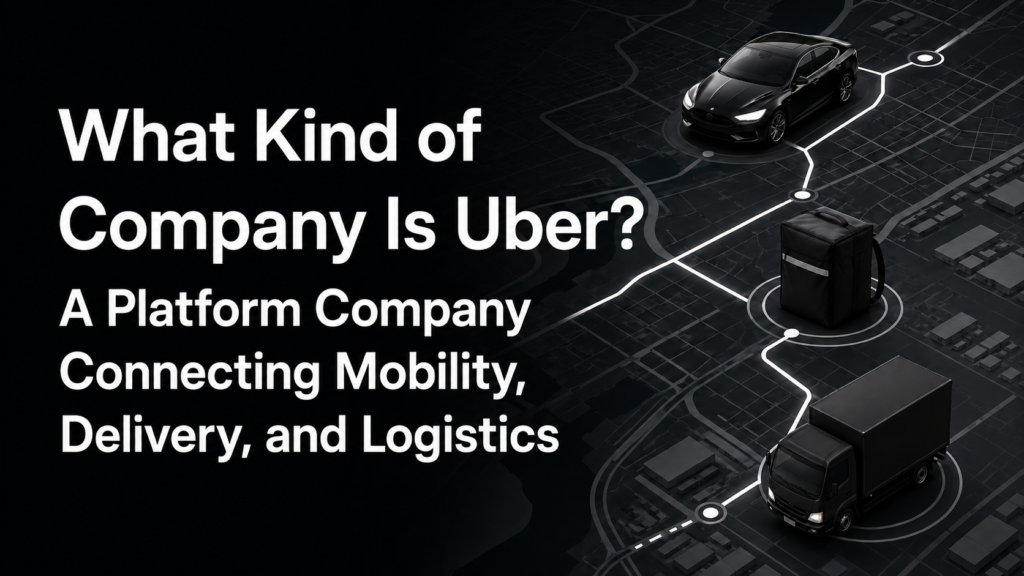
Uber’s main businesses are currently divided into three areas: Mobility, Delivery, and Freight. It has expanded its business scope from moving people to delivering food and goods and transporting freight for businesses.
Understanding these three businesses helps show why Uber is more than simply a ride-hailing company.
Uber Is More Than a Ride-Hailing Company
Uber’s core business is not manufacturing automobiles itself but operating a platform where multiple participants can move and conduct transactions.
Uber describes this structure as a multisided platform.
A multisided platform differs from a service used by only one type of user. Participants with different roles join the same platform, and the platform connects them so they can find one another and conduct transactions.
In Uber’s ride-hailing service, for example, passengers who need transportation are connected with drivers through the platform. The platform handles not only requests and matching but also various parts of the service process, including trip information, pricing, and payments.
Uber has expanded this platform structure from moving people to food and goods and then to freight transportation for businesses.
Mobility — Connecting the Movement of People
Mobility is one of Uber’s major businesses.
When a passenger requests a trip through the Uber app, the platform connects the passenger with a driver who can provide the transportation service.
In simple terms:
Passenger transportation demand → Uber platform → Driver
Depending on the region, Uber offers not only conventional ride-hailing but also various transportation services such as taxis, rental cars, and public transportation through its platform.
What Uber provides through Mobility, therefore, is not the vehicle itself so much as a platform that connects users with the transportation services they need and allows them to use those services.
Delivery — Connecting Orders and Delivery of Food and Goods
The second major business is Delivery.
Uber Eats is one of its main services.
Delivery brings together consumers who want to order food and other goods, merchants such as restaurants and grocery stores that sell those goods, and service providers who actually carry out the deliveries.
Consumers can find and order products through the platform, merchants can receive orders, and delivery service providers can deliver those products to consumers.
Rather than producing and selling most of the food or goods itself, Uber provides an environment in which the various participants involved in ordering and delivery can conduct transactions.
Freight — Connecting Freight Transportation for Businesses
Uber’s business does not end with transportation and delivery services for individual consumers.
Uber Freight targets the business freight transportation market.
It connects shippers that need to send freight with carriers that can actually transport it, while supporting logistics operations such as freight booking and transportation management.
In simple terms:
Shipper → Uber Freight → Carrier
While Mobility and Delivery are closer to individual transportation and consumer activity, Freight can be viewed as an example of Uber expanding its platform business into corporate logistics.
Why Are These Three Businesses Part of the Same Company?
Mobility, Delivery, and Freight deal with different things.
But the three businesses have one thing in common.
Uber did not invent transportation, delivery, or freight shipping themselves. All of these existed before Uber.
The problem Uber seeks to address through its platform is the inefficiency involved when demand for a service and the supply capable of providing it need to find each other and conduct a transaction.
When someone needs transportation, the platform connects that person with a driver. When goods are ordered, it connects merchants and delivery services. When a business needs to send freight, it connects the business with a carrier.
Although the objects being moved are different, the underlying business structure is the same: bringing demand and supply together on a platform and enabling transactions to take place.
This is why businesses as different as ride-hailing, food delivery, and corporate logistics can all be connected within a single company, Uber.
How Does Uber Make Money?
To understand Uber’s revenue structure, it is important to distinguish between the total value of transactions generated on the platform and the revenue that Uber actually recognizes.
The full amount paid by a passenger for a ride or by a consumer for a Delivery order does not automatically become Uber’s revenue.
According to Uber’s 2025 Form 10-K, Mobility generates revenue from drivers’ use of the platform and related services, as well as services provided to end users in certain markets.
In Delivery, major revenue sources include platform use by merchants and delivery service providers and services provided to end users. Advertising is also included as a source of revenue in the Delivery business.
Freight generates revenue through the provision of freight transportation and logistics services.
For this reason, describing Uber simply as “a company that takes a fixed percentage fee from every transaction” would oversimplify its actual business structure.
Transaction structures vary by business and market, but broadly speaking, Uber has a structure in which transportation, orders, and freight transactions take place through its platform, generating revenue in the process of facilitating those transactions and providing related services.
Uber Does Not Have Just One Type of Customer
Because Uber is a platform company, its customers cannot be categorized as easily as those of a conventional product company.
Mobility involves passengers and drivers, while Delivery involves consumers, merchants, and delivery service providers. Freight connects shippers and carriers.
Uber also provides services such as Uber for Business, which helps companies manage business transportation, and Uber Health, which helps healthcare organizations manage transportation for patients and employees.
Uber’s business, therefore, does not target only end consumers. It has a structure in which different participants—including individuals, service providers, merchants, businesses, and organizations—conduct transactions within the same platform.
DANA NOTES Commentary
If Uber is viewed simply as a ride-hailing company, it is difficult to understand why Delivery and Freight are part of the same business.
However, the relationship among the three businesses becomes clearer when Uber’s expansion is viewed as a process of broadening the areas where its platform structure is applied.
The company initially connected the movement of people and later expanded the objects connected through its platform to food and goods and then to corporate freight.
When understanding Uber, therefore, the important question is not how many vehicles the company owns, but what kinds of movement and transactions it is bringing onto its platform.
Rather than expanding its business around transportation assets themselves, Uber has broadened its business areas by connecting the various participants involved in the movement of people, goods, and freight.
Understanding this business structure is the starting point for examining which markets Uber may seek to expand into next.