Notice
This article was written based on materials publicly available from Ryanair, Google Cloud, the European Union Aviation Safety Agency (EASA), EUROCONTROL, and related sources as of August 12, 2026. DANA NOTES analysis is also included.
What This Article Covers
Ryanair Signed a Five-Year Agreement with Google Cloud
Ryanair announced a five-year data and AI partnership with Google Cloud on August 12, 2026.
Under the agreement, Ryanair plans to deploy Google Workspace and Google Cloud services to 35,000 people across its network.
This also includes Gemini Enterprise, which can connect organizational data, automate workflows, and build custom AI agents.
Ryanair said it would use Gemini Enterprise to automate some decision-making and optimize crew operations. It plans to increase both operational efficiency and infrastructure resilience to support its growth target of carrying 300 million passengers annually by 2034.
Reuters reported that Ryanair also plans to use Google DeepMind’s AlphaEvolve and WeatherNext, in addition to Gemini, for areas such as fleet operations and maintenance planning.
The adoption of generative AI by companies itself is no longer something new.
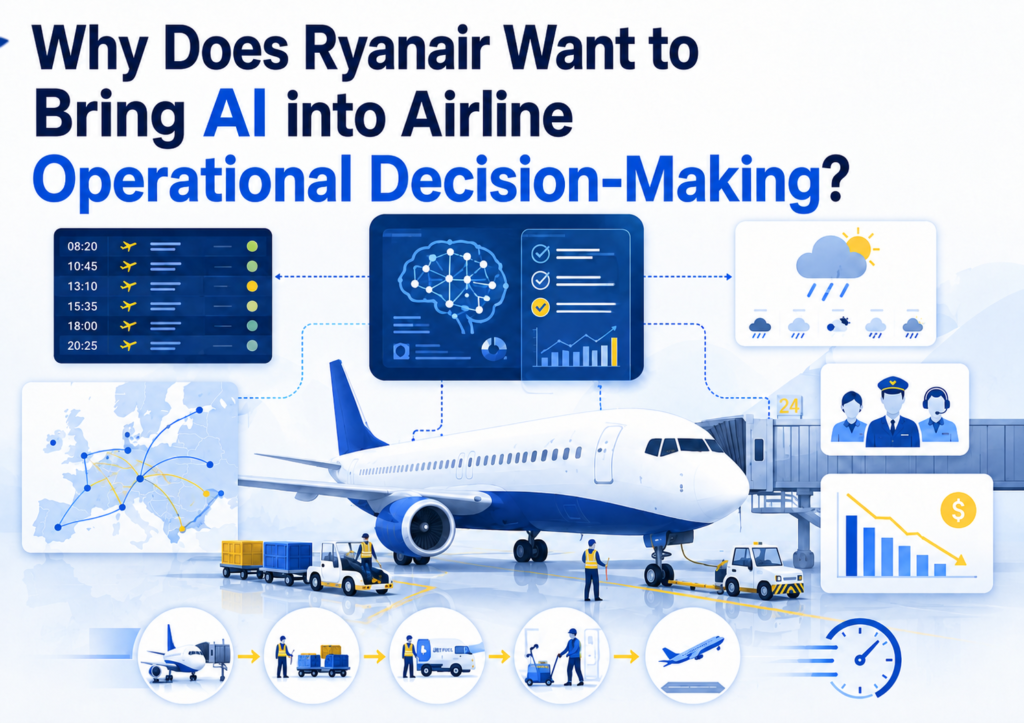
However, Ryanair’s agreement is worth examining because it is not simply about using AI for document creation or customer service. It is about connecting AI with the decisions and workflows that arise in the actual operation of an airline.
What kinds of decisions does an airline have to make that make AI necessary?
Ryanair’s Operating Strategy Is Slightly Different from That of Traditional Hub Airlines
Google Cloud’s introduction to Ryanair, released on August 12, 2026, describes the Ryanair Group as operating 95 bases, around 3,900 flights per day, more than 220 airports, and approximately 650 aircraft.
In a traditional Hub-and-Spoke model, flights from multiple regions gather at major hub airports and then connect again to other regions.
Ryanair, by contrast, mainly operates a Point-to-Point model, distributing aircraft and crews across multiple airports and directly connecting one city to another.
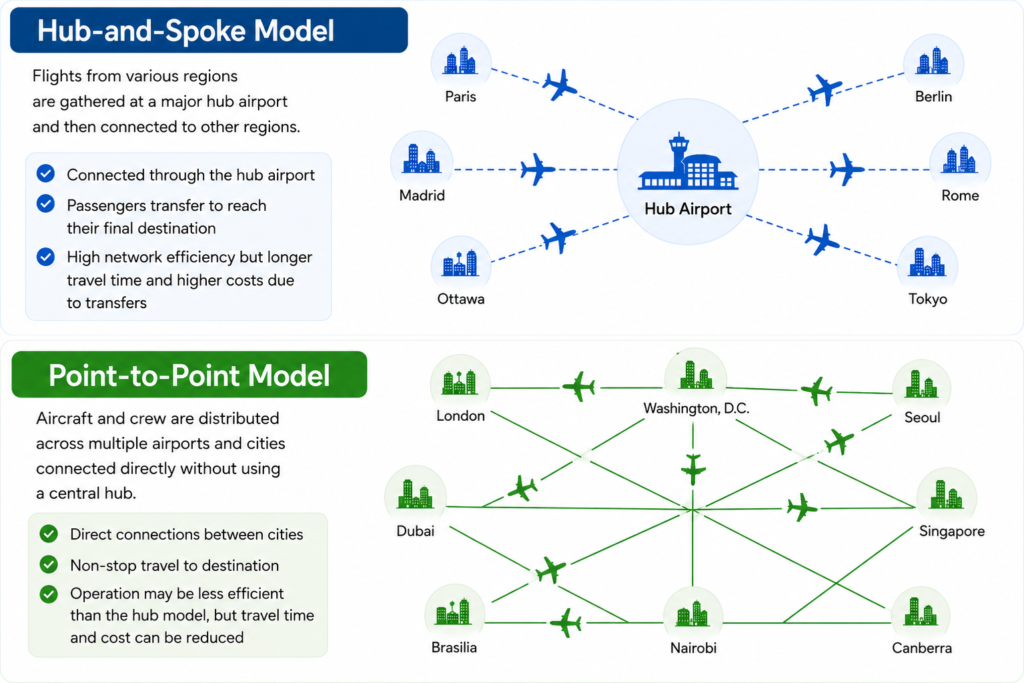
Here, a base is closer to an operating base where aircraft and crews are stationed to begin and manage operations than to a hub where passengers gather to make connections.
In this structure, if aircraft or personnel become insufficient at a particular base, it is difficult to immediately bring in resources from another region.
To deploy crew members from another base, the airline must check not only their location and travel time but also their qualifications, working hours, and rest periods. Bringing in an aircraft from another region can also affect the routes that aircraft was originally assigned to operate.
Because aircraft and personnel are distributed across multiple regions, deciding where and how to reallocate resources when a problem occurs also becomes an important operational decision.
Airline Schedules Must Satisfy Multiple Constraints at the Same Time
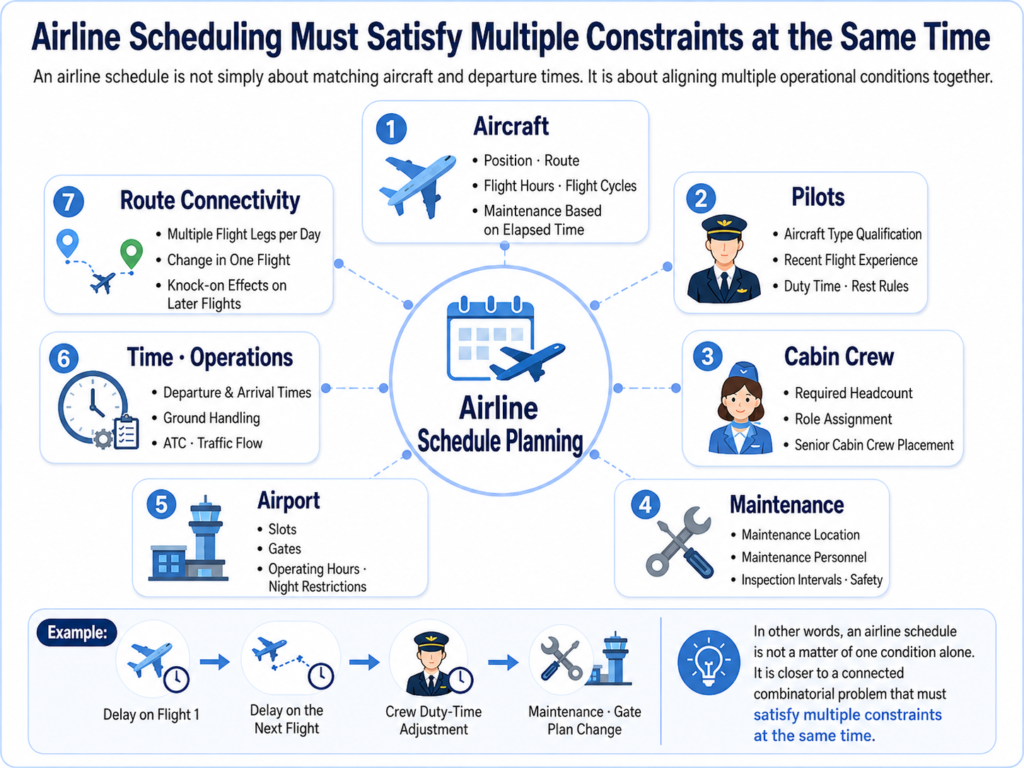
An airline schedule is not simply a matter of matching aircraft with departure times.
Aircraft, pilots, cabin crew, maintenance, airports, time, and routes all have to be considered together.
For aircraft, maintenance plans determined by factors such as flight time, number of flights, and elapsed time must be considered in addition to location and routes. EASA’s aircraft maintenance programs also manage maintenance task intervals using Flight Hours, Flight Cycles, Calendar Time, and other criteria.
Pilots must have the qualifications to operate the relevant aircraft type and sufficient recent flight experience, while also meeting requirements concerning flight duty periods and rest periods. EASA applies flight duty time limitations and rest requirements to commercial air transport.
Cabin crew must also meet the required staffing levels and roles. The minimum number of cabin crew can vary depending on aircraft certification conditions and other factors, and the assignment of a Senior Cabin Crew Member must also be considered when required.
Maintenance locations and maintenance personnel, airport slots, operating hours, night restrictions, ground handling, air traffic flows, and air traffic control conditions are added to these constraints.
And because a single aircraft operates several routes consecutively during the day, a change to one flight can affect other flights that follow it.
A Single Delay Can Disrupt the Entire Schedule
Suppose, for example, that a flight is delayed by two hours.
The aircraft’s next operation may also be delayed, while the working hours of the pilots and cabin crew increase.
If they can no longer continue working and replacement personnel are assigned, the flights those people were originally responsible for may then be affected.
If the aircraft was scheduled to undergo maintenance at night, the maintenance schedule may also change. If the aircraft ends its operations at an airport different from the one originally planned, even the first flight of the following day may be affected.
If airport operating hours, night restrictions, and air traffic flows overlap with these issues, the available options become even more limited.
A single problem can spread through aircraft, personnel, maintenance, airports, and subsequent routes in a chain.
What Decisions Does an Airline Have to Make?
In situations like these, there is not just one correct answer for the airline.
The original aircraft could be moved to the necessary base even if it arrives late, or another aircraft could be assigned instead. The operating sequences of aircraft could be swapped, or pilots and cabin crew could be moved from another base.
The airline could also operate a Positioning Flight, moving an aircraft to the required location without passengers, delay some flights further, or, in some cases, cancel a particular flight to restore the remaining operations to normal.
But every choice comes with a cost.
Moving an empty aircraft creates operating costs without passenger revenue, and bringing in another aircraft or crew requires the existing schedule to be adjusted again. If the delay of one flight continues to be carried forward, the problem may spread to subsequent flights.
So the problem that operations staff have to solve is not simply:
“How can we get this flight to depart?”
It is closer to:
“Among the options currently available, which decision will minimize the company’s overall loss?”
The problem is not that there are no available options. It is that there are too many conditions and options to consider.
How Are Existing Optimization Systems Different from AI Agents?
Ryanair has not been manually calculating all of these complex operations until now.
Ryanair already uses AWS cloud and AI technologies to optimize aircraft and flight schedules.
When Ryanair extended its agreement with AWS for another five years in July 2026, it said it was using AWS to optimize schedules for 647 aircraft and around 3,900 flights per day, while also using AI technologies such as Amazon Bedrock and Bedrock AgentCore.
Therefore, it would not be accurate to understand the new Google Cloud agreement as meaning that humans previously created schedules but AI will now create them instead.
Existing optimization systems already play a very important role in calculating possible combinations while reflecting complex constraints.
What may change with the addition of AI agents is not so much the optimization calculation itself as the decision-making flow before and after that calculation.
For example, if an existing optimization engine calculates aircraft and crew allocation plans, an AI agent could, when a situation changes, check the necessary data across multiple systems, call the appropriate tools or optimization systems, compare the results, and then connect them to the next task.
In simplified form,
Situation change detected → Necessary data checked → Optimization systems and tools executed → Available alternatives compared → Some decisions or follow-up tasks executed
It connects multiple steps in this way.
Gemini Enterprise is also introduced as a platform that can connect organizational data, automate workflows, and build custom AI agents. Ryanair’s statement that it plans to use it to automate some decision-making is connected to this.
In other words, rather than AI agents replacing existing optimization systems, they may be used to connect multiple systems and data sources and automate decision-making and follow-up work more broadly.
However, Ryanair has not yet disclosed which operational systems it will actually connect or how far AI agents will be allowed to execute tasks directly.
The Scope of AI Use Disclosed by Ryanair Is Still Limited
What can currently be confirmed directly from Ryanair’s official announcement is the automation of some decision-making, optimization of crew operations, and improvement of productivity across the company.
Reuters additionally reported fleet operations and maintenance scheduling using Google DeepMind’s AlphaEvolve and WeatherNext.
On the other hand, it has not been disclosed whether AI will directly decide which aircraft should be moved to which base, whether a particular flight should be delayed or cancelled, or how crews should be reassigned.
The direction presented in the agreement and the actual level of operational automation need to be viewed separately.
What Changes If Operational Decisions Become Faster?
Ryanair’s purpose in adopting AI is ultimately connected to improving operational efficiency.
The longer it takes to respond to operational disruptions, the more costs continue to arise, and the greater the possibility that a problem affecting one flight will spread to other flights.
What matters is that even if a schedule is optimized in advance, it is difficult to keep it in that state during actual operations.
Every time circumstances change, multiple conditions have to be recalculated, executable alternatives have to be found quickly, and a new operating plan has to be created.
If AI agents can structure and automate some of the processes in which people check multiple systems, gather data, and compare alternatives, decision-making time can be reduced.
Ryanair also emphasized efficiency in this agreement, while Google Cloud explained that applying generative AI at scale could help reduce operating costs.
Structuring and automating existing work more quickly to reduce operating costs and improve resource utilization. This ultimately connects to improving corporate profitability.
How Much Can AI Reduce Bottlenecks in Operational Decision-Making?
Airline operational decision-making becomes complex not only because there are many conditions related to aircraft, pilots, cabin crew, maintenance, airports, and routes, but also because those conditions are interconnected.
When an operational disruption occurs, multiple approaches must be considered, such as changing aircraft, reassigning crews, changing operating sequences, or delaying or cancelling some flights.
And one choice then affects other flights, personnel, and maintenance schedules.
If AI agents can connect multiple operational data sources and rules, quickly narrow down executable options, and automate repetitive decisions and follow-up tasks, they can reduce the burden of people having to check every possible case themselves.
However, actual flight operations involve many exceptional situations, and it has not yet been disclosed how much data and how many systems AI will be able to access.
How much it can actually reduce bottlenecks in operational decision-making is something that will need to be confirmed through pilot operations and actual implementation results.
Dual Cloud Is a Choice to Distribute Outage Risk
Ryanair did not stop using AWS because it signed an agreement with Google Cloud.
After extending its AWS agreement by five years in July 2026, it signed a new five-year agreement with Google Cloud in August.
Ryanair describes this as a dual-cloud strategy and says it intends to strengthen infrastructure resilience.
However, this cannot be regarded as a physical redundancy architecture in which identical systems are replicated across AWS and Google Cloud.
The specific architecture has not been disclosed, including whether the same workloads are replicated across both clouds so that operations automatically switch over when one side experiences an outage, or whether the two clouds are responsible for different workloads.
What can currently be confirmed is that Ryanair is distributing its infrastructure dependency by using two major cloud providers together.
DANA NOTES Commentary
What deserves attention in this agreement is not which AI model Ryanair chose, but how far AI can be connected to a company’s decision-making process.
Gemini Enterprise and other AI models can also be used by other airlines. Therefore, the actual difference is likely to come from how reliably Ryanair can connect its operational data and rules, existing optimization systems, AI agents, and business systems.
For a company like Ryanair that operates thousands of flights per day, what matters more than saving a few minutes on a single decision is that such decisions are repeated countless times throughout the day. Even small differences in time and inefficiencies can accumulate into cost differences at the overall scale.
Therefore, the business significance of this AI adoption can be seen as lying not in the use of a new AI model itself, but in reducing the time required for repeated operational decision-making and increasing operational efficiency by structuring and automating more processes.
However, for this to become an actual competitive advantage, Ryanair must secure not only model performance but also data quality, connections with existing systems, handling of exceptional situations, and the reliability of actual execution.
Ryanair’s AI adoption is closer to a project for determining how reliably the decision-making processes involved in complex corporate operations can be automated.
What to Watch Going Forward
The first thing to confirm is whether this five-year agreement can progress from the announcement stage through actual pilot operations and into stable operational deployment.
The areas Ryanair is trying to connect are not a single, simple task. Because it must connect operational data and existing systems involving aircraft, crews, maintenance, and other areas that affect one another, actual implementation may be difficult.
Another important issue is the reliability of external data.
An airline can plan its own schedules and resources, but actual operations are also heavily affected by variables outside the company, such as weather, airport capacity, air traffic control, and air traffic flows. EUROCONTROL’s network operations data also repeatedly identifies weather, airport capacity, and airport air traffic control capacity among the major causes of air traffic flow management delays.
Therefore, improving the accuracy of operational AI requires more than simply searching the internet in real time. It is important to connect reliable data sources such as meteorological agencies, airports, and air traffic management organizations and to establish a structure that makes it possible to verify the source of information, when it was updated, and how current it is.
Going forward, the following areas need to be examined:
- Which tasks are piloted first and expanded into actual operations
- To what extent existing operational systems and AI are connected
- How external operational data such as weather, airport, and air traffic control data are incorporated
- How the recency and sources of data are verified to secure the reliability of decisions
- Where the boundary lies between the stage at which AI proposes alternatives and the stage at which it executes them directly
- How people intervene when an incorrect decision or system failure occurs
- Whether actual indicators such as delays, cancellations, crew operations, maintenance schedules, and operating costs improve after implementation
- How the roles of AWS and Google Cloud are actually divided
More important than the five-year contract period itself is whether Ryanair can reliably connect different internal systems and external data and implement decision-making at a level that can be trusted in actual flight operations.
Whether it can reach that stage will be the most important criterion for evaluating Ryanair’s AI project.