
Notice
This article is based on publicly available information as of August 10, 2026, including official announcements from WeRide and GreenMobility, data from the Danish Meteorological Institute (DMI), the Heihe municipal government in China, relevant European Union institutions, and three research papers. Denmark’s Robotaxi service is still at a stage prior to regulatory approval and actual commercial operation, and the article also includes DANA NOTES analysis.
What This Article Covers
Reference
Brown, N. E., Motallebiaraghi, F., Rojas, J. F., Ayantayo, S., Meyer, R., Asher, Z., Ekti, A. R., Wang, C., Goberville, N., & Feinberg, B. (2023). Evaluation of autonomous vehicle sensing and compute load on a chassis dynamometer. 2023 IEEE 26th International Conference on Intelligent Transportation Systems (ITSC), 1989–1995.
Luke, J., Salazar, M., Rajagopal, R., & Pavone, M. (2021). Joint optimization of autonomous electric vehicle fleet operations and charging station siting. 2021 IEEE International Intelligent Transportation Systems Conference (ITSC), 3340–3347.
Paparella, F., Chauhan, K., Hofman, T., & Salazar, M. (2023). Electric autonomous mobility-on-demand: Joint optimization of routing and charging infrastructure siting. IFAC-PapersOnLine, 56(2), 2526–2531.
Chinese autonomous driving companies are expanding their presence in the European market.
On August 3, 2026, Chinese autonomous driving company WeRide (文远知行) and Danish electric mobility company GreenMobility announced a strategic partnership to develop Level 4 autonomous mobility services in Denmark.
Level 4 refers to a stage of autonomous driving in which the autonomous driving system handles driving within defined operating conditions and areas.
Subject to the necessary regulatory approvals, the two companies aim to launch a service available to the general public in the first half of 2027. The vehicle planned for deployment is WeRide’s latest Robotaxi, the GXR. More specifically, GreenMobility has stated that it aims to begin operating fully autonomous vehicles in Copenhagen in the first half of 2027.
The project will not be pursued by the two companies alone.
According to official announcements from GreenMobility and WeRide, the Danish Road Directorate (Vejdirektoratet), the Danish Road Traffic Authority (Færdselsstyrelsen), and relevant national and local authorities are expected to participate in the development and validation process. Testing and service deployment will proceed in accordance with Danish and EU regulations.
However, the involvement of public authorities does not mean that commercial service has already been approved.
The official announcement still describes actual service deployment as a plan subject to regulatory approval. As of August 10, 2026, WeRide and GreenMobility have not disclosed additional operating details such as the initial number of vehicles, the specific operating area within Copenhagen, or the charging method, and have said that further details will be announced in the coming months.
This raises one question.
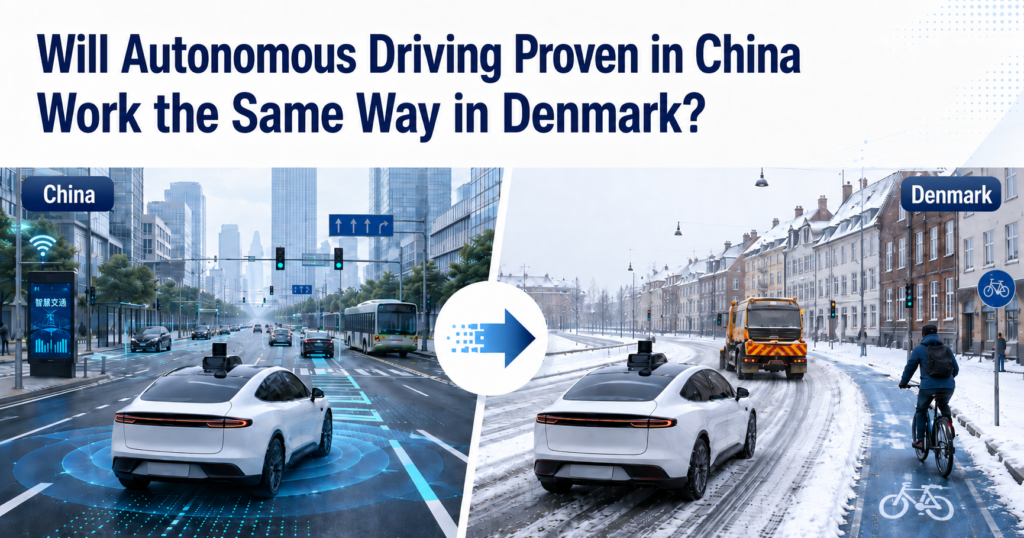
If an autonomous driving system has already been validated by carrying real passengers in China, will it work the same way in Denmark?
How Far Has Autonomous Driving Progressed in China?
China’s autonomous driving market is no longer limited to technical testing.
According to data released by China’s State Council Information Office, 69% of new passenger vehicles in China in January and February 2026 were equipped with Level 2 combined driver-assistance systems. However, Level 2 is a driver-assistance technology in which the driver remains responsible for driving, so it should be distinguished from Level 4 Robotaxis.
Level 4 Robotaxis have also moved into actual paid service in some approved areas.
In February 2025, WeRide’s GXR received approval in Beijing for a fully driverless paid ride-hailing service with no safety operator inside the vehicle. The service area also included major parts of the Beijing Economic-Technological Development Area and certain expressway sections connecting to Beijing Daxing International Airport.
In 2026, accessibility was further expanded by allowing users in China to hail WeRide Robotaxis through WeChat.
It would therefore be difficult to describe WeRide’s entry into Denmark as the first test of a technology that has not been sufficiently validated on real roads.
However, gaining commercial operating experience in China and being able to operate a stable service in the same way in Denmark are two different issues.
Will the Operating Experience Gained in China Be Enough in Denmark?
An autonomous driving system does not operate simply by recognizing cars and pedestrians.
It must also evaluate road structures and signaling systems, intersection rules, right-of-way, cyclist movements, pedestrian behavior, and the driving patterns of local motorists.
Major Chinese cities also have complex traffic environments where pedestrians, bicycles, and electric two-wheelers interact.
Therefore, the fact that Denmark has many bicycles is not itself a problem that Chinese autonomous driving systems have never encountered.
What matters is how the same cyclists and pedestrians move within different road structures and traffic rules.
WeRide also recognizes the need for this kind of local adaptation in overseas markets.
In July 2026, while conducting local validation of its L2++ intelligent driving solution in Germany, France, Japan, and other markets, WeRide explained that local adaptation and validation are necessary because countries differ in traffic regulations, road environments, driving cultures, and climate conditions.
Although this is not the same product as its Robotaxi, it illustrates why local validation is necessary when autonomous driving technology is deployed in overseas markets.
Rain in Summer, Snow and Ice in Winter… Road Conditions Change With the Seasons
WeRide is not encountering cold-weather environments for the first time.
In 2022, the company conducted winter road tests of its Robotaxis and Robobuses in Heihe (黑河), Heilongjiang Province, China.
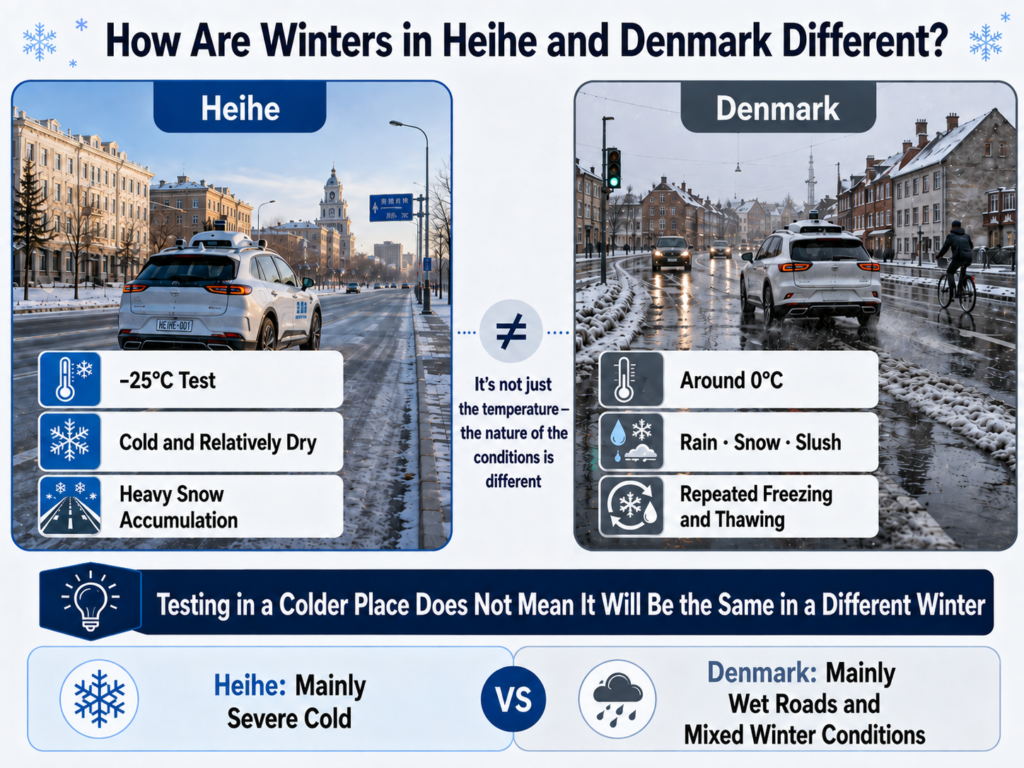
According to information disclosed by WeRide, test temperatures fell as low as -25°C, heavy snow generated substantial sensor noise, and frozen road surfaces caused strong reflections. WeRide conducted road tests of its Robotaxis and Robobuses under these conditions.
Heihe itself has extremely severe winters.
The Heihe municipal government describes the local climate as a mid-temperate continental monsoon climate. Winters are long, cold, and dry, while summers are short but warm and humid. The annual average temperature across Heihe ranges from 2.3°C to 3.2°C, and the historical record low is -45°C.
If WeRide has already tested its vehicles at -25°C in Heihe, does that mean Copenhagen’s winter should actually be an easier environment?
Not necessarily.
Heihe’s Winters Are Colder but Drier
Heihe is strongly influenced by a continental climate.
Its winters are long, temperatures fall sharply, and conditions are relatively dry. Summers, by contrast, are short, with relatively higher precipitation and humidity.
For autonomous vehicles, the ability to cope with extremely low temperatures themselves is therefore very important.
WeRide’s Heihe testing is meaningful in this respect.
Denmark’s Winters Are Milder but Hover Around 0°C
According to the Danish Meteorological Institute’s 1991–2020 climate normals, Denmark’s overall average winter temperature is 2.0°C.
The monthly averages are 2.8°C in December, 1.6°C in January, and 1.5°C in February.
Compared with Heihe, Denmark is much warmer.
However, winter temperatures fluctuating around 0°C create a different set of problems.
Snow can fall and then melt, while melted snow and water can freeze again. Snow and water can form slush, and road conditions can change from hour to hour as snow-removal work takes place.
DMI also explains that Denmark can experience mild and wet winters depending on weather patterns over the Atlantic.
Therefore, if Heihe represents an environment in which vehicles must withstand extremely low temperatures, Denmark can be viewed as an environment in which vehicles must manage repeated changes involving snow, rain, water, freezing, and thawing.
Meteorological Winter Lasts Three Months, but Low Temperatures Last Longer
Meteorological winter in Denmark runs for three months, from December through February.
However, vehicle operations do not necessarily need to be evaluated only according to the calendar definition of winter.
According to DMI’s 1991–2020 monthly climate normals, the average temperature is approximately 3.3°C in March, 7.2°C in April, 9.4°C in October, and 5.5°C in November. It is not until May that the average temperature rises above 10°C.
In other words, if a monthly average temperature below 10°C is used as one reference point, the period lasts roughly seven months, from October through April of the following year.
This does not mean that temperatures remain below 10°C every day for seven months.
These figures also represent nationwide Danish climate normals rather than data from a single monitoring station in Copenhagen.
However, they are meaningful from the perspective of an operator running Robotaxis throughout the year.
Meteorological winter may last only three months, but the period during which low temperatures, wet roads, and the possibility of icing may need to be considered in vehicle operations can be much longer.
In fact, Denmark recorded 30.9 nationwide snow-cover days during the winter of 2025–2026. Under DMI’s definition, this means days when at least half of Denmark was covered by 0.5 cm or more of snow at 8 a.m.
The 1991–2020 climate normal was 18.6 days.
Summer does not eliminate weather-related problems either.
Rain can create wet roads and spray, while water can accumulate on cameras and other sensor surfaces.
What matters in Denmark, therefore, is not whether the vehicle can pass a single extreme-weather test in one particular season, but whether it can maintain stable service throughout the year under recurring conditions involving rain, snow, freezing, and thawing.
What Does an Autonomous Vehicle Rely on When Lane Markings Are No Longer Visible?
Heavy snow can obscure some road markings.
Modern Robotaxis do not drive by relying on a single painted line detected by a camera. They combine information from cameras, LiDAR, positioning systems, and multiple other sensors.
However, the problem changes when several sources of information become unreliable at the same time.
WeRide also identified sensor noise caused by heavy snow and strong reflections from icy roads as technical challenges during its Heihe testing.
Consider, for example, a two-lane, two-way road where snow has made the centerline almost impossible to see.
A snowplow is moving slowly ahead.
Unlike an ordinary passenger car, a snowplow is not simply traveling toward a destination. Its purpose is to remove snow from the road, not simply to travel to a destination, so it may move in positions or trajectories that differ from those of ordinary vehicles.
In this situation, an autonomous vehicle cannot simply conclude:
“The vehicle ahead is slow → overtake it.”
It must evaluate the road structure hidden beneath the snow, the position of oncoming traffic, the snowplow’s movements, road-surface conditions, and the reliability of its current sensor information together.
If the available information is insufficient, it may need to abandon overtaking and instead slow down or wait.
Winter performance in autonomous driving is not only about whether the system can recognize objects in snow. It is also about how conservatively it can adjust its usual driving strategy when the available information becomes incomplete.
Rare Situations That Are Difficult to Encounter on Real Roads Are Repeated in Simulation
It is difficult to repeatedly test every dangerous situation on real roads.
In January 2026, WeRide introduced WeRide GENESIS, explaining that it can generate rare or extreme driving situations that are difficult to capture on real roads and use them for large-scale training and validation.
This technology is also important for overseas expansion.
Roads, traffic behavior, weather, and regulations differ from city to city, making it difficult to repeatedly validate every possible situation through real-world road testing alone.
However, passing a particular scenario in simulation or on a test track is not the same as continuing to operate a service in a real city when snow, ice, snowplows, sensor contamination, and passenger requests occur at the same time.
Commercial Robotaxi operations add one more condition that technical testing does not have.
The vehicle must continue carrying paying passengers.
The Same Distance Can Require Different Amounts of Energy in Winter
Road conditions affect not only autonomous driving decisions but also energy management.
In cold environments, the usable energy and driving efficiency of electric vehicles can be affected, while preconditioning the battery and vehicle to an appropriate temperature before operation also requires energy.
Robotaxis also have additional power loads beyond those of ordinary electric vehicles.
These include autonomous driving sensors and high-performance computing equipment.
Researchers at Oak Ridge National Laboratory installed autonomous driving sensors and computing equipment on a 2015 Kia Soul EV and compared three operating conditions on a chassis dynamometer.
- Sensors and computing equipment not in use
- Sensors only
- Sensors and computing equipment operating together
Under the combined UDDS-HWFET driving cycle, estimated driving range compared with the baseline vehicle fell by 5.6% with sensors alone and by 12.2% with both sensors and computing equipment operating.
These figures should not be directly applied to the current WeRide GXR.
A 2015 Kia Soul and a current Robotaxi differ in battery technology, sensors, and computing equipment.
However, the structure demonstrated by the study is important.
The autonomous driving system itself consumes electricity.
Robotaxi power consumption therefore cannot be calculated simply according to how many kilometers the vehicle travels.
Energy is required not only to move the vehicle but also to operate the autonomous driving system, thermal management, and other equipment.
A Robotaxi May Be Unable to Accept a New Passenger Even When Battery Power Remains
A Robotaxi cannot simply use almost all of its battery and then stop operating in the middle of the road.
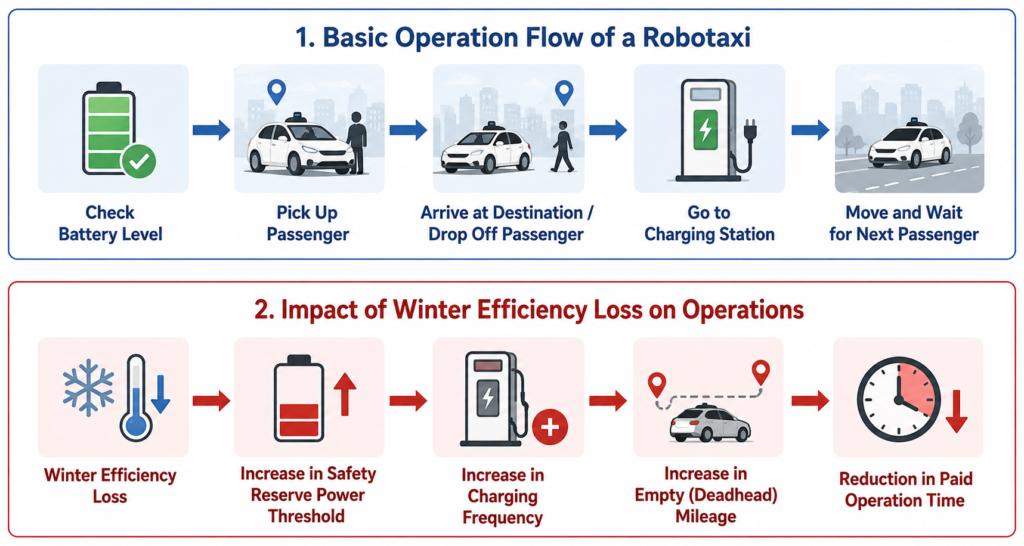
Therefore, when assigning a new passenger, the system needs to consider not only the current battery level but also the energy required afterward.
Conceptually, the calculation can be viewed as follows:
Current battery level
→ Travel to the passenger
→ Travel to the passenger’s destination
→ Travel to an available charging location afterward
→ Safety reserve for unexpected situations
WeRide has not disclosed the actual battery level at which it stops assigning new rides.
However, one important point follows from this structure.
The location of the charging station can also change how far the vehicle can be dispatched.
A vehicle that needs to travel 2 km to a charging location after dropping off a passenger and a vehicle that needs to travel 15 km do not necessarily have the same ability to accept another passenger, even if they have the same battery level.
GreenMobility Already Has Access to a Charging Network
GreenMobility’s role in the Danish project becomes important at this point.
GreenMobility currently operates a total of 1,500 shared electric vehicles in Copenhagen and Aarhus.
Its Copenhagen vehicles are not dependent on only a few dedicated GreenMobility charging stations.
According to GreenMobility’s official guidance, vehicles in Copenhagen can use E.ON and Spirii charging stations, and some vehicles can also use fast and ultra-fast chargers.
This means that WeRide’s entry into Copenhagen is unlikely to require building an entirely new EV charging infrastructure from scratch.
Its local partner already has experience operating a large number of electric vehicles using public charging networks.
However, an important distinction needs to be made.
There has been no announcement that the charging network currently available to GreenMobility vehicles will be the same network actually used by GXR Robotaxis.
The GXR’s charging specifications and operating locations, as well as whether it will use the E.ON and Spirii networks as they are currently used, have not yet been disclosed.
There Are Chargers, but Who Will Plug In a Driverless Robotaxi?
Charging GreenMobility’s current electric vehicles is not automated.
GreenMobility’s official instructions explain that users take the charging cable from the vehicle, physically connect it to the vehicle and charger themselves, and disconnect the cable again when charging is complete. Users may also receive a bonus for connecting low-battery vehicles to a charger.
With the current shared electric vehicles, a person performs this task.
But a Level 4 Robotaxi has no driver.
Even if the vehicle can drive itself to a charging station, if it uses the same type of cable-based charging infrastructure, the physical task of connecting the charging cable to the vehicle still needs to be handled separately.
As of August 10, 2026, WeRide and GreenMobility have not disclosed whether Denmark’s GXR vehicles will be charged by:
- on-site personnel,
- a limited number of dedicated charging hubs,
- the existing public charging network, or
- an automated charging system.
This may not be a minor operational issue.
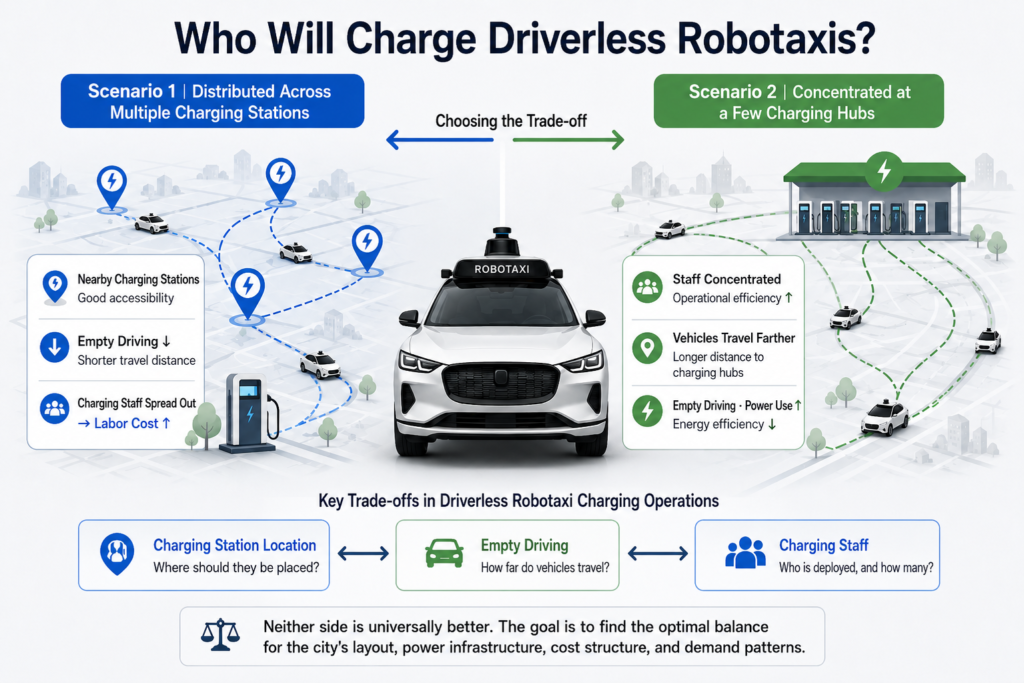
Should People Be Placed at Many Charging Stations, or Should Vehicles Be Brought to a Few Hubs?
If charging cables need to be connected manually, the operator faces a trade-off.
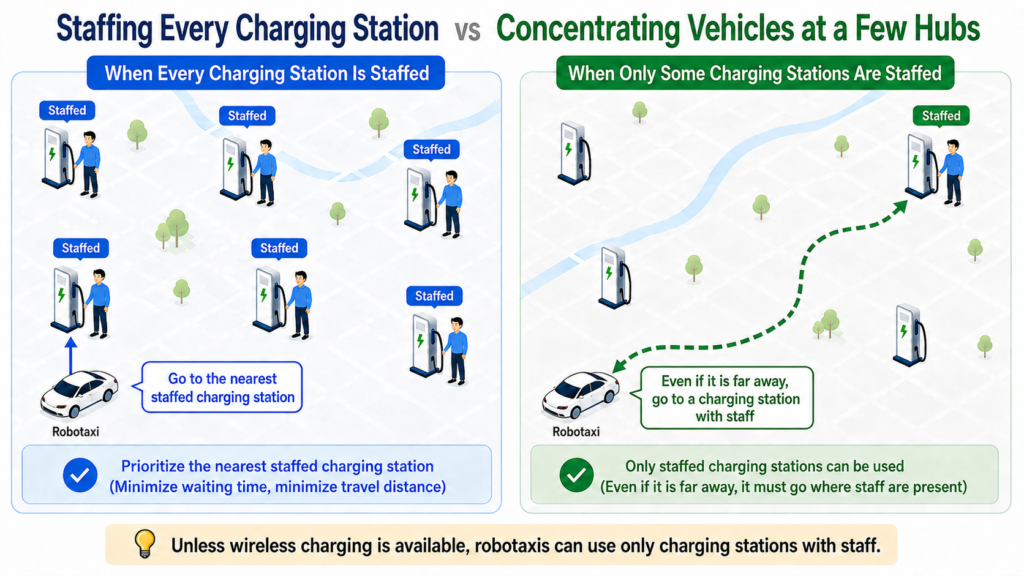
If Many Charging Stations Are Used
Vehicles can travel to nearby chargers.
This can reduce the distance and time they travel without passengers simply to recharge.
However, if cables need to be connected by people at multiple locations, the question becomes how charging personnel should be deployed.
Keeping people available at all necessary locations could increase labor costs.
If Vehicles Are Concentrated at a Few Charging Hubs
A small number of employees could manage multiple vehicles at a single location, making labor operations easier to manage.
However, the Robotaxis would then need to travel to those charging hubs.
If the charging hub is far from where the passenger was dropped off, the process becomes:
Passenger drop-off
→ Empty travel to charging hub
→ Charging queue
→ Charging
→ Travel back to an area with passenger demand
This type of travel without a passenger can be described as empty vehicle travel.
Empty vehicle travel creates two types of cost for a Robotaxi business.
First, there is no fare revenue while the vehicle is traveling without a passenger.
Second, an electric vehicle still consumes battery power while traveling to recharge.
In other words, energy is consumed simply to reach the place where the vehicle will obtain more energy.
For Charging Stations, Location Matters More Than Quantity
The relationship between charging-station location and empty vehicle travel is already an important research topic in electric autonomous mobility-on-demand services.
Paparella et al. (2023) used real taxi-demand data from Manhattan, New York, to jointly optimize the routes of electric autonomous mobility-on-demand vehicles and the placement of charging infrastructure.
The researchers found that a balance is required between the distribution of charging stations and empty vehicle travel.
If there are too few charging stations, vehicles must travel farther to recharge.
However, continuously adding more charging stations does not lead to the same level of improvement indefinitely.
In the Manhattan case study, jointly optimizing charging-station locations with vehicle operations reduced the energy consumed by vehicles traveling without passengers by up to approximately 30% compared with a simple placement method, while the benefits of adding more stations became much smaller beyond a certain point.
Luke et al. (2021) examined San Francisco and compared a scenario that scaled up the existing distribution of charging stations with one that optimized station locations specifically for autonomous vehicle operations.
When charging-station locations were jointly optimized with vehicle operating patterns, the results included:
- 11.20% reduction in empty vehicle travel distance
- 31.11% reduction in charging-station procurement cost
- 9.59% reduction in total cost
- 4.37% reduction in charging energy consumption
- 10.07% reduction in peak charging load
The optimized charging infrastructure was also more spatially distributed across the city than the existing charging-station layout.
This was because the stations were positioned in a way that reduced unnecessary travel by vehicles trying to reach available charging locations.
Of course, the results from Manhattan and San Francisco cannot be directly applied to Copenhagen.
The road networks, passenger demand, vehicle scale, and charging environments are all different.
However, the common conclusion of the two studies is clear.
What Robotaxis need is not simply a large number of chargers, but charging infrastructure that matches actual passenger demand and vehicle travel patterns.
From this perspective, GreenMobility’s existing access to E.ON and Spirii charging networks is an advantage for WeRide.
However, charging locations that are convenient for today’s human-operated shared electric vehicles are not necessarily the most efficient locations for driverless Robotaxis.
Which parts of the existing charging network will actually be used for Robotaxis, and whether separate dedicated charging hubs will be established, remain to be seen.
There Are Additional Costs to Consider
Optimizing charging-station locations and empty vehicle travel alone does not determine all of the actual operating costs of a Robotaxi service.
Luke et al. (2021) considered vehicle procurement costs, charging-station procurement costs, electricity costs, and vehicle travel costs when jointly optimizing autonomous electric vehicles and charging infrastructure. However, the researchers explicitly stated that land-use costs, labor costs, and permitting costs associated with charging stations were not included in the model because they vary significantly by location.
This makes labor costs a potentially important additional operating variable in the Copenhagen Robotaxi project.
Current GreenMobility users connect the charging cables themselves, meaning that users perform part of the charging process. But with a driverless Robotaxi, this task would need to be handled in another way.
If people handle the charging directly, a trade-off emerges.
Allowing Robotaxis to charge at many locations and deploying personnel where needed could enable vehicles to use nearby chargers and reduce empty vehicle travel. However, distributing charging personnel across multiple locations could increase labor costs.
Conversely, concentrating charging personnel at a small number of dedicated hubs could make workforce operations more efficient. But vehicles would then need to travel to the designated charging hubs after dropping off passengers, which could increase empty vehicle travel, travel time, and energy consumption.
In actual Robotaxi operations, another variable is therefore added to the relationship examined in previous research:
Charging-station location ↔ Empty vehicle travel
becomes
Charging-station location ↔ Empty vehicle travel ↔ Charging personnel
Whichever approach is chosen, the cost does not disappear. Placing people closer to the vehicles could increase labor costs, while moving vehicles closer to the people could increase empty vehicle travel and energy consumption.
As of August 10, 2026, WeRide and GreenMobility have not disclosed how charging for Copenhagen Robotaxis will be operated.
Therefore, once actual service begins, not only the number of available chargers, but also who performs the charging work and where the vehicles and charging personnel are positioned could become important factors in determining Robotaxi operating costs and vehicle utilization.
Longer Trips to Chargers Can Also Reduce the Battery Available for Dispatch
The location of charging hubs affects more than empty vehicle travel.
It can also affect the ability to assign new passengers, as discussed earlier.
Conceptually, a Robotaxi’s energy calculation becomes:
Current battery level
→ Travel to the next passenger
→ Travel to the passenger’s destination
→ Travel to the designated charging hub
→ Safety reserve
The farther away the charging hub is, the more energy the vehicle needs to reserve for that final leg.
In other words, even when the physical battery level is the same, the amount of energy effectively available for serving a new passenger can decrease.
This issue could become more significant in winter.
Cold temperatures can alter vehicle energy efficiency, while additional energy may be required to manage the battery and vehicle systems, even as the vehicle still needs to travel empty to a charging hub.
This can create the following chain:
Lower energy efficiency
→ More frequent charging
→ More empty travel to charging hubs
→ Energy consumed even during empty travel
→ New ride assignments stopped earlier
→ Less revenue-generating service time
Vehicle Utilization Matters More Than Maximum Driving Range
This is where the technical issue becomes a business issue for Robotaxi operators.
A Robotaxi does not generate revenue simply by traveling long distances.
It needs to spend enough time carrying paying passengers.
There are no passengers while the vehicle is traveling to recharge.
It cannot accept passengers while charging.
There is also no fare revenue while sensors are being inspected or the vehicle is undergoing maintenance.
If operations are suspended because of severe weather, that time also produces no revenue.
Therefore, Robotaxi businesses need to consider not only maximum driving range but also:
- How many hours per day each vehicle actually carries passengers
- How much paid-service time is available per charging cycle
- How much time is spent traveling empty to recharge
- Actual charging time
- Time lost to maintenance, cleaning, and inspections
- The proportion of all vehicles that can actually be deployed into service
Being technically capable of autonomous driving and maintaining sufficiently high vehicle utilization to make money are two different things.
Why the Partnership With GreenMobility Matters
WeRide’s decision to partner with GreenMobility in Denmark can also be understood within this operating structure.
GreenMobility already operates 1,500 shared electric vehicles in Copenhagen and Aarhus.
It has local operating experience in deciding where vehicles should be placed, when they should be charged, which vehicles need maintenance, and how vehicles should be supplied to areas where users need them.
WeRide also describes the partnership as combining its Level 4 autonomous driving technology with GreenMobility’s local vehicle operations and shared mobility experience.
A Robotaxi service requires more than an autonomous driving system.
Autonomous driving system
→ Vehicle
→ Vehicle operations and maintenance
→ Waiting
→ Charging
→ Ride-hailing and dispatch
→ Payment
→ Customer service
All of these elements need to work together to create an actual service.
It is therefore not sufficient to view the overseas expansion of Chinese autonomous driving companies simply as the export of autonomous driving software.
What matters is whether autonomous driving technology can be integrated with a local operating system and turned into an actual business.
Where Will the Danish Road Data Seen by Autonomous Vehicles Go?
Overseas Robotaxi operations also require attention to how data is processed.
Robotaxi cameras and other sensors continuously perceive the environment around the vehicle.
However, perceiving data through sensors, storing that data, and transmitting it to an external server are different issues.
As of August 10, 2026, publicly available information does not establish what raw sensor data the GXR vehicles operating in Denmark will store, how long the data will be retained, where it will be processed, or whether systems or personnel in China will be able to access it.
Therefore, there is currently no basis for concluding that Danish road footage will be transmitted to China.
However, the European Data Protection Board (EDPB) has separate guidelines addressing the processing of personal data in connected vehicles and mobility applications.
As of August 2026, China is also not included among the countries covered by the European Commission’s adequacy decisions for personal data protection.
Therefore, if personal data is actually transferred to China, the free-transfer framework provided by an adequacy decision would not apply, and other international-transfer mechanisms or requirements under the GDPR would need to be satisfied. Standard Contractual Clauses (SCCs) are one such mechanism.
As the Danish service becomes more concrete, the location and method of sensor-data storage and processing, retention periods, and whether data is transferred outside the EU will also need to be examined.
DANA NOTES Commentary
The most interesting aspect of WeRide’s entry into Denmark is not autonomous driving technology itself, but the process of turning that technology into an actual service.
Even technology that has accumulated commercial operating experience in China and been tested under extreme weather conditions faces different roads, regulations, charging systems, and vehicle operating methods when transferred to another country.
Copenhagen does not lack charging infrastructure. GreenMobility already operates a large number of electric vehicles and uses existing charging networks.
The question is how vehicles with no drivers will be charged.
Placing people at multiple charging locations could create labor costs, while concentrating vehicles at a small number of dedicated charging hubs could increase the distance and time spent traveling without passengers.
Previous studies have already shown that charging-station location affects empty vehicle travel and operating costs, but the model used by Luke et al. (2021) did not include land-use, labor, or permitting costs.
When WeRide and GreenMobility begin actual operations, the issue studied in previous research,
Charging-station location ↔ Empty vehicle travel
will therefore gain another variable:
Charging personnel and actual operating costs
Ultimately, the question is not only whether the GXR can drive autonomously in Copenhagen.
Whether it can maintain sufficient vehicle utilization after accounting for empty travel, charging time, and charging personnel may determine the actual viability of the business.
What has been validated in China is the autonomous driving technology.
What needs to be validated in Denmark is whether that technology can still work as a business when integrated with a local operating system.
What to Watch Going Forward
- Regulatory approval: Whether the first-half 2027 Copenhagen service target leads to actual approval for commercial operation
- Operating area: Which parts of Copenhagen and which roads the service will initially cover
- Initial vehicle count: How many GXR vehicles will be deployed
- Role of government agencies: What roles the Danish Road Directorate, Danish Road Traffic Authority, and local authorities will actually play in validation and operations
- Local vehicle specifications: How the battery, sensor, and computing configuration of the GXR vehicles deployed in Denmark will be determined
- Weather-related operating limits: How operating restrictions or suspension criteria will be set for rain, heavy snow, icing, and other conditions
- Sensor management: How sensors will be managed during actual service when exposed to snow, water, and road contaminants
- Actual power consumption: How much electricity each vehicle consumes under real Danish operating conditions
- Charging network: Whether the GXR will actually use the existing E.ON and Spirii charging networks
- Charging method: Whether charging cables will be connected manually, dedicated charging hubs will be used, or automated charging will be introduced
- Charging personnel: Where and how charging staff will be deployed if manual charging is used
- Charging-hub locations: Whether charging will be concentrated at a small number of hubs or distributed across multiple locations
- Empty vehicle travel: How much travel without passengers will be generated by charging operations
- Dispatch criteria: How distance to charging stations and required safety reserves will be reflected in new passenger assignments
- Vehicle utilization: How many hours per day each vehicle actually spends carrying passengers
- Operating costs: The per-vehicle cost including charging, labor, maintenance, cleaning, empty travel, and waiting time
- Data processing: Where sensor data will be stored, how it will be processed, and how long it will be retained
- International data transfers: Whether personal data will be transferred outside the EU and which GDPR transfer mechanism will be applied
- Business viability: Whether the Copenhagen Robotaxi service can build a sustainable revenue structure based on actual fares, vehicle utilization, charging costs, and operating expenses