A digital service requires multiple types of infrastructure to operate.
When you search for a product in an online shopping mall, a server processes the request, retrieves product information and images, and delivers them to the user. Even in this short process, equipment that processes data, networks that transmit data, and storage space that keeps information are all used together.
These components are deployed in places where the service can operate, receive power and cooling, and are continuously managed.
Because digital infrastructure includes a wide range of technologies and facilities, it can be divided in different ways depending on the criteria used to view it.
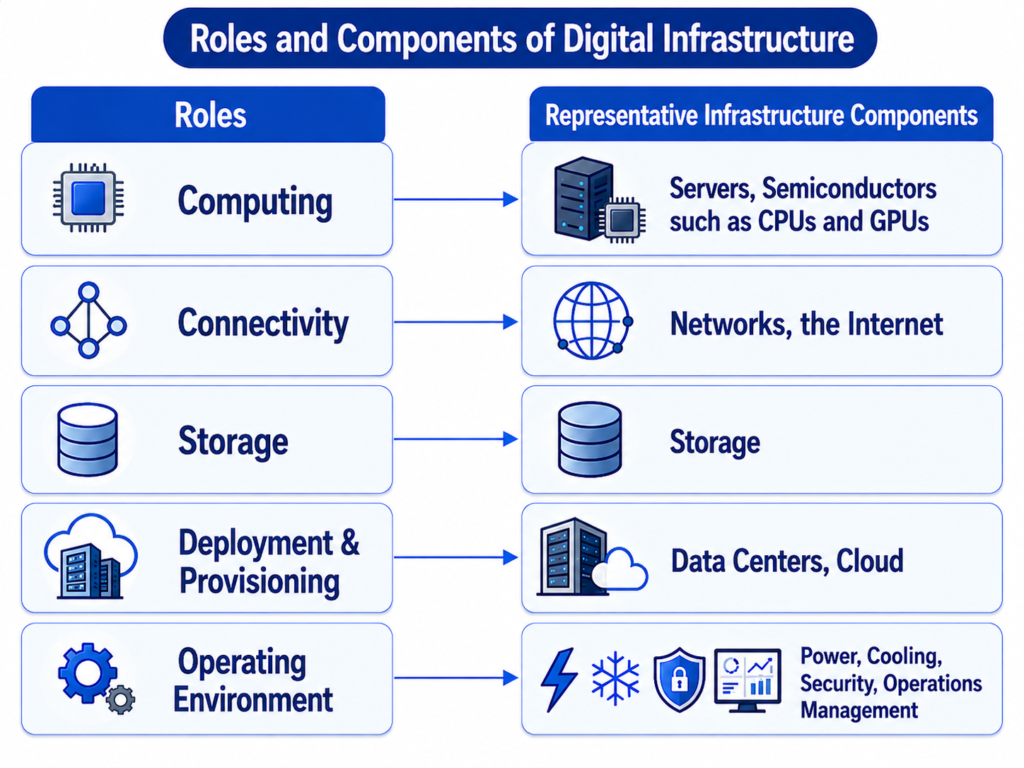
In this article, to make the overall structure easier to understand, we will look at it by dividing it into five areas based on the roles each infrastructure component performs: computing, connectivity, storage, deployment & provisioning, and operating environment. This is a classification organized by DANA NOTES to help explain the roles of infrastructure.
1. Computing — Turning Data into Actual Results
Computing is the role of processing user requests and data to produce the required results.
Computation is used in finding products that match a search term, calculating an order total, transforming a photo, and generating a response from an AI model.
In this process, a server runs programs and systems and processes requests. Semiconductors such as CPUs and GPUs inside the server perform the actual computations.
The computing capacity required also differs from service to service.
A service that provides a simple webpage, a service that processes many users’ requests at the same time, and a service that runs a large-scale AI model differ in the number of servers and the performance of the semiconductors they require.
The scale of the computing infrastructure required is determined by the type and amount of work the service processes.
2. Connectivity — Moving Data Where It Needs to Go
Data in a digital service continuously moves between different devices and systems.
A request sent from a smartphone is delivered to a server, and the server exchanges data with other servers or storage systems. The processed result is then delivered back to the user’s device.
The representative infrastructure responsible for this movement is the network.
The internet connects different regions and networks and links users and services. Inside a data center as well, multiple servers and storage devices exchange data through networks.
Therefore, connectivity infrastructure plays both the role of linking users and services and the role of moving data within the infrastructure itself.
3. Storage — Keeping the Data the Service Will Use
Digital services keep a large amount of data and use it again when needed.
Examples include member information, product information, photos, videos, documents, and order records.
The representative infrastructure responsible for this role is storage.
When a user uploads a photo, the photo file is stored, and when the user opens the photo again later, the stored data is retrieved. In an online shopping mall, product information and order history are stored and used again in future use.
Computing infrastructure processes incoming requests, while storage infrastructure maintains the data that the service will continue to use.
As the amount of data in a service increases, the required storage space also grows, and how quickly data can be read and written becomes important as well.
4. Deployment & Provisioning — Making Infrastructure Available for Actual Use
Servers, storage, and network equipment are deployed in an environment where the service can actually operate.
A data center provides the physical space and facilities where this equipment is installed and operated.
In a data center, servers, storage devices, and network equipment are deployed, and the power and cooling facilities needed to keep the equipment operating are also put in place.
There are also various ways for companies to use these computing resources.
A company can build its own servers and equipment, or it can use the space and facilities provided by a specialized data center. By using the cloud, it can use computing resources such as servers, storage space, and networks in the form of services.
A data center provides the physical foundation where computing equipment is actually installed and operated. The cloud provides these computing resources in forms and at scales that companies or developers need.
This distinction helps us understand both where computing resources are deployed and how companies use those resources.
5. Operating Environment — Creating the Conditions That Allow Infrastructure to Keep Running
Power is supplied to servers and network equipment. The heat generated by the equipment is managed through cooling facilities.
The status of services and equipment is checked through monitoring, and when a failure occurs, the cause is identified and the system is restored to a normal state. Security protects systems, networks, data, and services from abnormal access and attacks.
The operating environment typically includes the following elements:
- Power
- Cooling
- Security
- Monitoring
- Failure response and operations management
These elements maintain the conditions that allow the equipment and systems used for computing, connectivity, and storage to operate reliably.
As the scale of a service grows, the amount of required equipment, power usage, and generated heat also increase. The number of systems that must be managed and the scope of failure response also expand.
That is why, when building infrastructure, not only the performance of servers and semiconductors but also power supply, cooling capacity, security, and operations management are considered together.
Actual Infrastructure Contains Multiple Roles at Once
The five roles are a framework for understanding the overall structure of digital infrastructure. Actual equipment and facilities are used across multiple roles.
In a data center, servers and semiconductors responsible for computing, networks that move data, and storage that keeps data are all deployed together. Power and cooling, as well as security and monitoring systems for operating them, are also in place.
In the cloud, multiple types of computing resources such as computing capacity, storage space, and networks are provided in the form of services.
Therefore, even when looking at the same object, we can distinguish what kind of equipment it is, what role it performs, where it is deployed, and in what way it is provided.
If you know this framework, then when we look one by one at servers, semiconductors, networks, storage, data centers, and the cloud, you will be able to more easily understand the position and role each infrastructure component takes in digital services.
DANA NOTES in One Line
Digital infrastructure is a structure in which various technologies and facilities divide up and perform the roles of computing, connectivity, storage, deployment & provisioning, and operating environment, and work together.