Introducing Infrastructure Literacy 30: Why We Need to Understand Infrastructure in the AI Era
When reading news about AI, you often encounter terms such as models, training, inference, generative AI, multimodal AI, and AI agents.
However, when you look a little deeper, new terms begin to appear.
There are stories about GPU shortages, news that companies are building AI data centers, analyses stating that power and cooling have become key competitive factors in the AI industry, and announcements that cloud companies are investing enormous amounts of money in AI infrastructure.
You may begin by trying to understand AI technology, only to find that you also need to understand semiconductors, servers, networks, data centers, and even power.
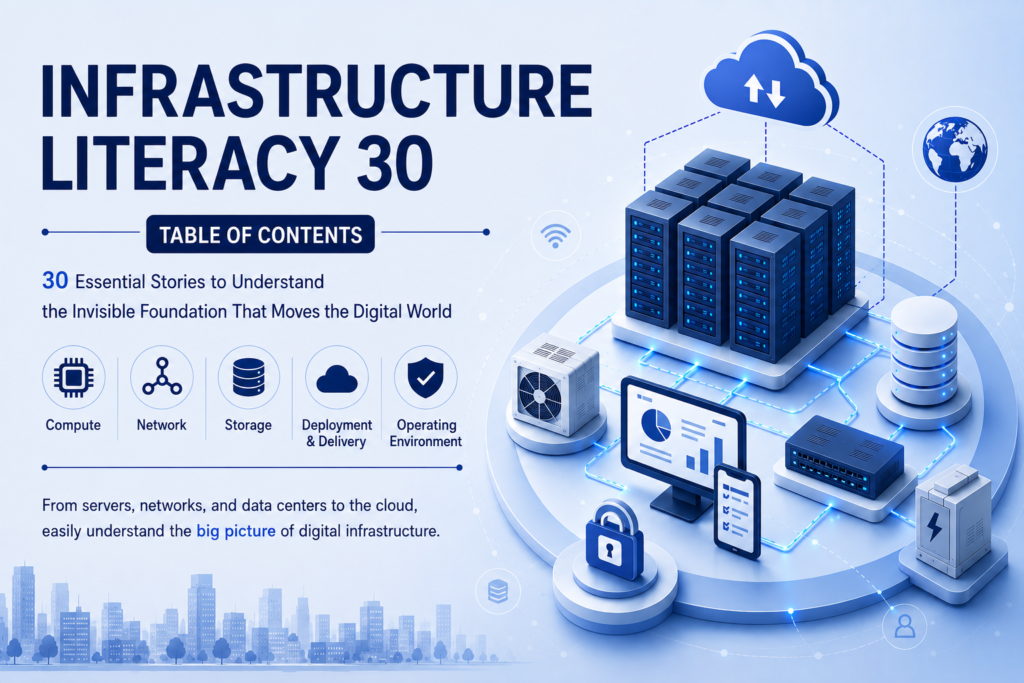
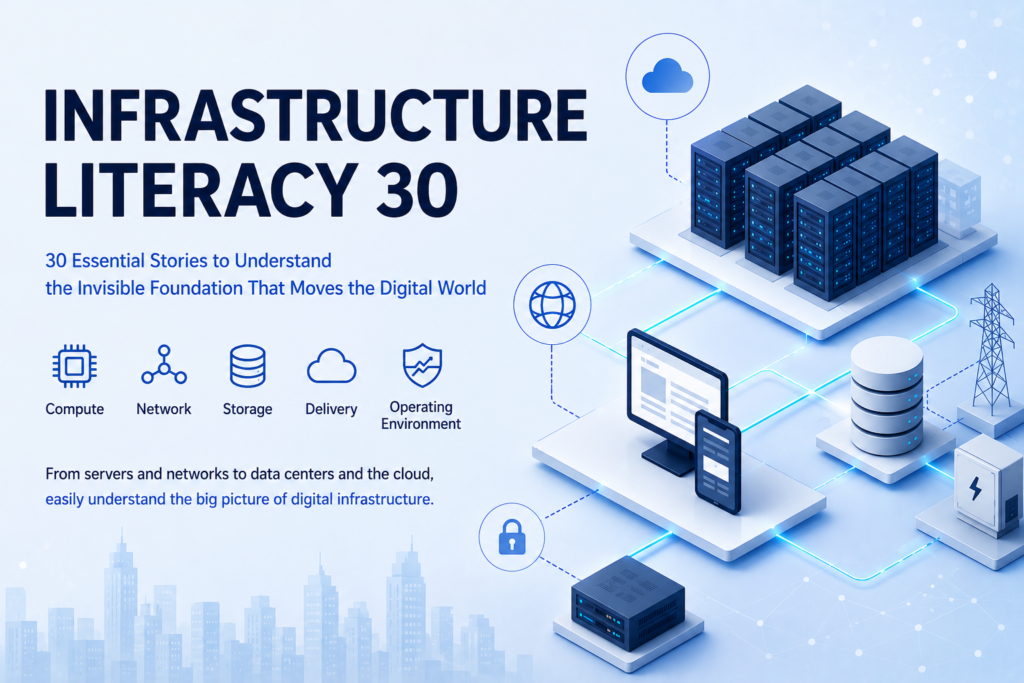
To help readers understand this flow, DANA NOTES is launching Infrastructure Literacy 30.
To Understand AI, You Also Need to Understand Infrastructure
AI is not a technology that operates only on a screen.
When a user enters a question into an AI service such as ChatGPT, the request is delivered to a server through a network. On the server, AI semiconductors such as GPUs process the model’s computations, while data is stored in or retrieved from storage systems and databases.
For this process to operate reliably, the data center also requires power supply and cooling systems. As the number of users increases, more servers and network resources are needed, and technologies for operating and managing the service so that it does not stop also become important.
In other words, if an AI model is the technology that produces results, infrastructure is the foundation that supports the model so that it can actually operate.
No matter how advanced an AI model is, it is difficult to provide it as an actual service without sufficient computing resources to train and operate it, networks to transmit data, and power to run the equipment.
How Are AI Literacy 30 and Infrastructure Literacy 30 Different?
AI Literacy 30 is a series for understanding what AI is.
It explains the concepts and operating principles of AI technology, including how AI learns from data, how generative AI differs from traditional AI, and how AI models and services are distinguished.
Infrastructure Literacy 30, on the other hand, is a series for understanding where and how AI and IT services operate.
It examines the underlying structures that support technology, including the role of servers, the differences between CPUs and GPUs, why data centers require large amounts of power, and what cloud services actually provide.
The two series begin with different questions, but they ultimately connect as part of the same structure.
If AI Literacy 30 is the process of understanding the technology that produces results, Infrastructure Literacy 30 is the process of understanding the environment that allows that technology to operate.
Infrastructure Is Not Simply a Collection of Equipment
When people think of infrastructure, they often imagine servers or data center buildings.
However, actual IT infrastructure does not consist of a single piece of equipment.
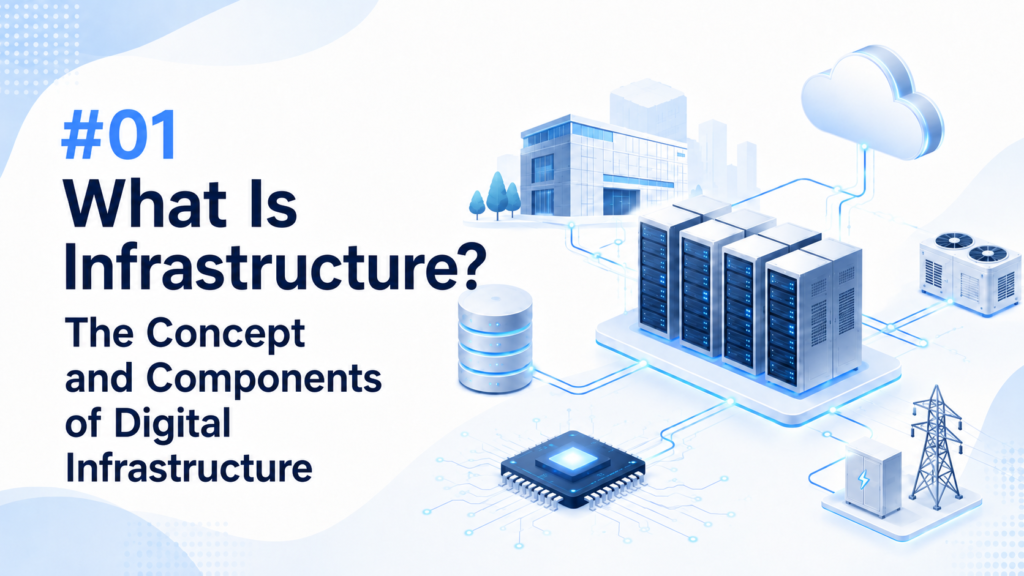
Semiconductors and servers that handle computation, storage systems that store data, networks that transmit information, cloud services that provide the required resources, power and cooling systems that operate the equipment, and security and operational systems that protect the system are all connected.
Each element may appear to exist independently, but in practice, they affect one another.
Even with a large number of high-performance GPUs, servers cannot operate without sufficient power. Even when enough servers are available, slow network speeds can reduce the efficiency of large-scale AI training. Even after a data center is built, it is difficult to maintain services without reliable cooling and operational systems.
Understanding infrastructure, therefore, is not about memorizing the names of equipment. It is about understanding the role of each element and how those elements are connected.
Understanding Infrastructure Changes How the AI Industry Looks
Competition among AI companies today does not end with building better models.
Who secures more AI semiconductors, where data centers are built, how the necessary power is secured, and how reliably cloud and network systems are operated are also becoming important competitive factors.
Understanding infrastructure also allows you to view companies’ large-scale investment announcements from a different perspective.
Rather than focusing only on the size of the investment, you can consider what equipment and facilities the company is investing in, how much its actual service capacity will increase, whether it can handle operating and electricity costs, and how the investment connects to the company’s revenue structure.
To understand the AI industry, it is necessary to look not only at model performance but also at the foundation that makes that performance possible and sustainable in the real world.
What Infrastructure Literacy 30 Will Cover
Infrastructure Literacy 30 will examine, in order, the essential foundations that make up IT and AI services, including servers, semiconductors, networks, storage, data centers, cloud services, power, cooling, security, and operational structures.
Rather than focusing on how developers install equipment or build systems, the series will first explain what each technology is, why it is necessary, and how it connects to other elements.
Instead of simply listing technical terms, it will also explain the roles these technologies play in actual companies and industries.
By reading AI Literacy 30 and Infrastructure Literacy 30 together, you can understand not only the principles through which AI produces results, but also the physical and technical foundations on which that technology is provided as a service.