What This Article Covers
Every day, we watch videos on our smartphones, order products online, and communicate through messaging apps. We also search for information on websites, store files in the cloud, and ask AI questions.
What users see is the screen of an app or website. When they tap a button, the next screen appears, and when they enter a search term, the results are displayed.
However, these digital services do not operate on their own within the screen.
Equipment is needed to process user requests, along with connections that transmit data and storage space that keeps information. Power and cooling must also be supplied so that the equipment can operate reliably, and systems must be in place to manage failures and security issues.
The foundation that supports an activity or service and makes it possible is called infrastructure.
What Is Infrastructure?
Roads, railways, ports, power grids, and water and sewage systems are representative examples of infrastructure required for society to function normally.
A road is not the final destination people are trying to reach. Without roads, however, people and goods cannot move smoothly.
A power grid is not itself a household appliance or a machine used in a factory. Without a supply of electricity, however, lights, computers, and production equipment cannot be used.
In other words, infrastructure is not the product or service that users ultimately use. It is the foundation that provides the conditions necessary for that product or service to operate.
The Digital World Also Needs Infrastructure
Websites, apps, online games, internet banking, video streaming, and AI services also require a foundation to operate.
When a user enters a search term, equipment located somewhere must process the request. When a photo is uploaded, storage space is needed to keep the file. When a video is played, the video data must be delivered to the user through the internet.
The technological foundation that supports the operation of digital services is called digital infrastructure.
Digital infrastructure does not refer only to visible equipment such as computers or servers.
It is a broad concept that also includes facilities where equipment is installed, networks that transmit data, systems that store information, environments through which services are provided, and operational systems that manage failures and security.
Digital infrastructure can therefore be defined as follows.
Digital infrastructure refers to all the facilities, equipment, technologies, and operational environments that support the operation of digital services such as websites, apps, online services, and AI.
What Roles Does Digital Infrastructure Perform?
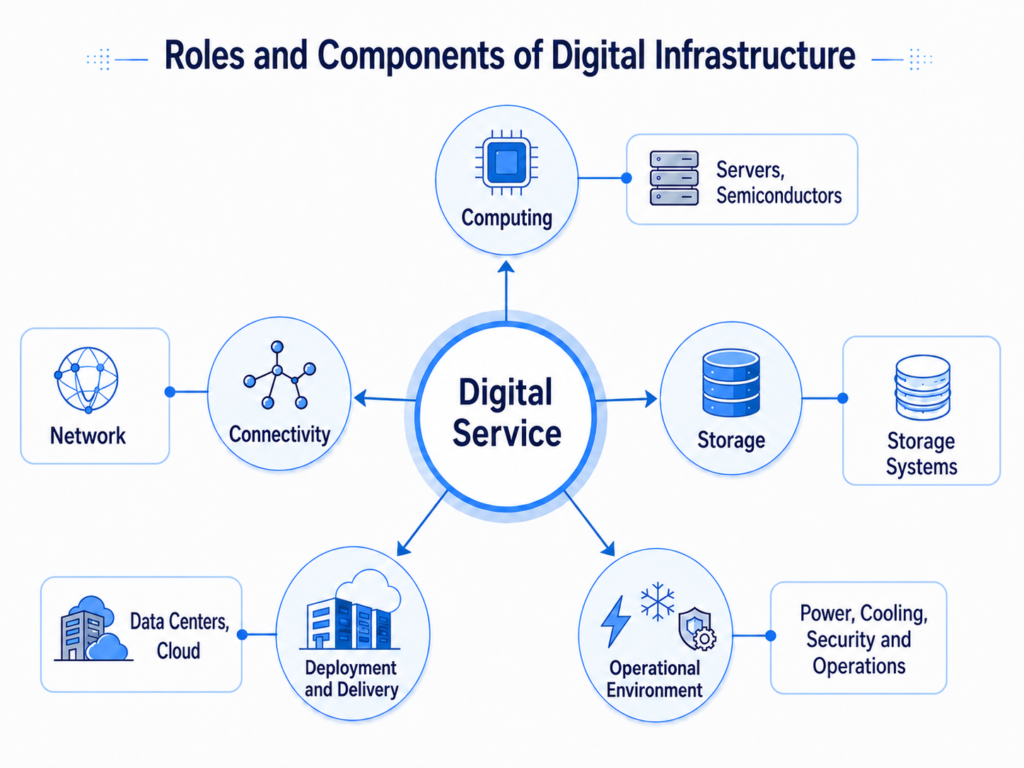
For a digital service to operate, five main roles are required.
1. Computing
It analyzes requests sent by users and performs the necessary tasks.
Finding search results, calculating an order total, and generating an AI response all fall under computing.
2. Connectivity
It transmits data between users and services and between different pieces of equipment.
A connection is needed for a request sent by a user to reach the service operator’s system and for the processed result to be delivered back to the user.
3. Storage
It stores data such as member information, documents, photos, videos, and order records.
Reliable storage space is required for a service to retrieve previous information or allow multiple users to access data.
4. Deployment and Delivery
It installs equipment and systems and makes them available in a form that users can access as a service.
A company may build and operate its own equipment, or it may use the resources it needs as a service through the cloud.
5. Operational Environment
It supplies power and cooling, manages failures and security issues, and keeps the service operating.
No matter how powerful the equipment is, it cannot operate properly without electricity or if the heat it generates is not adequately removed.
These roles are not all handled by a single piece of equipment. Different facilities, equipment, and systems divide the roles and work together.
What Does Digital Infrastructure Include?
Digital infrastructure typically includes the following elements.
- Servers
- Semiconductors
- Networks
- Storage
- Data centers
- Cloud
- Power
- Cooling
- Security and operations systems
Each element performs a different role.
Servers and semiconductors perform the necessary computations, networks transmit data, and storage keeps data.
Data centers provide the physical environment in which servers, storage devices, and network equipment can be installed and operated.
The cloud allows companies and users to access computing resources such as servers, storage space, and networks as services.
Power runs the equipment, while cooling reduces the heat generated by the equipment. Security and operations systems respond to failures and external attacks and manage the infrastructure so that it remains stable.
Digital infrastructure therefore does not refer to one particular piece of equipment.
It should be understood as a single foundational system in which multiple technologies and operational environments are interconnected to support digital services.
The specific structures and roles of each element will be examined one by one in later articles.
How Are Services and Infrastructure Different?
A service is a function or result that users directly use.
Examples include:
- Watching videos
- Making online payments
- Sending messages
- Storing photos and documents
- Searching the internet
- Generating AI responses
By contrast, infrastructure is the foundation that supports these services and enables them to operate.
When users access a video streaming service, they do not directly check which servers and storage devices are operating. When they order a product from an online store, they are not conscious of which data centers and networks the request passes through.
However, when infrastructure encounters a problem, the service visible to the user is also affected.
If the network connection is lost, requests and data cannot be transmitted. If the power supply is interrupted, the equipment cannot operate. Infrastructure is usually not visible, but it is essential for keeping services running reliably.
The relationship between services and infrastructure can be compared to a building and its foundation.
The space people actually use is inside the building, but the building requires a foundation underneath it to remain stable. Digital services also operate on the foundation provided by digital infrastructure.
What Happens Behind the Play Button?
Consider a video streaming service.
When a user taps the play button on a smartphone, the video may appear to start immediately. Behind the screen, however, multiple parts of the infrastructure operate in sequence.
First, the user’s device sends a request to play the video.
The request travels through the internet and networks to the system that operates the service. A server checks which video the user requested and finds the video data stored in storage.
The data is then transmitted back to the user’s smartphone through the network. The user’s device plays the received data as images and sound.
For this process to continue, servers and storage must operate normally, and a network must be available to carry the data. Power and cooling must also be supplied reliably to the data center where the equipment is installed.
The user sees only a single playback screen, but behind it, multiple facilities, pieces of equipment, and systems are working together.
Digital Services Do Not Exist Only on Screens
Digital services can easily appear to have no physical form.
The term cloud can also create the impression that data and services are floating somewhere in the air.
However, files stored in the cloud are actually kept on storage devices installed in data centers. Responses generated by AI are also the results of computations performed by physical servers and semiconductors.
Data transmitted through the internet also passes through numerous wired and wireless network devices.
The fact that digital services are not visible does not mean that they have no physical foundation. The functions we see on a screen are the result of facilities, equipment, technologies, and operational environments working together.
Why Should We Understand Digital Infrastructure?
Understanding digital infrastructure allows us to look beyond the functions visible on a website or app.
When a company launches a new service, it must determine how many user requests it needs to process, where it will store its data, and how it will configure its network.
It must also decide whether to build its own servers and data centers or use the cloud. As the number of users grows, computing capacity, storage space, and network capacity must also be expanded.
The same applies to AI services.
Even when an AI model has strong performance, it may be difficult to process requests from many users if there are not enough servers and semiconductors to run it. Storage for large volumes of data and networks that deliver the results are also required.
This is why companies invest in semiconductors, servers, data centers, cloud services, power, and cooling.
The growth and competitiveness of digital services are connected not only to the functions visible on the screen, but also to the infrastructure that makes it possible to operate those functions in practice.
DANA NOTES in One Line
Infrastructure is not the service itself but the foundation that supports and enables it to operate, while digital infrastructure refers to all the facilities, equipment, technologies, and operational environments that make digital services possible.
Read Next
Where do digital services actually operate?
In the next article, we will examine the relationship among the client, which the user directly interacts with, the server, which processes requests, and the internet, which connects the two.
#02 Where Do Digital Services Operate?