Notice
This article is based on publicly available materials as of August 18, 2026, including data center policy materials from New South Wales (NSW), the Australian Energy Market Operator’s (AEMO) 「2026 Integrated System Plan」, materials from the Australian Parliament, South Korea’s 11th Basic Plan for Long-Term Electricity Supply and Demand, the direction of the 12th Basic Plan for Long-Term Electricity Supply and Demand, and related policy materials from the Ministry of Climate, Energy and Environment. DANA NOTES’ analysis is also included.
Recommended Reading
What This Article Covers
In Part 1, we examined how the way companies secure electricity and share the cost of additional infrastructure can differ depending on a country’s electricity industry structure when AI data centers require large amounts of power.
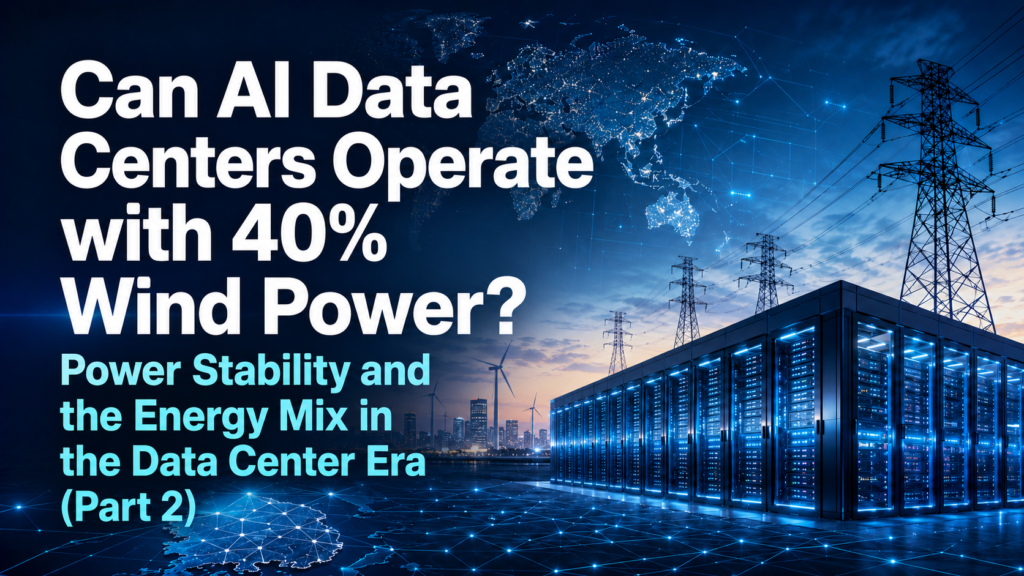
NSW in Australia has a competitive electricity market structure in which data center operators can enter into long-term Power Purchase Agreements (PPAs) with generators. Building on this structure, the NSW Government has introduced a condition requiring new data centers to procure the energy they need through new renewable energy contracts within a four-year transition period after operations begin, with at least 40% of that energy coming from wind power.
Wind generation varies depending on wind conditions. Data centers operate servers, networks, and cooling facilities 24 hours a day.
Looking at these two characteristics together raises a new question.
What is needed to supply stable electricity to AI data centers operating 24 hours a day while maintaining a high share of wind power?
This question goes beyond NSW’s 40% wind requirement and leads to a broader look at generation sources, energy storage, transmission grids, and data center locations in the AI era.
Data Centers Need Both Annual Electricity Volume and Hourly Supply Capability
Electricity planning considers both how much electricity can be generated over a year and how much power can be supplied at a particular time.
Wind generation increases when winds are strong and decreases when winds are weak. Solar power also generates electricity mainly during hours when sunlight is available.
Data centers have a different demand profile. Servers and network equipment continue operating, and cooling facilities that handle the heat they generate also run alongside them.
For this reason, evaluating the power stability of AI data centers requires looking at total generation, hourly supply capability, storage capacity, and the electricity grid together.
Australia’s electricity market operator, AEMO, also designs its long-term electricity system around this structure in the 「2026 Integrated System Plan」. AEMO proposes expanding renewable generation while deploying energy storage, transmission and distribution networks, and generation sources that can supply power when needed.
NSW’s 40% Wind Requirement Is Part of a Broader Mix of Power Resources
NSW’s 40% wind requirement for new data centers is one part of the data center’s electricity portfolio.
The NSW policy includes energy storage and power supply firming measures alongside new renewable energy contracts. It also includes requirements for data centers to be able to adjust electricity use when demand on the grid is high.
According to publicly available policy materials, data centers are required to have the capability, when necessary, to adjust the electricity they draw from the grid by up to 25% of their average load for as long as two hours.
Methods that can be used for this include load shifting, which moves computing workloads to different times, as well as energy storage and on-site generation facilities.
The structure can be viewed simply as follows.
Wind and Solar Generation
→ Energy Storage
→ Power Supply Firming
→ Electricity Grid
→ Data Center
NSW is connecting wind power contracts with electricity storage and demand adjustment as part of a single power supply system for data centers.
Energy Storage Connects the Time Electricity Is Generated with the Time It Is Used
As renewable energy expands, storage plays the role of managing differences in timing.
Electricity generated during the day when solar output is high can be stored in batteries and used in the evening. Electricity produced when wind generation is high can also be stored and supplied later when demand increases.
Pumped hydro performs the same role in a different way.
When electricity is plentiful, water is pumped to a higher elevation. When electricity is needed, the water is released to generate power again. Because it can store and supply electricity at large scale, pumped hydro can also be used to balance supply and demand across the national power system.
In AEMO’s 2026 electricity plan, the expansion of storage facilities is also included as a major infrastructure component alongside the growth of renewable energy.
Different storage technologies also serve different time horizons. Batteries that can supply electricity quickly for shorter periods and storage resources that can provide power for longer periods address different types of electricity demand.
As continuous electricity demand from facilities such as AI data centers increases, how much electricity can be stored and how many hours it can be supplied for also become important power infrastructure conditions.
Data Centers Can Also Participate in Electricity Demand Management
The workloads processed in AI data centers have different timing requirements depending on their purpose.
For services such as search, financial transactions, and cloud services that must respond immediately to user requests, processing speed and latency are important.
AI model training and large-scale data processing jobs that run according to schedules have more flexibility in when they can be processed.
This characteristic can also be used in electricity grid operations.
During periods of high electricity demand, some training workloads can be moved to other times, while stored electricity can be used to reduce the amount of power drawn from the grid. During periods of lower demand and higher renewable generation, more computing work can be performed.
NSW’s requirement for data centers to have load-shifting and demand-adjustment capabilities is designed to make use of this characteristic.
Under this structure, data centers become large electricity consumers while also serving as facilities that can participate in grid demand management by adjusting the timing of some computing workloads.
Australia Is Combining Renewable Energy, Storage, Gas, and Transmission Networks
Australia’s current long-term electricity plan is focused on expanding renewable generation together with the infrastructure that supports it.
AEMO’s 「2026 Integrated System Plan」 presents an electricity system that combines renewable energy such as wind and solar, energy storage including batteries, transmission and distribution networks connecting regions, and gas generation that can supply electricity when needed.
Each resource performs a different role.
Wind and solar generate electricity, while storage manages the difference between generation time and consumption time. Transmission networks connect generation regions with demand centers, and gas generation improves grid flexibility by supplying electricity when required.
NSW’s decision to combine wind contracts with storage and demand-adjustment conditions for data centers also aligns with the current direction of Australia’s electricity system.
Connecting 40% wind power to 24-hour data center operations requires energy storage, firming resources, and electricity grids to work together.
Nuclear Power Is Also Being Discussed Again in Australia
Australia currently operates no commercial nuclear power plants, and its federal legal framework restricts the construction of nuclear power plants.
In 2026, political discussions have continued over whether these restrictions should be lifted and nuclear power should be added to the country’s electricity supply options.
AEMO’s current long-term electricity plan is built around renewable energy, energy storage, transmission and distribution networks, and gas generation. Nuclear power is not included as a generation source in the current plan.
As electricity demand from data centers and industry grows, Australia may therefore continue to consider two issues in parallel.
One is how quickly the renewable energy, storage, and transmission system currently being developed can be expanded.
The other is whether nuclear power should be included among the generation options available to meet long-term growth in electricity demand.
The expansion of AI data centers is becoming one of the factors raising Australia’s electricity demand outlook and is entering long-term energy policy discussions as a new demand variable.
South Korea Is Also Incorporating AI Data Center Growth into National Electricity Planning
In South Korea, rising electricity demand from the spread of AI is also being incorporated into national electricity planning.
The 11th Basic Plan for Long-Term Electricity Supply and Demand, finalized in 2025, projected total data center electricity demand of 6.2 GW in 2038. This included 1.8 GW already reflected in the existing demand trend and an additional 4.4 GW associated with factors such as the expansion of AI.
The plan also proposed expanding generation capacity in line with rising electricity demand.
In its 2038 generation mix outlook, the 11th Basic Plan projected nuclear power at 35.2% and renewable energy at 29.2% of total electricity generation. It also estimated that 23 GW of long-duration Energy Storage Systems (ESS) would be needed to support renewable energy expansion and manage electricity supply and demand across different times of day.
In 2026, work is underway on the 12th Basic Plan for Long-Term Electricity Supply and Demand.
The direction announced by the Ministry of Climate, Energy and Environment in January 2026 includes construction of the two new large-scale nuclear reactors contained in the 11th plan, expansion of renewable energy, and additional ESS and pumped hydro capacity. New electricity demand from the expansion of AI and electric vehicles is also expected to be reflected in the new plan.
The expansion of AI is beginning to directly affect the country’s long-term electricity demand outlook.
South Korea Is Pursuing a Mix of Nuclear, Renewable Energy, LNG, and Storage
In June 2026, the Ministry of Climate, Energy and Environment announced power infrastructure policies to support semiconductors, physical AI, and AI data centers, presenting a direction that combines a range of generation and storage resources.
These include nuclear power, SMRs, solar and wind power, LNG, ESS, and pumped hydro.
Each generation source and storage facility performs a different role in the electricity system.
Nuclear power can generate large amounts of electricity at a high capacity factor. Solar and wind are used to expand carbon-free generation capacity. LNG generation can adjust output in response to electricity demand and changes in the output of other generation sources. ESS and pumped hydro help manage differences between electricity production and consumption across different times of day.
South Korea’s AI data center electricity policy is also moving toward using these resources as a combined portfolio.
The government is also releasing information on 345 kV substations with available grid capacity so that data center operators can incorporate electricity supply conditions into location decisions.
Discussion about power sources in the AI data center era is therefore expanding to include both which generation sources to select and how to combine them by share and role.
In South Korea, Transmission to the Seoul Metropolitan Area Is Also Important
In South Korea, generation facilities and transmission networks work together to supply electricity to data centers.
Data center companies have favored the Seoul metropolitan area because they consider network connectivity, access to corporate customers, existing cloud infrastructure, and latency.
Large-scale generation facilities are widely distributed outside the Seoul metropolitan area.
The east coast hosts major generation facilities, including nuclear and thermal power plants. Long-distance transmission networks are required to deliver electricity produced in these areas to consumers in the Seoul metropolitan area.
The government is pursuing policies to increase the utilization of existing transmission lines and expand new transmission networks in order to meet new electricity demand in the Seoul metropolitan area and major advanced industrial regions.
The electricity supply plan for the Yongin semiconductor cluster also combines generation facilities around the industrial complex with long-distance transmission lines.
South Korea’s AI data center power supply can therefore be viewed through the following structure.
Expansion of Generation Facilities
→ Expansion of Transmission Networks
→ Grid Connection in the Seoul Metropolitan Area
→ Data Center Power Supply
As the construction schedules for generation facilities and transmission networks move forward together, the amount of electricity that data centers can actually use also increases.
Data Center Locations Are Determined by Both Power and Networks
One way to reduce transmission distances is to locate large electricity consumers closer to major generation regions.
The South Korean government’s policy of accelerating power system impact assessments for AI data centers outside the Seoul metropolitan area and releasing information on substations with available grid capacity is also connected to the regional distribution of data centers.
Network conditions are also considered when choosing data center locations.
Services that require real-time responses can achieve shorter latency more easily when they are located close to major users, corporate customers, and internet exchange points.
AI model training and scheduled data processing workloads have greater flexibility in where processing takes place.
This difference creates the possibility of distributing data center functions across multiple regions.
Services that require low latency can be placed close to major network hubs, while computing workloads with greater location flexibility can be placed in regions with favorable electricity supply conditions.
Designing power and network infrastructure together makes it possible to consider both the regional distribution of data centers and the burden on transmission networks.
AI Data Center Power Stability Is Built by Combining Generation, Storage, and Transmission
As electricity demand from AI data centers increases, national energy policies are becoming more closely connected to the data center industry.
Several elements need to be considered when building a stable electricity supply.
Generation facilities produce the required amount of electricity.
Dispatchable generation sources provide output when electricity is needed.
Energy storage manages differences between generation time and consumption time.
Transmission networks connect generation regions with the demand regions where data centers are located.
Demand management adjusts the timing of electricity use to manage grid loads during peak periods.
Australia is expanding an electricity system that combines renewable energy, energy storage, gas generation, and transmission networks.
South Korea is pursuing a structure that combines nuclear power, renewable energy, LNG, ESS, pumped hydro, and the national backbone power grid.
Countries choose different generation sources and have different electricity market structures, but the conditions required by AI data centers are becoming increasingly similar.
An electricity system is needed that can generate sufficient power when it is required and reliably deliver it to the places where it is needed.
DANA NOTES Commentary
NSW’s 40% wind requirement connects the electricity demand created by AI data centers with investment in new generation facilities and broader electricity system infrastructure.
As wind and solar generation expand, the roles of energy storage, transmission networks, and demand adjustment also grow. NSW has incorporated wind PPAs, storage, and demand-adjustment conditions into its development policy so that new data centers participate in this electricity system.
South Korea has presented a direction that expands nuclear power, renewable energy, LNG, ESS, pumped hydro, and electricity networks together in response to rising electricity demand from AI and the semiconductor industry.
Looking at the two countries together broadens the criteria for evaluating energy competitiveness in the AI data center era.
The ability to connect generation volume, hourly supply capability, storage facilities, transmission networks, data center locations, and network conditions into one system determines the power competitiveness of the data center industry.
Discussions surrounding nuclear and renewable energy also need to consider construction timelines, hourly supply characteristics, energy storage, transmission availability, and the actual locations where data centers require electricity, alongside the share of each generation source.
As the scale of the AI industry grows, the connection between energy policy and IT infrastructure policy is also expected to become stronger.
Variables to Watch
In NSW, it will be important to see what types of wind and renewable energy PPAs are actually arranged by the first data centers using the new fast-track approval process. How data centers implement storage and demand-adjustment requirements in actual operations will also provide a measure of the policy’s effectiveness.
In Australia, the pace of new wind, solar, storage, and transmission investment will be important alongside the rate of growth in data center electricity demand. The ability to accommodate large-scale 24-hour demand will be influenced by how generation facilities and the electricity infrastructure supporting them are built out together.
Australia’s political discussion over the introduction of nuclear power is also a long-term variable. The long-term generation mix may change depending on whether the current legal restrictions and electricity planning framework remain in place or policy options expand to include nuclear power.
In South Korea, an important variable will be the extent to which the 12th Basic Plan for Long-Term Electricity Supply and Demand, currently under development, reflects long-term electricity demand from AI and data centers. The scale and timing of new nuclear power, renewable energy, LNG, ESS, and pumped hydro will also need to be watched.
The actual pace of construction of the national backbone power grid connecting the Seoul metropolitan area and major advanced industrial regions is another important variable. As generation facilities and transmission networks are developed on coordinated schedules, the amount of electricity available to new data centers can also expand.
Investment in data centers outside the Seoul metropolitan area is another factor to watch. If more regions can meet network connectivity and latency requirements, new data center location options may emerge that reduce the distance between electricity generation regions and data consumption regions.