Notice
This article is based on publicly available materials as of August 18, 2026, including data center policy materials from the New South Wales (NSW) Government in Australia, Infrastructure NSW, the Australian Energy Market Operator (AEMO), Korea Electric Power Corporation, Korea Power Exchange, laws related to the national backbone power grid, and materials from electricity authorities in various countries. DANA NOTES’ analysis is also included.
What This Article Covers
Building an AI data center requires large amounts of electricity along with GPUs, servers, networks, and cooling facilities. As more data centers consume tens to hundreds of megawatts of electricity, the way electricity is supplied is also becoming a major condition for the data center business.
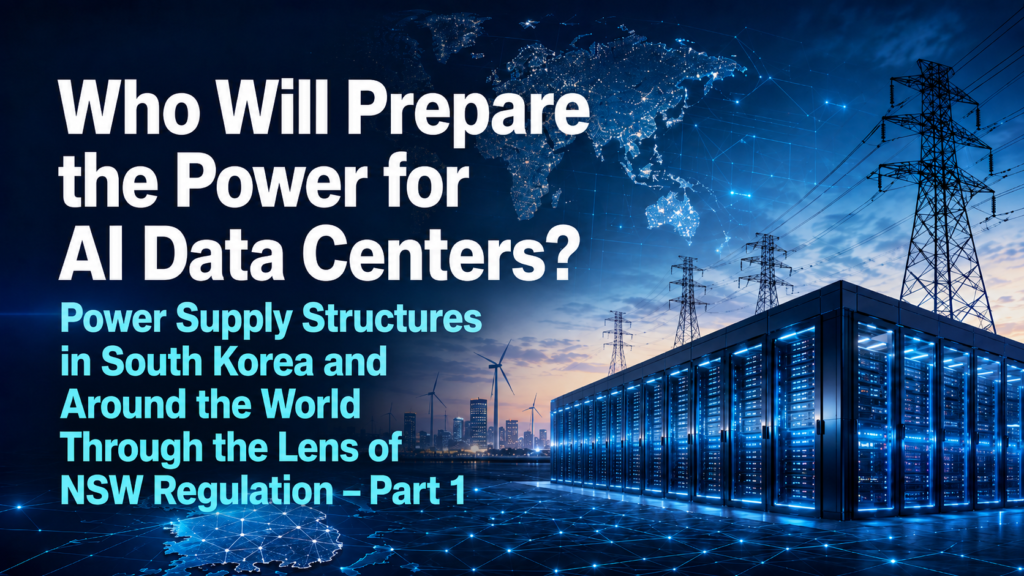
The new data center policy announced by the New South Wales (NSW) Government in Australia on August 17, 2026, is one example of this change. NSW introduced a fast-track approval process aimed at reviewing new data center developments that meet certain criteria within up to 75 days, while also setting conditions related to power procurement and additional infrastructure costs.
To understand this policy, it is first necessary to look at how Australia and South Korea supply electricity.
NSW Introduces New Power Procurement Conditions for Data Centers
NSW’s new Data Centre Policy Framework sets out six principles that data center developers are required to meet. Projects that satisfy the criteria and do not require additional information are targeted for assessment within 75 days.
For power procurement, data centers are required to procure the energy they need through new renewable energy contracts within the four-year transition period after operations begin, with at least 40% of that energy coming from wind power. The framework also sets a direction in which developers bear the costs of additional power and water infrastructure. It also includes the principle that data center development should not impose net costs on existing communities and electricity consumers.
Whether 40% wind power can provide a stable electricity supply for data centers is a separate issue. NSW also requires energy storage and power supply firming measures. This will be examined in detail in Part 2.
The point to focus on in Part 1 is how the large new electricity demand created by data centers is connected to the infrastructure costs required to support it.
The same direction appeared in the data center consultation materials released by Infrastructure NSW in March 2026. One of the key principles proposed was that, when additional grid investment is required to connect a data center, the developer should bear those costs in order to reduce increases in electricity costs for existing households and businesses. The final policy has now reflected this direction in actual development conditions.
Large Electricity Consumers in Australia Can Design Their Own Contracts
Electricity in eastern and southeastern Australia is traded primarily through the National Electricity Market (NEM).
In the NEM, multiple generators sell electricity, while retailers and large electricity consumers purchase it. The market and electricity system are operated by the Australian Energy Market Operator (AEMO).
Under this structure, a large data center can enter into a PPA (Power Purchase Agreement) with a generator to secure the electricity it needs over a long period. Generators gain long-term buyers, while data centers can design their power procurement structures by considering price, contract duration, and generation source. AEMO has also explained that data center companies are increasingly using PPAs to support investment in new generation and storage facilities.
For example, one data center may enter into a long-term PPA with a wind power generator and arrange additional contracts with other generation sources or storage facilities.
This electricity market structure also provides the background for the NSW Government to make wind power shares and new renewable energy contracts part of its development conditions.
Power Contracts and Grid Connections Are Both Necessary
After entering into a power contract with a generator, an electricity grid is needed to deliver the generated electricity to the data center.
Electricity generally moves through the following structure:
Power Plant → Transmission Grid → Substation Facilities → Distribution and Connection Facilities → Data Center
Data centers in Australia also go through connection procedures according to the physical capacity of the transmission network and the grid.
According to AEMO, as of the end of March 2026, 11 large data center projects of 5 MW or more were undergoing transmission connection procedures in the NEM, with their combined maximum electricity demand reaching 5.4 GW. About 60% were located in NSW and 40% in Victoria. AEMO aims for approximately two years from application to the commencement of electricity supply for large data centers, while the actual period varies depending on project readiness and grid conditions.
Australia’s competitive electricity market provides data center companies with various power procurement options. Grid connection availability and transmission capacity form the foundation that turns those contracts into actual electricity supply.
NSW Is Expanding the Cost Responsibility of New Large Consumers
Under this policy, existing electricity businesses continue to build and operate transmission networks and the power system.
The change appears in how the costs created by additional demand are shared.
NSW’s 2026 consultation materials examined the existing structure in which data centers bear the costs of direct connection facilities and dedicated infrastructure, while the costs of upgrades to the broader transmission network can be spread across a wider group of electricity consumers. The materials then proposed requiring large data centers to bear the cost of additional grid investment required because of their demand.
This is also where the significance of the new policy lies.
Existing electricity businesses remain responsible for constructing the grid needed by data centers. Data center companies become more directly involved in power procurement contracts and additional infrastructure costs related to the large new demand they create.
In South Korea, the First Question Is Whether Power Can Be Supplied to the Site
South Korea also has multiple power generation companies and private generators, while the Korea Power Exchange (KPX) operates the electricity market. In the electricity market, generators, electricity sellers, district electricity businesses, and large direct purchasers that meet certain requirements can trade electricity.
Korea Electric Power Corporation (KEPCO) plays a central role in transmission and distribution, which deliver electricity to actual demand locations. KEPCO builds and operates transmission, substation, and distribution networks across the country and delivers electricity generated at power plants to the areas where companies and households use it.
For a large data center project, the following question therefore becomes important:
“Can the required amount of electricity be supplied to this site?”
In South Korea, businesses planning to use 10 MW or more of electricity are subject to a power system impact assessment. The system examines the impact on the electricity grid in advance to determine whether large-scale demand can be connected to the existing grid in a stable manner.
South Korea also has direct electricity purchasing systems and PPAs. In actual supply, transmission and distribution networks that connect the generation source to the data center are also required. When grid capacity in a particular area is insufficient, data center developers may adjust the location, scale, or timing of electricity supply.
Transmission Networks Are Needed Between Data Centers in the Seoul Metropolitan Area and Generation Regions
Power infrastructure and digital networks both affect data center location decisions in South Korea.
Data centers are connected to large-scale telecommunications networks and exchange large volumes of data at high speed. Low latency, dense network connectivity, and connections to corporate customers and other data centers affect the competitiveness of a location.
In South Korea, this digital infrastructure and corporate demand are concentrated in the Seoul metropolitan area, creating a strong preference for data centers to locate there as well. The government’s inclusion of measures to ease excessive concentration in the Seoul metropolitan area in its power system impact assessment policy is also connected to this concentration.
Electricity generation is distributed differently. Large-scale generation facilities, including nuclear and thermal power plants, are located along the east coast, and long-distance transmission networks are needed to deliver the electricity generated there to the Seoul metropolitan area.
The East Coast–Seoul Metropolitan Area HVDC project being pursued by KEPCO is a representative example. The project is an ultra-high-voltage direct-current transmission network spanning approximately 280 km from Uljin, North Gyeongsang Province, to Hanam, Gyeonggi Province, designed to transmit electricity generated on the east coast to the Seoul metropolitan area.
Under this structure, generation capacity and transmission capacity must be secured together.
Even when sufficient electricity is generated on the east coast, insufficient transmission capacity to the Seoul metropolitan area makes it difficult to connect new large-scale demand there. South Korea’s data center power challenge therefore includes long-distance transmission grid expansion as a core piece of infrastructure alongside power generation facilities.
Locating data centers closer to generation regions can reduce the burden of long-distance transmission. At the same time, data center companies consider network connectivity, latency, access to corporate customers, and the existing cloud ecosystem. Data center location becomes a matter of optimizing power infrastructure and digital networks together.
South Korea Expands Its National Backbone Power Grid Through Government Planning and Transmission Operators
South Korea manages large-scale transmission networks as national backbone infrastructure.
The Act on Special Measures for the Expansion of the National Backbone Power Grid, which has been in effect since September 26, 2025, aims to accelerate expansion of the national backbone grid in order to secure stable electricity supply and strengthen the competitiveness of major national industries. The government establishes long-term plans for expanding the national backbone power grid, including strategies for grid expansion and directions for investment and financing. Development projects defined under the Act are carried out by transmission operators.
KEPCO’s transmission line construction procedures also show a structure in which KEPCO establishes long-term transmission and substation facility plans based on the government’s electricity supply and demand plans and then carries out the actual construction of transmission infrastructure.
Accordingly, when additional national backbone transmission infrastructure is considered necessary to respond to growing data center demand in the Seoul metropolitan area, the government’s grid planning and infrastructure investment by existing transmission operators form the foundation for supply.
For companies, whether the public electricity system can supply the large amount of electricity required at their preferred site becomes an important premise of the business plan.
South Korea and NSW Differ in Power Procurement Paths and Cost Responsibility
From the perspective of a data center operator, the structures of the two markets can be compared as follows.
| Category | South Korea | NSW, Australia |
|---|---|---|
| Basic electricity structure | National electricity planning and a KEPCO-centered transmission and distribution structure | Competitive electricity market |
| Main question for data centers | Can the required electricity be supplied to this site? | Which generators and contracts will be used to secure the required electricity? |
| Power contracts | Direct purchasing and PPA systems also exist | Various contracts involving generators, retailers, and PPAs |
| Transmission grid | Expanded through national planning and transmission operators | Built and operated by regulated network businesses |
| Grid connection | Large demand is assessed for grid impact and supply availability | Large projects go through grid connection procedures |
| Government regulation | Power system impact assessments, national backbone grid planning, and related measures | Development policy sets power procurement and cost conditions for data centers |
| Additional infrastructure costs | Financed through the national grid system and project-specific cost-sharing structures | Greater responsibility placed on new data centers for additional grid costs |
Both South Korea and NSW have entities that operate the electricity grid, and data centers use electricity by connecting to that grid. The major differences appear in the range of contractual options available to data centers during power procurement and in the way the costs of new infrastructure are allocated.
How Do Power Supply Structures Differ Across Major Countries?
Electricity industries around the world differ in how generation, transmission, distribution, and retail supply are divided among businesses.
From the perspective of data center power procurement, these structures can be broadly organized into several types. The classification below simplifies complex national systems for easier understanding, and detailed regulations and market structures differ within each group.
| Type | Representative Countries | Main Characteristics |
|---|---|---|
| Public and Government-Led | South Korea, Taiwan, Vietnam, Indonesia | National planning and public or state-owned electricity companies have a strong influence on grid and supply decisions |
| Strong State Influence with Expanding Markets | China, Russia | The state and state-owned grid companies retain strong influence while market trading and competitive elements are operated or expanded |
| Competitive Electricity Market | Australia, United Kingdom | Competitive generation, retail, and wholesale markets are developed, giving companies a wider range of electricity contract options |
| Regional and Hybrid | United States, Japan | Competitive markets and regulated grid structures coexist depending on the region and business segment |
Taiwan’s Taipower is a vertically integrated power company responsible for generation and electricity supply. Vietnam’s EVN is involved in generation, transmission, distribution, and retail supply and plays a central role in the national transmission network. Indonesia’s PLN is also a government-owned electricity company with a major role in generation, transmission, distribution, and retail supply.
China is expanding its nationwide integrated electricity market while maintaining strong influence from national electricity planning and major grid companies.
Russia also operates market elements in generation and electricity trading while the state retains strong influence over the electricity grid. According to Rosseti’s 2023 Annual Report, the Russian Federation holds approximately 75.28% of PJSC Rosseti. Rosseti operates extensive transmission and distribution networks across Russia and plays a central role in national grid development and system connections.
In the United Kingdom, generation, transmission, distribution, and retail supply are separated, and multiple participants trade in the wholesale electricity market. Like Australia, it has a competitive market structure in generation and retail supply.
The United States has significantly different electricity market structures depending on the region. Competitive wholesale markets operated by RTOs and ISOs coexist with regions where vertically integrated utilities responsible for generation, transmission, and distribution remain central.
Japan fully liberalized its electricity retail market in 2016, allowing companies and households to choose their electricity retailers. Transmission and distribution networks are operated by regional transmission and distribution businesses licensed by the government, which are responsible for stable electricity supply.
These differences are reflected directly in the data center business.
Even when planning the same 200 MW data center, who the developer coordinates with for power supply, the contracting method, grid connection procedures, additional transmission costs, and project timelines can vary depending on the country and region.
The Structure of the Electricity Industry Is Also Part of the Data Center Investment Environment
In the AI data center industry, the power supply system itself functions as part of a country’s investment environment, alongside land and construction costs, GPU prices, and cooling technologies.
In markets with strong public and government-led characteristics, the amount of electricity that the state and grid operators can supply to a particular area and the timing of that supply have a major influence. In competitive electricity markets, companies can directly arrange long-term contracts with generators and incorporate procurement costs and the choice of generation source into their business strategies.
Both structures require transmission networks and grid connections. Data center investors therefore examine local generation capacity, available transmission capacity, the time required for grid connection, electricity contracting methods, and additional infrastructure costs together.
This is also where NSW has gone one step further with its new data center policy. While maintaining an environment in which companies can procure electricity through a competitive market, it has established development conditions that require the businesses creating large new demand to bear a more direct share of the resulting additional infrastructure costs.
DANA NOTES Commentary
The expansion of AI data centers is making electricity industry structures part of data center competitiveness.
In South Korea, available grid capacity in preferred locations such as the Seoul metropolitan area and the speed of national backbone transmission expansion directly affect data center investment. As the distance between the locations preferred by companies and regions with large-scale generation increases, the role of the transmission grid also grows.
In Australia, companies have a wider range of contractual options for arranging PPAs with generators. Building on this market structure, NSW has designed its policy so that new data centers secure the new generation contracts needed for their electricity demand and participate more directly in the costs of additional power infrastructure.
Going forward, data center competitiveness is likely to include, along with the ability to secure GPUs and servers, the ability to secure long-term electricity contracts, locations that can connect to the grid, and sufficient capital to absorb additional power infrastructure costs.
For governments, attracting data centers is also connected to electricity supply planning. Decisions about where data centers should be located, where the required electricity should be generated, how much new transmission infrastructure should be expanded, and how the costs should be shared between existing consumers and new large-scale users are becoming part of industrial policy.
Variables to Watch
In NSW, important factors to watch include the first data center projects to use the new 75-day fast-track assessment process and the scale and composition of the power purchase agreements signed by those projects. The extent to which developers are required to bear additional grid costs will also provide a measure of the policy’s practical impact.
In South Korea, key variables include the results of power system impact assessments for data centers in the Seoul metropolitan area and the construction schedule for the national backbone grid, including the East Coast–Seoul Metropolitan Area HVDC project. It will also be important to see whether regional dispersion of data centers leads to actual investment and whether more regions can meet network and latency requirements.
Across major global data center markets, changes in rules governing grid connection and cost allocation for large new electricity demand also require attention. In the United States, regulatory changes are also underway to accelerate grid connections for large electricity users such as data centers.
The NSW policy also leaves another question.
Can an electricity mix that includes at least 40% wind power reliably supply AI data centers that operate 24 hours a day?
Part 2 examines wind and solar power, energy storage, power supply firming measures, nuclear power, and transmission networks from the perspective of the 24-hour electricity demand of data centers.