
Notice
This article is based on materials and reports released by the Open Compute Project (OCP), Lightmatter, Samsung Electronics, OE Solutions, and other relevant companies as of August 17, 2026. DANA NOTES analysis is also included.
What This Article Covers
Key Terms
Optical Interconnect
A connection technology that uses light to transmit data between servers or semiconductor chips.
Silicon Photonics
An optical technology that uses silicon-based semiconductor technology to transmit, modulate, and detect light.
Optical Engine
A key component that converts electrical signals into optical signals and vice versa to transmit and receive data.
CPO (Co-Packaged Optics)
An architecture that places optical engines close to major semiconductor chips such as switch ASICs or XPUs.
PAM4
A signaling method that uses four amplitude levels within a single signal interval to transmit more data.
19 Companies Are Working to Change How AI Servers Connect
Competition in AI data centers is expanding beyond GPU computing performance to the way GPUs are connected to one another.
Data Center Dynamics reported on August 13, 2026, that a total of 19 companies, including Dell Technologies, Qualcomm Technologies, Corning, Foxconn Interconnect Technology, and Quanta Cloud Technology, are participating in the ‘Open Silicon Photonics for AI Systems’ project led by Lightmatter.
The project is a silicon photonics initiative being carried out within the Open Compute Project (OCP), with the goal of creating an open optical interconnect architecture that multiple companies can use together.
The CPO collaboration first announced by Lightmatter in March 2026 included Celestica, Corning, Dell Technologies, Flex, Foxconn Interconnect Technology, Hyve Solutions, Keysight, Qualcomm Technologies, and Quanta Cloud Technology. At the time, the goal was to create a common reference architecture and interoperability standards so that CPO (Co-Packaged Optics) from different vendors could be used together in next-generation AI systems.
The related work continued within the OCP Server Project, and in July, the ‘Open Silicon Photonics for AI Systems’ vision was submitted to the OCP Server Workgroup.
At the OCP APAC Summit in August 2026, Lightmatter presented a goal of designing this architecture so that it could scale from connecting 72 XPUs to more than 1,024. The project is currently at the stage of defining an open system architecture and interfaces capable of supporting more than 1,024 XPUs.
Why Do AI Data Centers Need Faster Connections?
As the performance of individual GPUs increases, the ability of multiple GPUs to exchange data quickly also becomes more important in large-scale AI systems.
When training large AI models, tens, hundreds, or even thousands of AI accelerators divide the workload among themselves. The faster each accelerator can exchange the data it needs, the more effectively the overall system can utilize its high computing performance.
Servers and semiconductors have traditionally transmitted data mainly through copper-based electrical signals. As data transmission speeds increase, power and design technologies for managing electrical signal loss and maintaining high signal quality are also becoming more important.
According to data presented by Lightmatter at the OCP APAC Summit, a copper connection distance of approximately 2 meters at 112G falls to less than 25 centimeters at 448G PAM4. This figure is based on specific conditions presented by Lightmatter and shows the need to consider both connection distance and power efficiency in high-speed data transmission.
As AI servers grow in scale, connection technologies that move data, along with the performance of computing devices, are becoming key factors that determine overall system performance.
What Does Silicon Photonics Change?
Silicon Photonics is a technology that uses semiconductor manufacturing processes to integrate light-based data transmission functions into chips.
While conventional electrical signals travel along copper wiring, optical communications convert data into light and transmit it through optical fiber. Using light expands the available options for transmitting high-bandwidth data in terms of both distance and power efficiency.
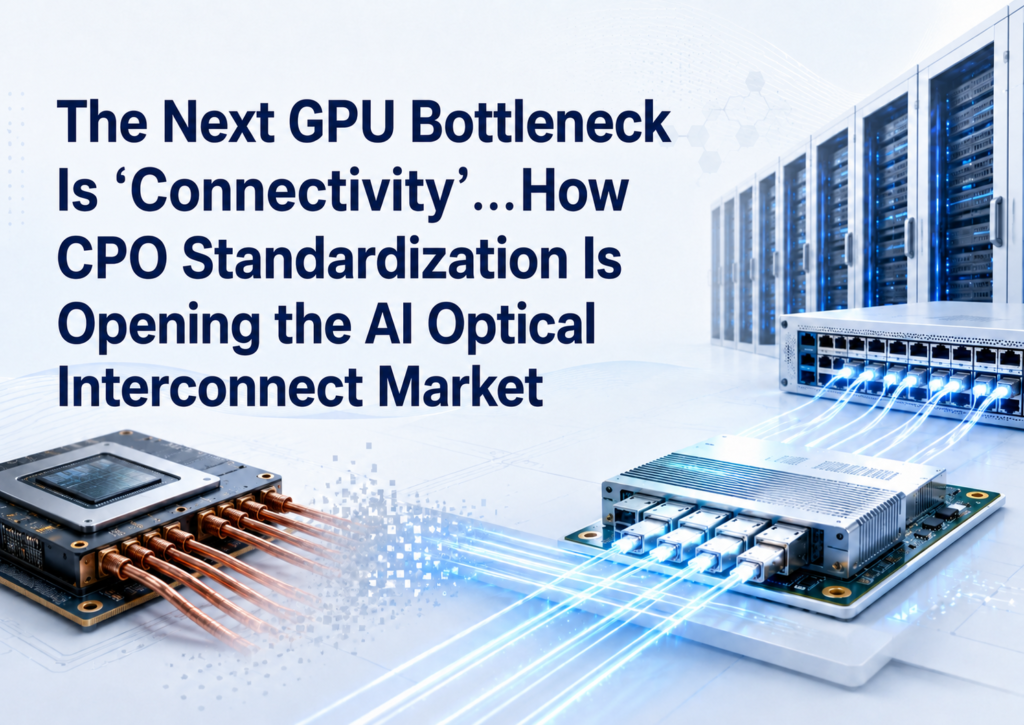
CPO (Co-Packaged Optics) is an architecture that places optical communication functions close to switch ASICs or AI accelerators.
Pluggable optical transceivers, which are widely used in data centers today, place optical modules at the front of the equipment, with electrical signals traveling from the switch ASIC to the optical transceiver.
CPO places the optical engine close to the main semiconductor, shortening the distance that electrical signals need to travel. This creates an architecture that can provide high bandwidth and power efficiency.
The core of CPO is therefore bringing optical communication functions closer to the chip in areas that require high-speed data transmission.
Samsung Foundry also describes CPO as an architecture that directly integrates optical interfaces with switch ASICs to improve bandwidth density, power efficiency, and signal integrity. Samsung Electronics presents not only CPO Switch, which places switch ASICs and optical engines together, but also a CPO XPU architecture that packages XPUs or GPUs together with optical engines.
Why Are Companies Pursuing ‘Standardization’ Together?
AI data centers involve a wide range of suppliers, from semiconductor companies to optical communications and server manufacturers.
Switch ASICs, optical components, lasers, optical fibers, connectors, packaging, server manufacturing, testing, and system integration all bring multiple technologies and components together within a single system.
When multiple companies use common architectures and interfaces, each supplier can focus on its area of expertise while making it easier to connect with components from other companies.
In announcing the project, Lightmatter identified integration, interoperability, reliability, and scalability across diverse supply chains as major challenges for expanding the CPO industry. Corning also explained that large-scale CPO deployment requires optical materials, optical fiber, high-density connectivity, advanced packaging, and system design to work together.
Once a common architecture is established, optical component companies can develop products according to defined interfaces, while server companies can combine components from multiple suppliers. Data center operators can also establish a foundation for choosing from a wider range of suppliers.
This is where the value of standardization comes from.
It creates a foundation for expanding technologies held by individual companies into an industrial structure in which multiple companies can manufacture, purchase, and connect them.
GPU Competition Is Expanding Into the Optical Component Supply Chain
In the AI semiconductor market, GPU computing performance was the first area to receive major attention.
As AI models grew in scale, HBM became increasingly important for supplying data quickly to GPUs. Now, the performance of networks and interconnects that move data between multiple GPUs is also becoming more important.
Competition in AI infrastructure is expanding into the following areas.
- Computing performance of GPUs and AI accelerators
- Memory bandwidth centered on HBM
- Networks connecting GPU to GPU
- Optical interconnects for high-speed data movement
- Advanced packaging that combines optical engines and semiconductors
This change is also broadening the range of companies that can participate in the AI infrastructure market.
Alongside companies that design GPUs, companies involved in optical components, lasers, optical transceivers, optical fiber, connectors, packaging, test equipment, and server manufacturing can also play roles in the AI infrastructure supply chain.
In particular, once common standards are established, the value of designing components that can be used across multiple systems and producing them reliably at scale could increase.
This is why CPO standardization matters not only to the semiconductor industry but also to the optical communications and manufacturing industries.
South Korea Already Has Companies That Can Participate in This Market
This shift can also create new opportunities for South Korean industry.
South Korea has a long-established industrial base in memory, semiconductor manufacturing, packaging, and optical communication components. As the CPO and optical interconnect markets expand, there are also companies capable of connecting their existing manufacturing capabilities to the new AI data center supply chain.
The largest company is Samsung Electronics.
Samsung Foundry officially presents Pluggable Optics and CPO solutions for its HPC and AI business and provides CPO Switch and CPO XPU together with advanced packaging architectures.
Samsung Advanced Institute of Technology (SAIT) is also researching next-generation optical interconnects based on silicon photonics and highly integrated optical connectivity technologies for expanding AI infrastructure.
Optical communications specialist OE Solutions is also developing products directly related to CPO.
In March 2026, OE Solutions introduced a 23dBm-class ELSFP (External Laser Small Form-Factor Pluggable) that supplies light sources to CPO in next-generation AI environments and announced that customer sampling would begin in the third quarter of 2026.
The company is expanding the technology and business experience it accumulated in optical transceivers for mobile communications and fixed networks into optical components for AI data centers.
Opticore is also expanding its business into the 400G and 800G-class optical transceiver market for AI data centers. In May 2026, the company disclosed a supply contract for 400G and 800G optical transceivers for AI data centers.
The activities of these companies show that South Korea has an industrial base that can connect semiconductor manufacturing with optical communication components.
As competition in AI data center performance expands from computing to memory and connectivity, the areas in which South Korea’s strengths in components and manufacturing can participate may also expand.
South Korea Can Connect Its Manufacturing Competitiveness to the Global Market
South Korea has actively used optical communication technologies while building LTE and 5G networks.
Smartphones and base stations are connected wirelessly, while optical communications play an important role in the fronthaul and backhaul behind base stations.
South Korea’s high population density and relatively small land area provided favorable conditions for building dense communications infrastructure, and domestic optical communications companies accumulated product and technology experience through this process. OE Solutions has also disclosed its experience supplying a large number of optical transceivers during South Korea’s 5G deployment.
In the optical interconnect market for AI data centers, the scope of these technologies can be expanded to the global market.
The main connection targets are servers, switches, and AI accelerators within a single data center and AI cluster. As a result, supplier competitiveness is more directly linked to the design and production of high-speed optical components, compliance with global standards, packaging, and mass-production capabilities than to the ability to build nationwide communications networks.
If the same standardized optical components can be used in data centers in the United States or Europe, South Korean companies can expand their experience in domestic communications network deployment into supplying components for global AI data centers.
This market provides an opportunity to connect the strengths of South Korea’s manufacturing base to the international AI infrastructure supply chain.
CPO and Existing Optical Communications Could Develop Together
As the optical interconnect market expands, CPO and existing pluggable optical communications could broaden their areas of application based on their respective strengths.
CPO is well suited to securing high bandwidth and power efficiency by placing optical engines close to high-performance switches or AI accelerators.
Pluggable optical transceivers have strengths in operations and maintenance because modules can be removed from and replaced in equipment easily. Samsung Electronics also presents Pluggable Optics and CPO as separate solutions for use in current data centers.
In CPO, placing optical engines and high-performance semiconductors close together also increases the importance of thermal management, packaging, manufacturing yield, and maintenance technologies.
Depending on these conditions, copper-based electrical connections, pluggable optical modules, NPO (Near-Packaged Optics), and CPO can be used in different areas according to system distance, performance, and cost.
The current OCP project is also moving toward creating an open system architecture in which various optical technologies and suppliers can participate.
Along with competition among technologies, the process of each technology finding the position where it can operate most efficiently will determine the future structure of AI data centers.
DANA NOTES Commentary
The key point to watch in this CPO standardization effort is the continued expansion of the areas where value is created within AI infrastructure.
As the computing performance of AI accelerators increased, the ability of memory to supply data quickly became more important, driving the growth of the HBM market. Now, as hundreds or more AI accelerators are used as if they were a single massive system, the value of moving data between those accelerators is also increasing.
Advances in computing performance create demand for faster data movement, and that demand in turn expands new markets in optical communications and advanced packaging.
Standardization further broadens participation in the supply chain.
When multiple companies use a common architecture, companies with expertise in optical components, lasers, optical fiber, optical transceivers, packaging, servers, and testing technologies can participate in a single AI system supply chain through their respective areas of specialization.
This point is also important for South Korean industry.
South Korea has industries that have already accumulated substantial technology and manufacturing experience in areas such as memory, semiconductor manufacturing, packaging, and optical communication components. Companies such as Samsung Electronics, OE Solutions, and Opticore are also pursuing businesses directly connected to AI optical interconnects.
As the CPO market grows, South Korea will have a new market in which it can expand its competitiveness not only in AI accelerators themselves but also in the core components and manufacturing supply chain that improve the performance of AI systems.
Even in the AI era, building high-performance systems requires manufacturing capabilities to design, produce, and connect physical semiconductors and components. How South Korea connects the manufacturing competitiveness it has accumulated over many years to the new market of AI infrastructure could become an important standard of industrial competitiveness.
Variables to Watch Going Forward
The first is the process through which OCP’s common architecture develops into concrete specifications.
Related projects and workgroup activities are currently underway, and as interoperability specifications and testing standards become more concrete, it will become possible to see which companies and technologies actually participate in the standards ecosystem.
The second is the actual scale of adoption by major AI system companies and data center operators.
As GPU and switch companies and hyperscalers deploy CPO in large-scale systems, the market for optical components and packaging supply chains can grow alongside them.
The third is cost, reliability, and power efficiency.
As CPO provides high bandwidth and power efficiency while manufacturing yield, packaging costs, and maintenance reach competitive levels, its range of applications can expand further.
The fourth is the actual expansion of supply by South Korean companies.
Whether Samsung Electronics expands its CPO and silicon photonics business to global customers, whether OE Solutions moves its external light source for CPO from customer sampling to mass production, and whether Opticore’s high-speed optical transceiver supply for AI data centers develops into a sustained business will provide concrete criteria for assessing opportunities for South Korean industry.