What This Article Covers
In recent years, AI has rapidly become part of our everyday lives.
It can write reports, translate languages, generate code, create images, and even hold natural conversations with people. As a result, many of us have wondered at least once:
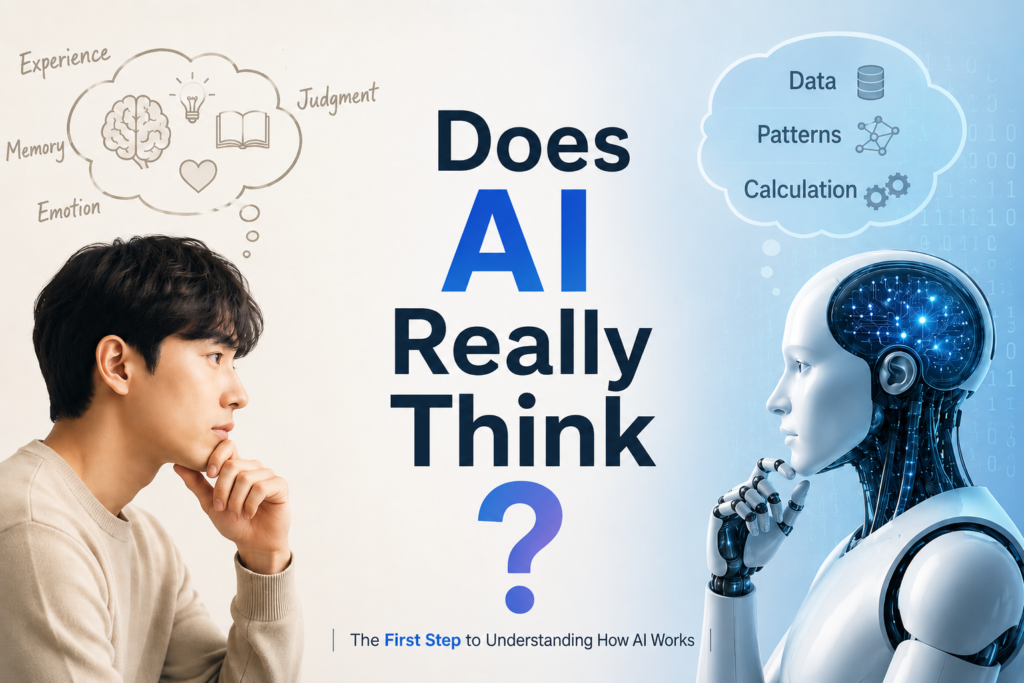
“Does AI really think?”
When using generative AI tools such as ChatGPT, it can often feel as though we are talking to another person. AI seems to understand what we mean and can even offer advice that fits the situation.
But to begin with the conclusion, today’s AI does not think like a human.
So how does AI generate such convincing answers?
In this article, we will explore the most fundamental principles behind AI and examine how human thinking differs from the way AI generates responses.
What Is AI?
AI stands for artificial intelligence.
It is a technology that enables computers to learn from data, solve problems, and generate new results.
Recognizing objects in photographs, converting speech into text, translating foreign languages, and answering questions are all common examples of AI in use.
Many people mistakenly imagine AI as something that thinks like a human.
However, AI is not a digital copy of a person.
It does not experience the world for itself or feel emotions. It is a program designed to learn from vast amounts of data and solve specific problems.
Humans Think; AI Calculates
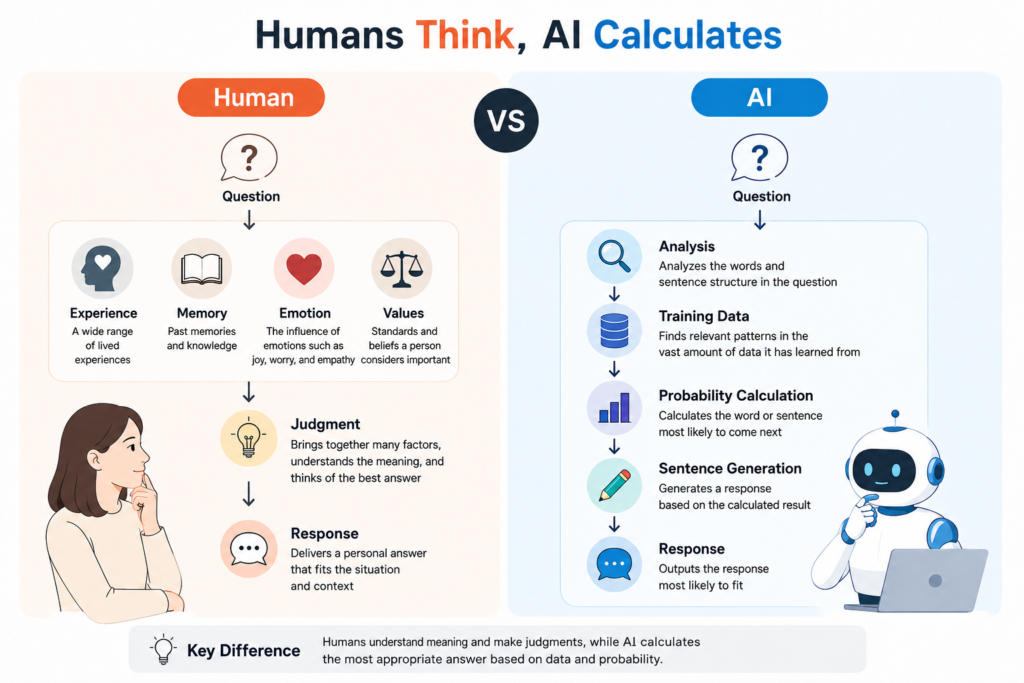
When people receive a question, they do not respond by looking only at the words.
They make judgments by drawing on their experiences, memories, emotions, and personal values.
For example, suppose someone asks:
“What would make a good birthday gift?”
A person would not simply think of a list of popular gifts.
They might consider the recipient’s age, hobbies, personality, preferences, the available budget, and the relationship between the two people. They then arrive at an answer by thinking, “This person would probably like this kind of gift.”
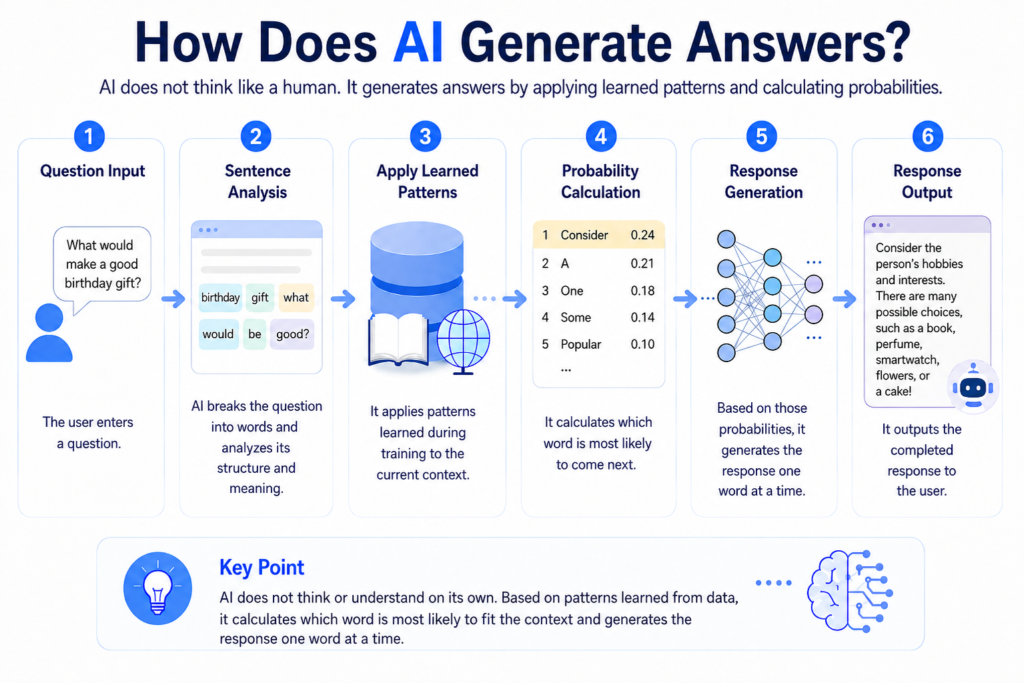
AI approaches the same question differently.
It does not think through the situation in the human sense.
Instead, it analyzes the words and structure of the question. Based on the vast amount of data it has learned from, it calculates which words or sentences are most likely to come next.
It repeats this calculation at extremely high speed until it completes a response.
In other words, humans try to understand meaning and make judgments, while AI calculates the output that is most likely to fit the input.
That is why AI-generated answers can sound remarkably natural.
However, sounding natural is not the same as actually understanding.
When AI says, “Consider the person’s hobbies when choosing a gift,” it is not experiencing concern or thoughtfulness toward that person. It generates the answer because it has learned the expressions and explanation patterns that people commonly use in similar situations.
Understanding this difference is the most important first step in understanding AI.
AI is not an entity that thinks like a person. It is a technology that calculates and generates the most appropriate response based on vast amounts of data.
Why Calculation Alone Can Produce Remarkable Results
This leads many people to another question:
“How can AI generate such natural responses if it is only calculating?”
The reason is that the scale of AI’s calculations far exceeds what most of us imagine.
Modern generative AI is trained on large amounts of data. During training, it adjusts billions of parameters that capture patterns and relationships in language. When a user enters a prompt, the model processes the prompt using those learned parameters and predicts what is most likely to come next.
Ultimately, AI does not appear intelligent because it thinks like a human.
It appears intelligent because it can apply patterns learned from enormous amounts of data and perform complex calculations at extraordinary speed.
The Most Important Perspective for Understanding AI
When we view AI as though it were human, we may expect too much from it.
On the other hand, if we think of it as nothing more than a search program, we may fail to recognize its remarkable potential.
The most accurate way to understand AI is to see it not as an entity that thinks, but as a technology that calculates.
Understanding this single idea will make future AI news and technical terms much easier to interpret.
DANA NOTES in One Sentence
AI is not an entity that thinks like a human. It is a technology that uses patterns learned from vast amounts of data to calculate and generate an appropriate response.