What This Article Covers
Since the arrival of ChatGPT, many people have started using AI for the first time.
However, AI was already being used all around us long before ChatGPT appeared. Facial recognition on smartphones, spam email filtering, YouTube video recommendations, and product recommendations on online shopping platforms are all powered by AI technology.
So why did people begin talking about an “AI revolution” after ChatGPT emerged?
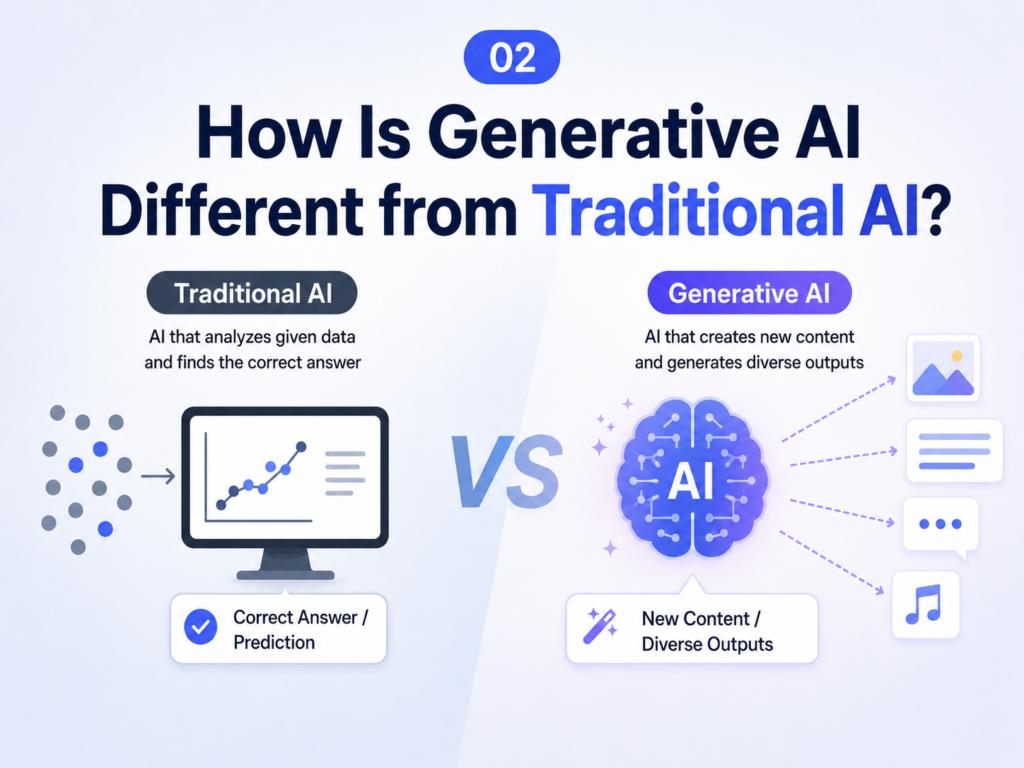
The reason is that generative AI learns and produces answers in a fundamentally different way from traditional AI.
Traditional AI Was Often Designed for Specific Tasks
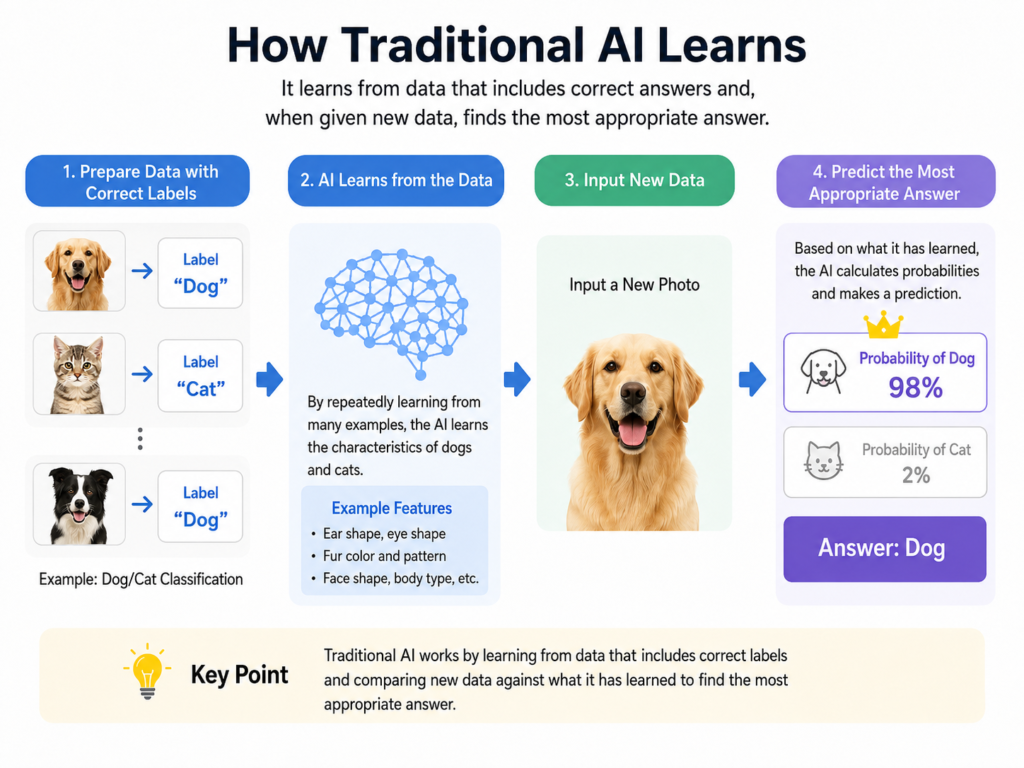
Traditional AI also learns from data.
Many traditional AI systems are designed to perform a specific task, such as classifying images, detecting spam, recommending products, or predicting outcomes.
Suppose we want to build an AI system that distinguishes between dogs and cats.
A developer prepares labeled data containing examples such as:
“This image shows a dog.”
“This image shows a cat.”
The AI analyzes these examples and identifies patterns associated with dogs and cats.
When it receives a new image, it uses those learned patterns to predict whether the image is more likely to show a dog or a cat.
In other words, many traditional AI systems are designed to analyze input data and produce a classification, prediction, score, or recommendation for a specific task.
Text-Based Generative AI Learns Patterns in Language
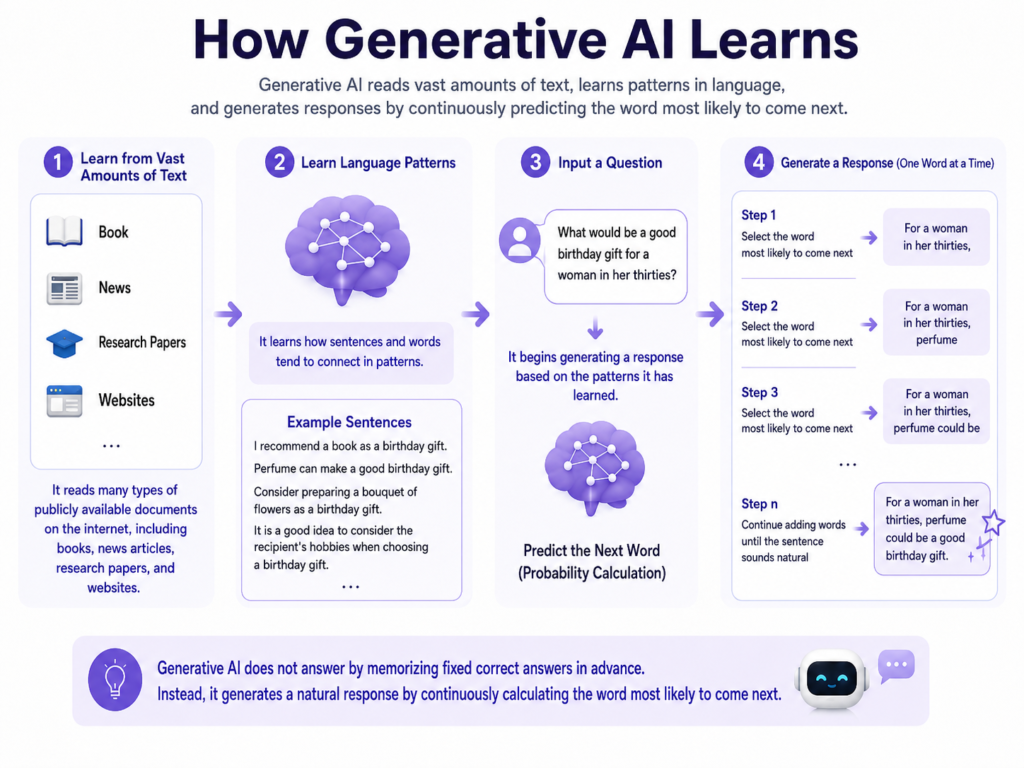
Text-based generative AI, by contrast, learns patterns in how words and sentences relate to one another.
It learns how words and sentences tend to follow one another by processing vast amounts of text, including books, news articles, research papers, and websites.
For example, an AI model may encounter countless sentences such as:
- I recommend a book as a birthday gift.
- Perfume can make a good birthday gift.
- Consider preparing a bouquet of flowers as a birthday gift.
- It is a good idea to consider the recipient’s hobbies when choosing a birthday gift.
By repeatedly learning from sentences like these, the AI identifies what kinds of information naturally tend to follow a phrase such as “birthday gift.”
Later, when someone asks, “What would be a good birthday gift for a woman in her thirties?” the AI does not retrieve a single answer that was prepared in advance.
Instead, it uses the language patterns it has learned to select the word most likely to come next. It then calculates the next word again, repeating this process until it completes a response.
In other words, generative AI does not memorize entire sentences and repeat them. It generates a response by continuously calculating which word is statistically most likely to come next.
This Is Why Generative AI Can Answer Many Different Questions
Most traditional AI systems were created for one specific purpose.
For example, they may be designed to classify images, recognize faces, or detect spam emails.
Generative AI, by contrast, can use a single model to respond to many different kinds of questions.
It can write text, translate languages, plan a travel itinerary, draft an email, generate code, or suggest ideas.
This is possible because it has learned patterns in language itself rather than memorizing a specific set of correct answers.
Generative AI Still Performs Calculations
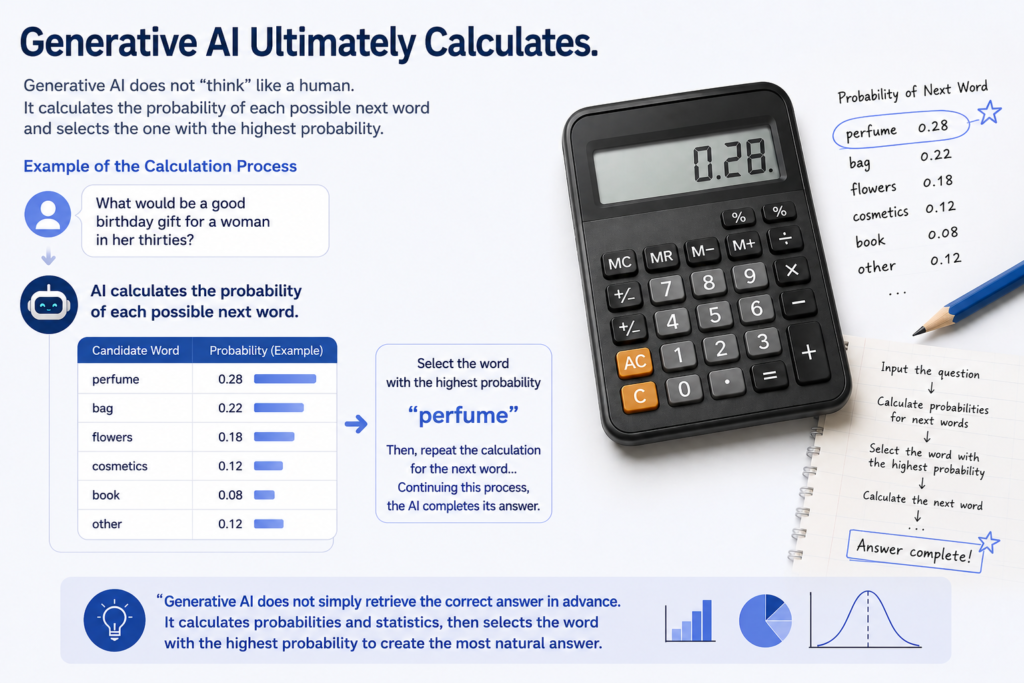
The fact that generative AI can produce many different answers does not mean that it thinks like a human.
As explained in the previous article, generative AI produces a response by continuously calculating which word is most likely to come next.
What makes generative AI remarkable is not that it thinks like a human. It is remarkable because it is highly capable of learning language patterns and calculating which word is statistically most likely to come next.
Traditional AI vs. Generative AI
| Category | Traditional AI | Generative AI |
|---|---|---|
| Main Focus | Performs a specific task | Creates new content |
| How It Works | Classifies, predicts, scores, or recommends | Generates new outputs from learned patterns |
| Typical Output | A label, score, prediction, or ranking | Text, images, audio, video, or code |
| Common Applications | Image classification, recommendation, fraud detection | Writing, summarization, image generation, coding |
DANA NOTES in One Sentence
When a user enters a question, text-based generative AI uses the language patterns it has learned to predict what is likely to come next and constructs a new response step by step.
The next article explains this answer-generation process in more detail.