What This Article Covers
Why Generative AI Does Not Retrieve a Prewritten Answer
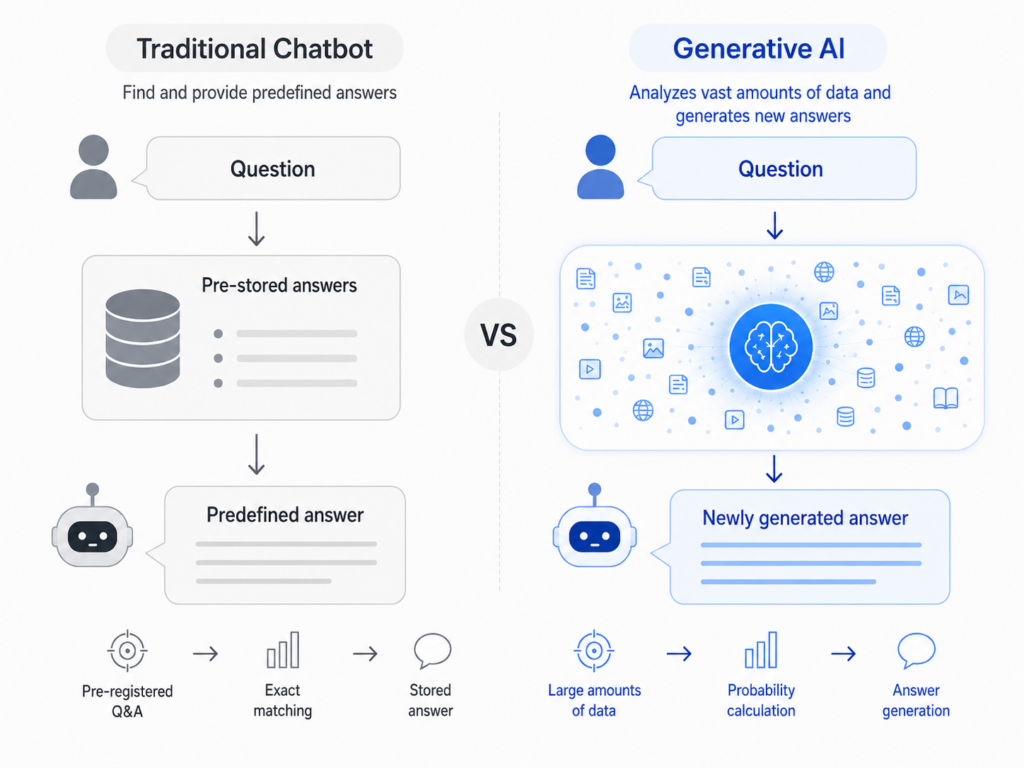
Before generative AI emerged, most chatbots relied on prewritten responses.
Developers prepared sets of questions and answers in advance. When a user entered a question, the chatbot searched for the closest match and displayed the corresponding answer.
Because of this, many people assume that today’s AI systems also retrieve answers that have already been stored.
Generative AI, however, works differently.
It creates a response at the moment a question is asked.
How does it decide what to say?
AI Uses Statistics and Probability to Predict What Comes Next
When people explain AI, they often use the term training.
The word can make AI sound as if it learns and understands information in the same way a person does. In reality, the process is different.
AI does not study information by understanding its meaning in the same way a person does.
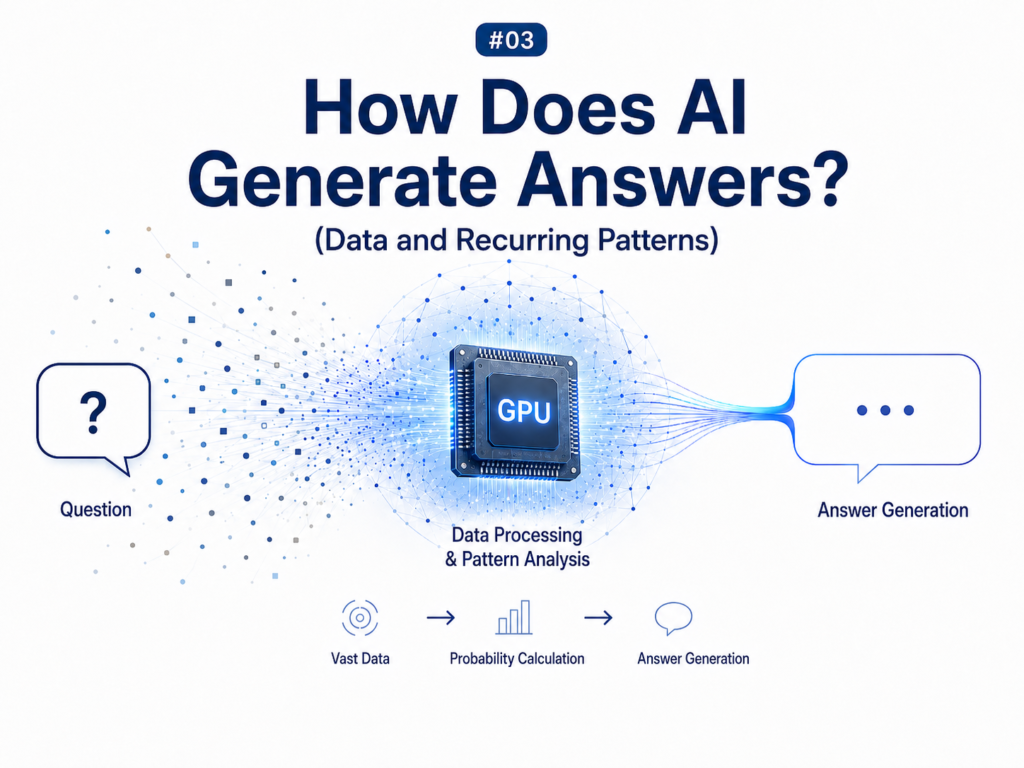
Instead, it repeatedly analyzes enormous amounts of data and identifies recurring patterns.
It examines which words frequently appear together, which sentence structures tend to sound natural, and which expressions commonly follow one another.
Put simply, AI repeatedly calculates:
“What word is likely to come next?”
For example, an AI model may encounter the sentence:
“The capital of South Korea is Seoul.”
It may find similar wording across many documents.
Through this process, the model learns a statistical pattern: after the phrase “The capital of South Korea is,” the word “Seoul” is much more likely to appear than the name of another city.
AI does not need to memorize and store every sentence exactly as it appeared.
Instead, it develops patterns from the relationships between words, sentences, and contexts.
AI Builds an Answer One Word at a Time
Now imagine that a user asks:
“What is the capital of South Korea?”
AI processes the question and begins constructing a response.
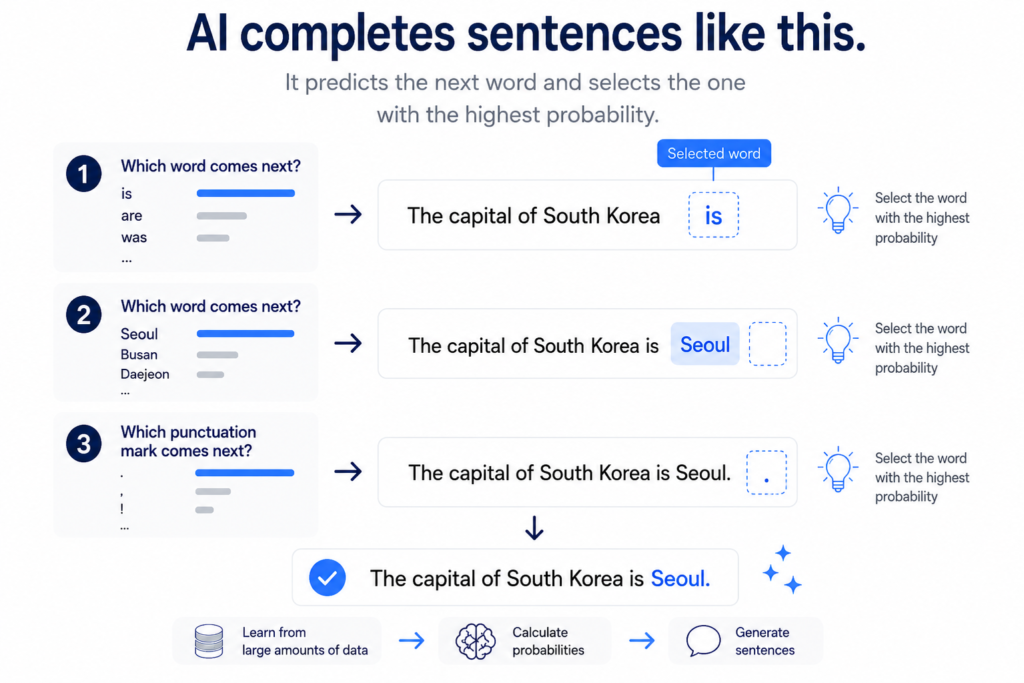
After generating a phrase such as “The capital of South Korea is,” it calculates which word is most likely to come next.
In this context, “Seoul” has a much higher probability than “Busan,” “Daejeon,” or “Gwangju.”
The model therefore selects “Seoul,” then performs another calculation based on the words generated so far.
After producing a phrase such as “The capital of South Korea is Seoul,” it determines whether the sentence should end or continue.
This process repeats until the response is complete.
In other words, AI does not create an entire answer in a single step.
It generates the response sequentially, choosing each word according to the context and the probability patterns identified during training.
All of these calculations happen so quickly that the user sees only the completed answer.
Why Can the Same Question Produce Different Answers?
AI does not always select exactly the same sequence of words.
At many points in a sentence, several words may all be reasonable choices.
One expression may have the highest probability, but other expressions may also fit the context well.
For example, AI might begin an answer with:
- “The main reason is…”
- “This happens because…”
- “AI generates answers by…”
All three openings may communicate the same basic idea.
The model can select among these plausible options instead of repeating only one fixed sentence every time.
Once a different word or phrase is selected, the rest of the answer may develop in a slightly different direction.
That is why one response may be shorter, while another includes an example or provides more detail.
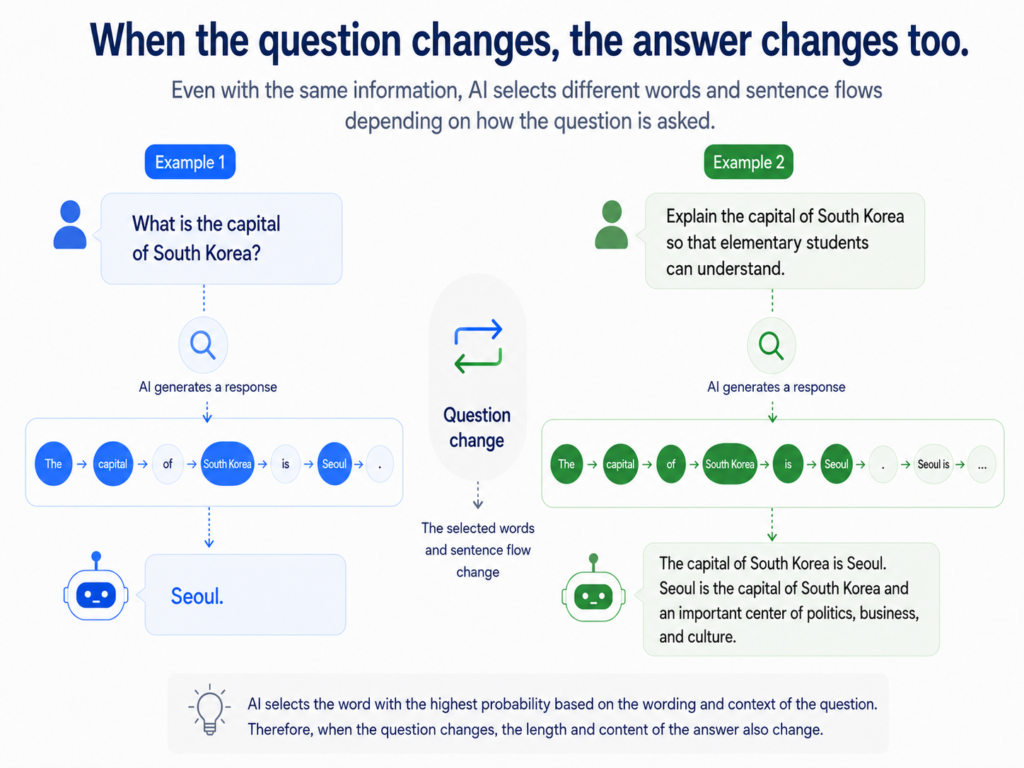
The wording of the question also affects the result.
Changing the sentence ending, adding a condition, requesting a simpler explanation, or specifying a particular audience changes the context that AI uses to generate the next word.
Even when the question is written in exactly the same way, however, several possible word choices may still have similar probabilities.
This is why generative AI can produce slightly different answers to the same question while preserving nearly the same meaning.
This Is How Generative AI Creates Answers
Generative AI uses statistical patterns learned from large amounts of data to construct new responses.
It examines the context, estimates which word is likely to come next, and repeats that process until the answer is complete.
This does not mean that AI is randomly combining unrelated words.
Its choices are guided by patterns found in the data and by the context of the conversation.
However, because several expressions may be appropriate in the same situation, the exact wording can change from one response to another.
That ability to create a new sentence rather than display only a fixed response is one of the defining characteristics of generative AI.
DANA NOTES in One Sentence
AI does not generate answers by thinking in the same way a person does. It uses patterns learned from data to estimate what is most likely to come next and builds a response step by step. Because several expressions may fit the same context, the same question can produce slightly different answers.