What This Article Covers
What Is AX (AI Transformation)?
Recently, companies have begun using the term AX (AI Transformation) more frequently, moving beyond DX (Digital Transformation).
DX is the process of digitally connecting a company’s work and creating a foundation for accumulating and using data. AX can be understood as the stage in which AI uses that foundation to directly assist with work and support decision-making.
In other words, DX is the process of building an environment in which data can be generated, managed, and used, while AX is the stage in which AI uses that data to work alongside people and create new value.
How Are DX and AX Different?
Many people think AX is simply a new name for DX, but their purposes are somewhat different.
DX begins with digitization, such as converting paper documents into digital form, and focuses on connecting multiple systems and creating a foundation for accumulating and using data.
AX, in contrast, uses existing data and systems to help AI support analysis and judgment, allowing work to be performed more quickly and accurately.
Let us look at an example.
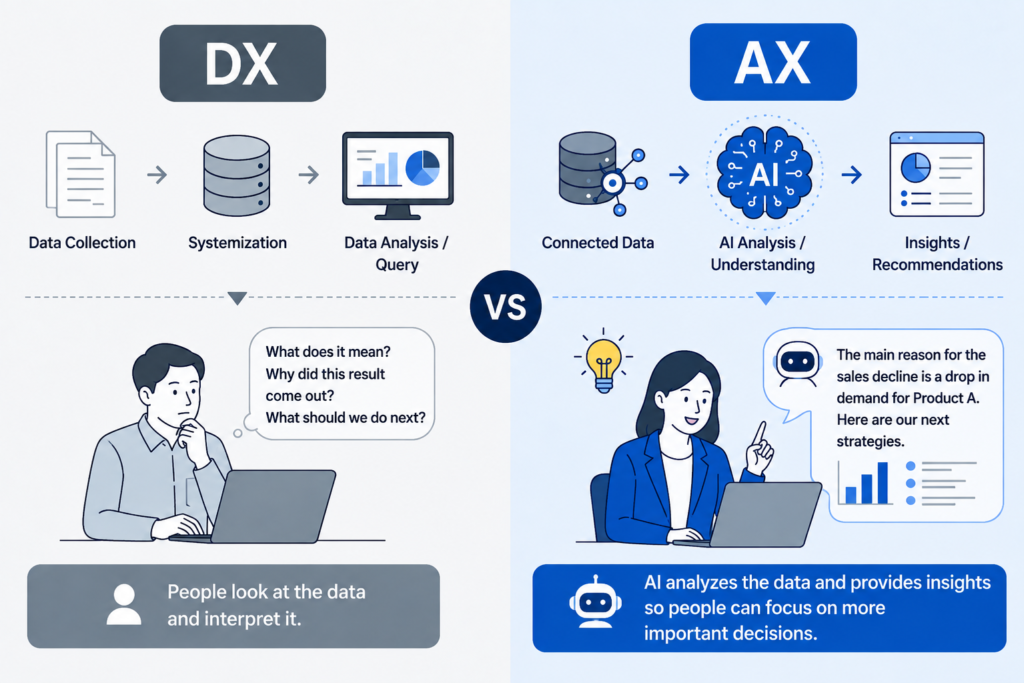
In the past, employees manually retrieved sales data from an ERP system, created spreadsheets, and prepared reports.
In a DX environment, BI (Business Intelligence) tools already make it possible to view sales trends, regional sales volumes, and product performance at a glance. However, interpreting the data and analyzing the causes are still the responsibility of people.
In an AX environment, however, employees can ask AI, “Analyze why sales declined this month.” AI can then combine various data, analyze the causes, and even create a draft report with charts.
Even when the same data is used, the way it is used is very different. In DX, people must examine and interpret the data. In AX, AI first organizes meaningful information, allowing people to focus on more important judgments based on the results.
AX Requires DX First
AI cannot create data on its own.
Data within the company must be organized, multiple systems must be connected, and the necessary information must be easy to retrieve.
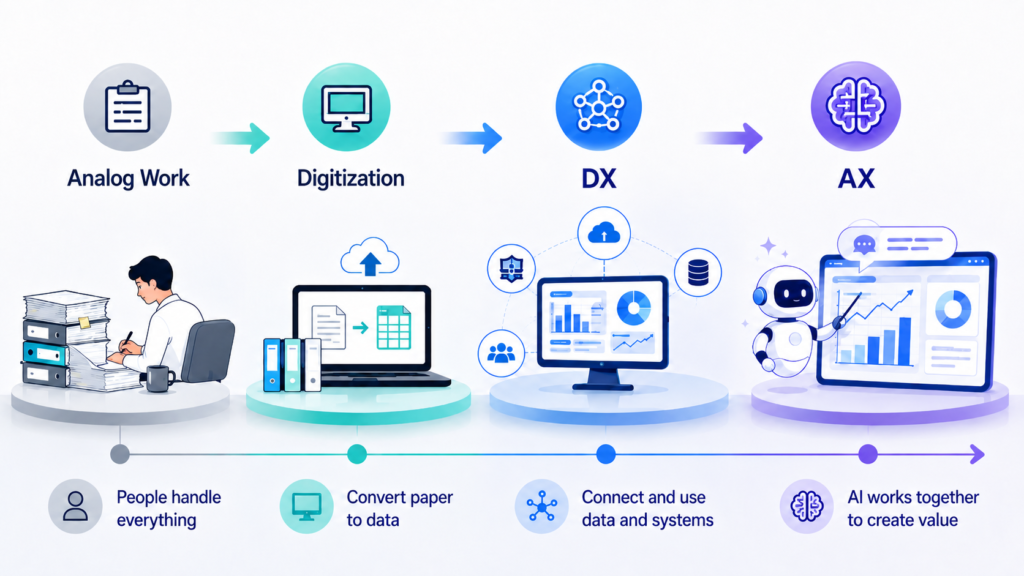
That is why many experts describe the stages of corporate development as follows:
Analog Work → Digitization → DX → AX
A company that uses only paper documents does not have enough data that AI can immediately use. It must first scan the paper documents or extract text from them and convert the information into digital data.
In contrast, if a company already has systems such as ERP, CRM, groupware, and cloud services in place, AI can use that data to automate and analyze various tasks.
AX is therefore not a concept that replaces DX. It can be understood as the next stage of innovation built on DX.
Where Is AX Used in Practice?
Many companies are already applying AX to various areas of their work.
In customer service centers, AI summarizes conversations and recommends appropriate responses.
Sales departments use AI to analyze customer data and identify customers who are more likely to make a purchase.
At production sites, AI analyzes equipment data to predict failures in advance.
Human resources departments may use AI to analyze résumés or recommend training programs that employees need.
Developers use AI coding tools to write and review programs more quickly.
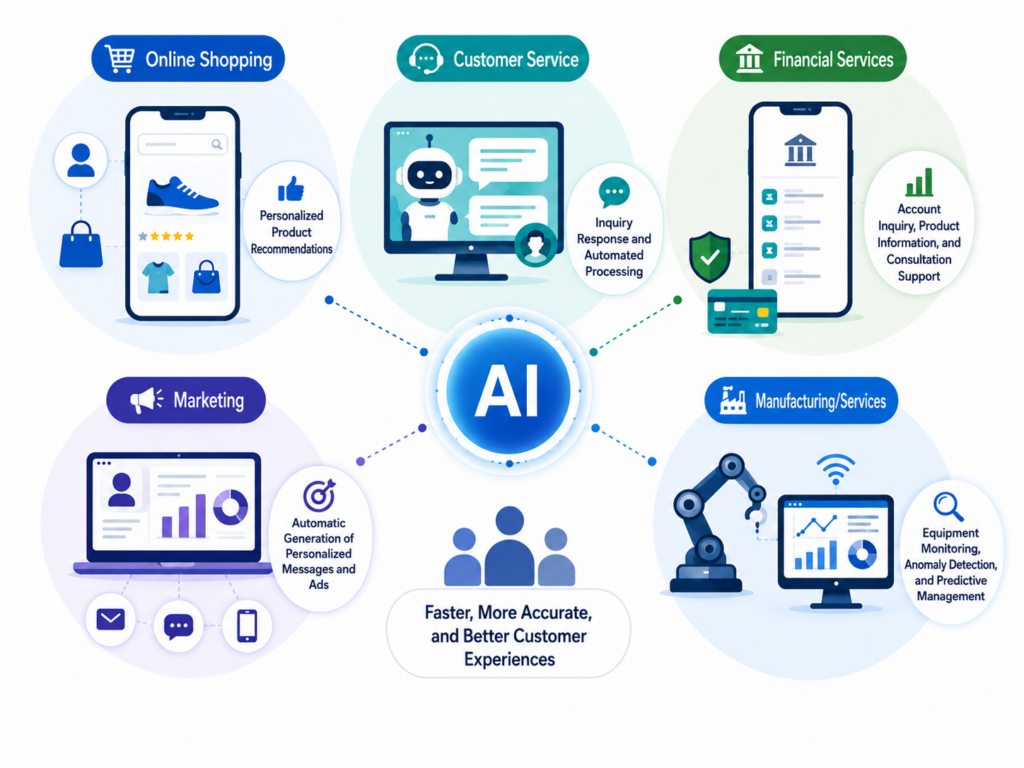
AX is also being actively used in services that interact directly with customers.
Online shopping platforms use AI to analyze customers’ purchase histories and behavioral data and recommend personalized products.
In financial services, AI chatbots handle account inquiries, provide product information, and conduct simple consultations in real time.
Telecommunications companies and platform services use AI to respond to customer inquiries first and connect customers to human representatives only when necessary.
In marketing, AI may analyze customers’ interests and behavioral patterns and automatically generate personalized messages or advertisements.
In the past, people had to find all the information themselves. Now, work is changing so that AI analyzes the information first, while people focus on final judgments and decision-making.
Technologies That Enable AX
AX does not refer to a single technology.
It is a concept in which multiple technologies work together to make AI usable in actual business operations.
The main technologies include:
- AI and generative AI
- Business systems such as ERP and CRM
- Cloud
- Databases
- API integration
- Data analytics (BI)
- Vector databases and RAG
- AI agents
When these technologies are organically connected, AI can move beyond being a simple chatbot and develop into a digital colleague that performs actual work.
AX Will Become Even More Important
Many companies are already producing completely different results even when they have access to the same data.
Some companies do little more than store and retrieve data, while others use AI to predict customer behavior, automate work, and make decisions more quickly.
This difference is likely to grow over time.
AI technology is also developing rapidly, and functions that are currently applied to only certain tasks are gradually expanding into a wider range of fields.
In the future, corporate competitiveness may depend not simply on whether a company has adopted AI, but on how effectively it can collaborate with AI.
AX represents this change and is a new direction for corporate innovation. Many companies are expected to pursue AX more actively as a strategy that follows DX.
DANA NOTES in One Line
DX is the process of building data and systems, while AX is a new way of working in which AI uses that foundation and works alongside people.