What This Article Covers
Advances in data, algorithms, and computing resources have enabled AI to grow rapidly. Then why do AI systems from the same era still differ in performance?
The Roles of Data and Models
Even when the same question is asked, different AI systems can provide answers of different quality.
Some AI systems give more accurate and natural answers, while others may give off-the-mark or insufficient answers.
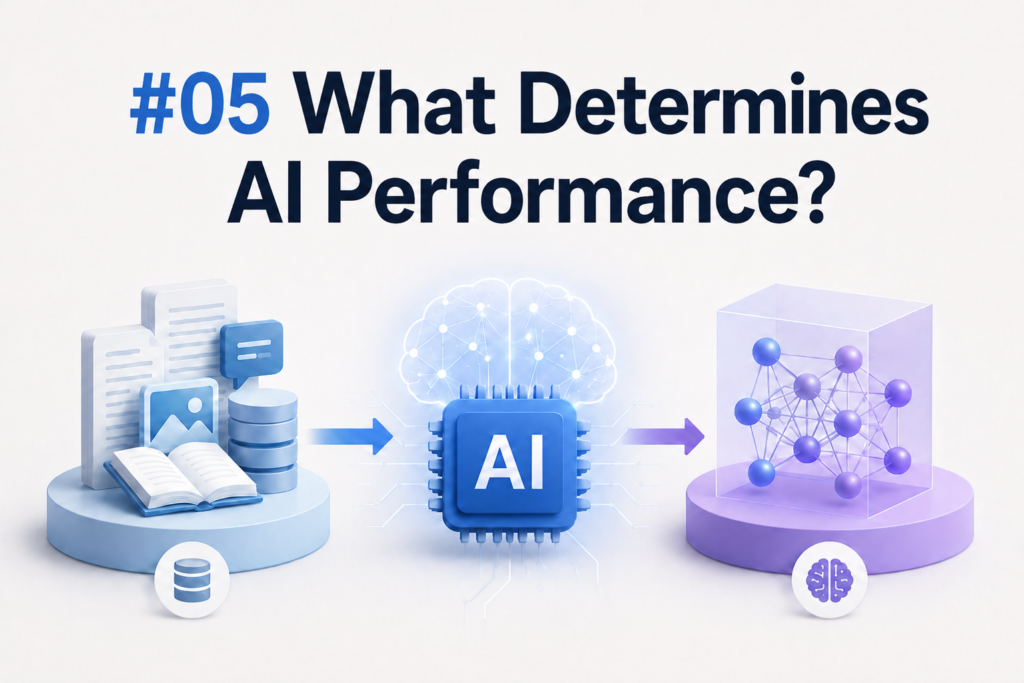
So, what determines AI performance?
Many people think that AI performance improves as the amount of data increases. However, in reality, both data and models work together to determine AI performance.
Data Quality Is More Important Than Data Quantity
AI learns from various types of data during training, including internet articles, books, news, academic papers, and programming code.
However, simply having more data does not necessarily make AI better.
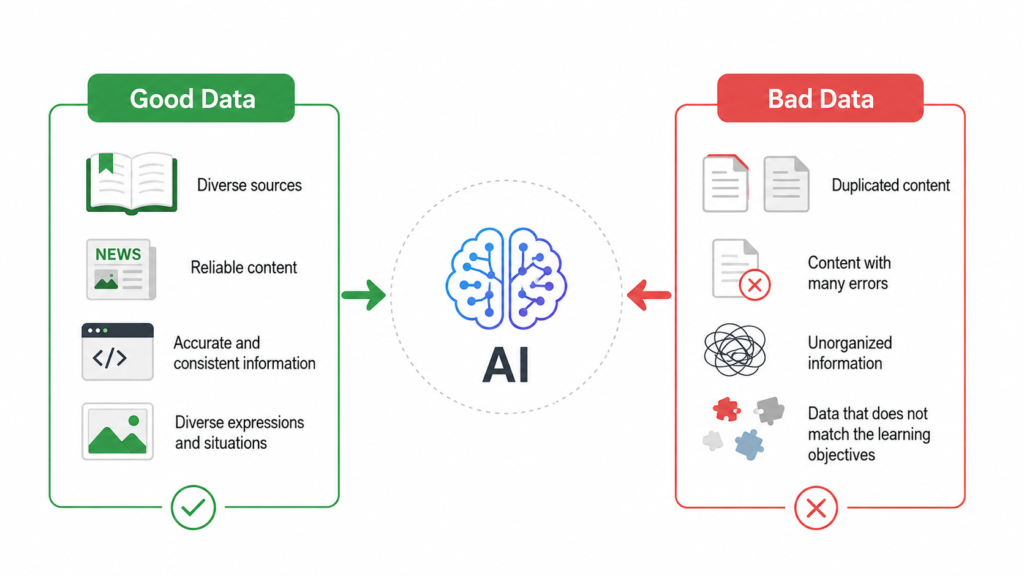
Good data for AI contains fewer errors, includes a variety of situations and expressions, and is well organized for the purpose of training.
On the other hand, if the data contains a lot of incorrect information, the same content is unnecessarily repeated, or much of the data is unsuitable for training, AI performance can also be affected.
In other words, not only the amount of data but also the quality of the data is very important to AI performance.
A Model Is How AI Calculates
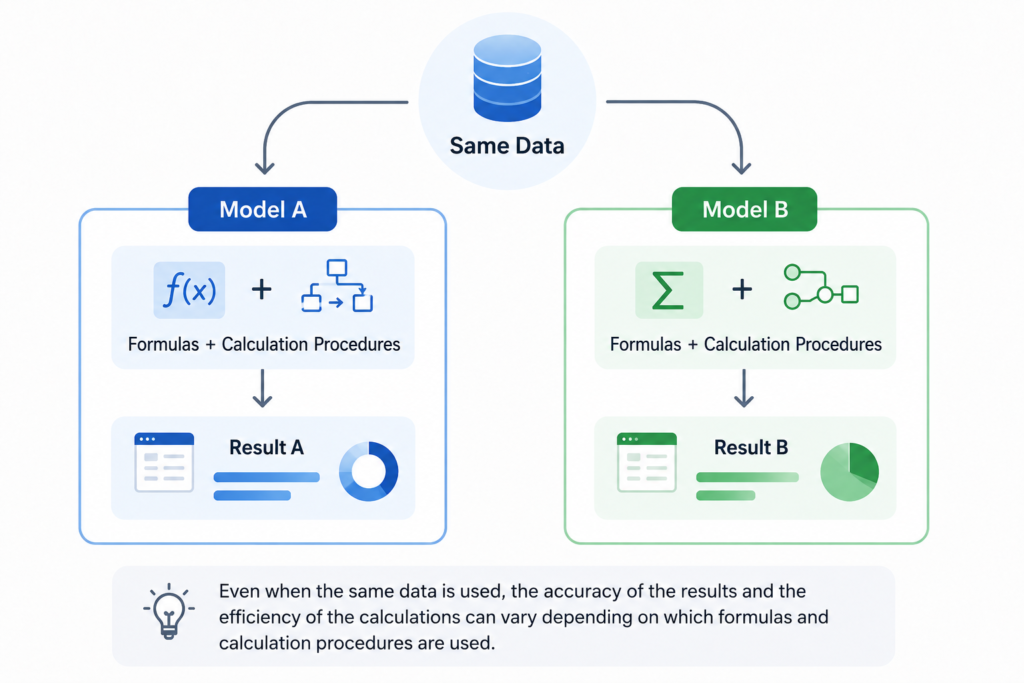
A model can be understood as the formulas and calculation procedures AI uses to produce an answer.
GPT, Claude, Gemini, LLaMA, and Sora, which many people are familiar with, are all names of such models.
Even when the same data is used, the accuracy of the results and the efficiency of the calculations can vary depending on which formulas and calculation procedures are used.
Just as companies continuously improve their production methods, AI companies also continue to improve their models in order to produce more accurate results or to produce similar results faster and at a lower cost.
How Does AI Become More Accurate?
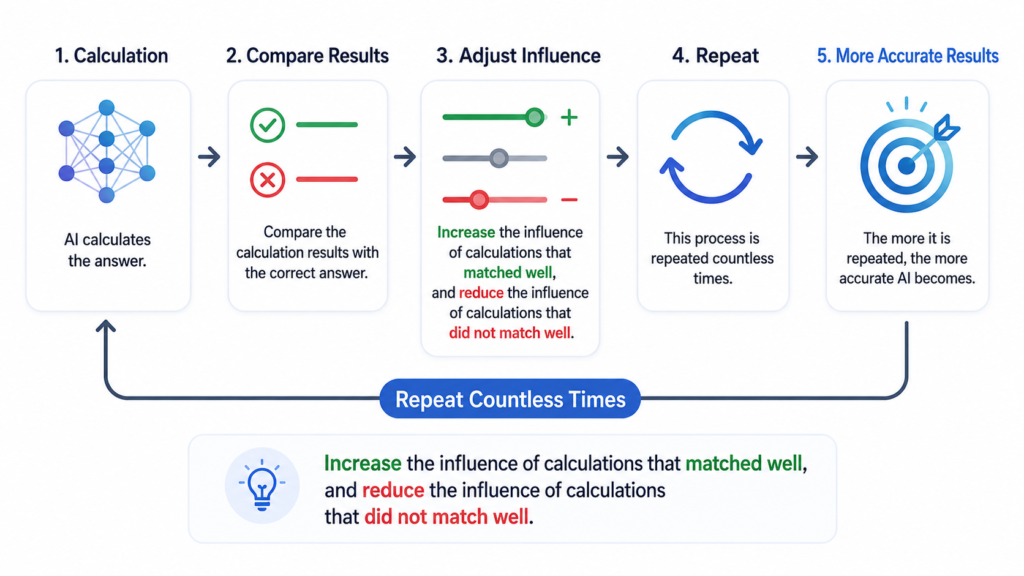
During the training process, AI gradually adjusts the numerical values used in its calculations so that it can produce more accurate results.
By repeating this process countless times, calculations that produced better results are given more weight, while the influence of incorrect calculations is reduced.
As this process is repeated, AI gradually becomes able to produce more accurate results.
In addition, high-performance computing hardware such as GPUs is used to process these repeated calculations more quickly.
Good AI Is Built with Both Data and Models
Having good data alone does not create the best AI.
On the other hand, even an excellent model has limitations in performance if it does not have good data.
Ultimately, AI performance improves when both good data and a good model are in place.
That is why AI companies today are constantly competing to secure better data while also developing better models.
DANA NOTES in One Sentence
AI performance depends on what data it was trained on and how the model that processes that data was designed.
In the Next Article
Having more data and a larger model does not mean that AI will always produce accurate answers.
In the next article, we will look at AI hallucinations, where AI presents things it does not know as if they were facts or creates information that does not exist, as well as the fundamental limitations of AI.