What This Article Covers
AI Is Not a Recently Invented Technology
Many people assume that AI first appeared with the arrival of ChatGPT.
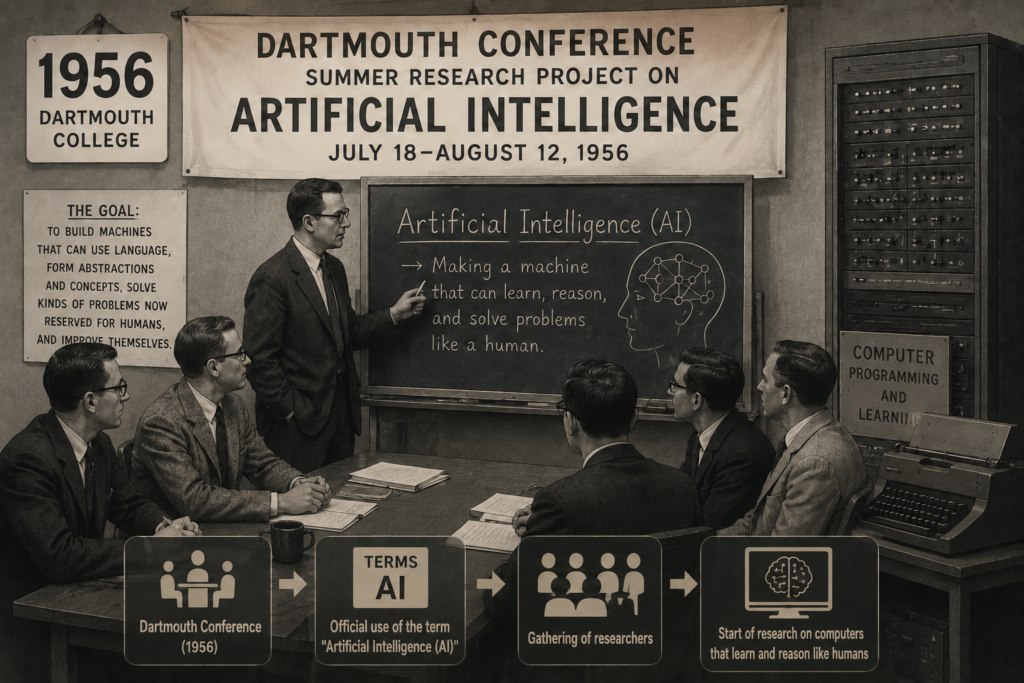
However, the concept of artificial intelligence has existed for much longer.
At the Dartmouth Conference in 1956, At the Dartmouth Conference in 1956, the term “Artificial Intelligence,” or AI, was officially used for the first time. Researchers began exploring how to build computers capable of learning and reasoning like humans.
In other words, the history of AI goes back about 70 years.
So how did AI become as capable as it is today?
Three Elements Must Advance Together for AI to Develop
AI development depends on three major elements.
- Data: The material from which AI learns
- Algorithms: The methods AI uses to learn
- Computing resources: The processing capacity AI uses to perform calculations
These three elements are closely connected.
Even with an excellent algorithm, an AI system cannot learn properly without enough data.
Conversely, even when data and algorithms are available, training can take an extremely long time—or become practically impossible—if there is not enough computing power to perform the necessary calculations.
In other words, AI cannot achieve significant growth through the advancement of only one of these elements.
Computing Power Was the Biggest Limitation in the Past
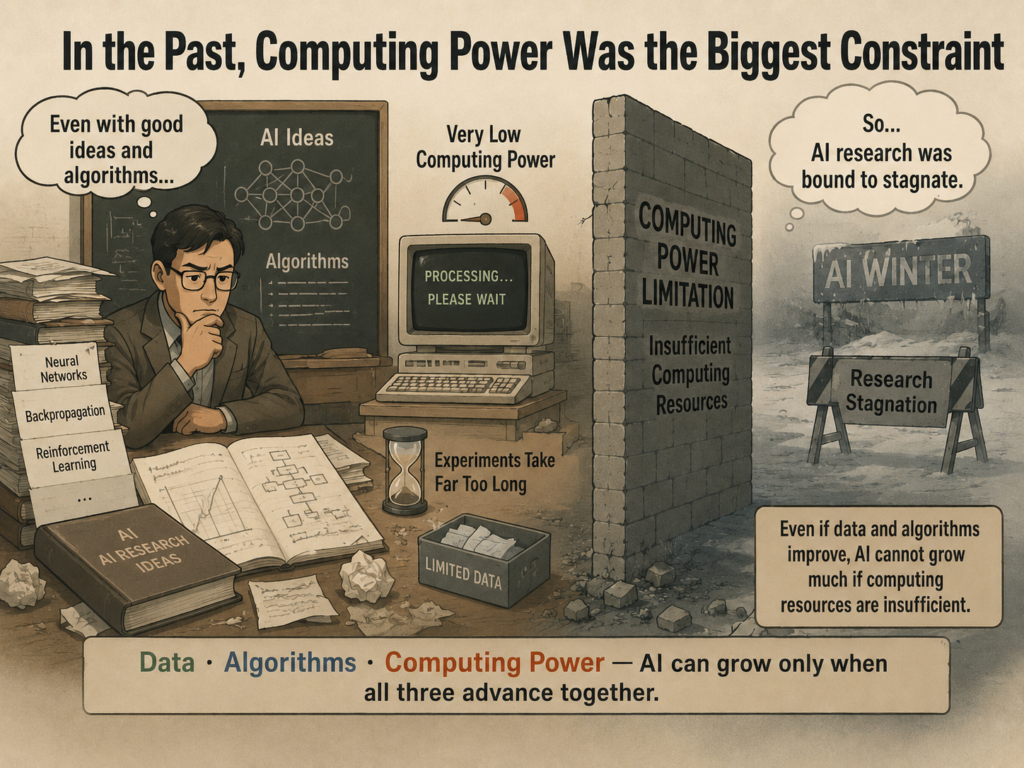
AI researchers have proposed various ideas and algorithms for decades.
However, computers at the time were far less powerful than they are today, and there was not enough data available for training.
Testing complex algorithms took a considerable amount of time, and it was extremely difficult to train large-scale AI models in that environment.
Even when data and algorithms improved, there were not enough computing resources to support them. As a result, AI research went through several periods of stagnation.
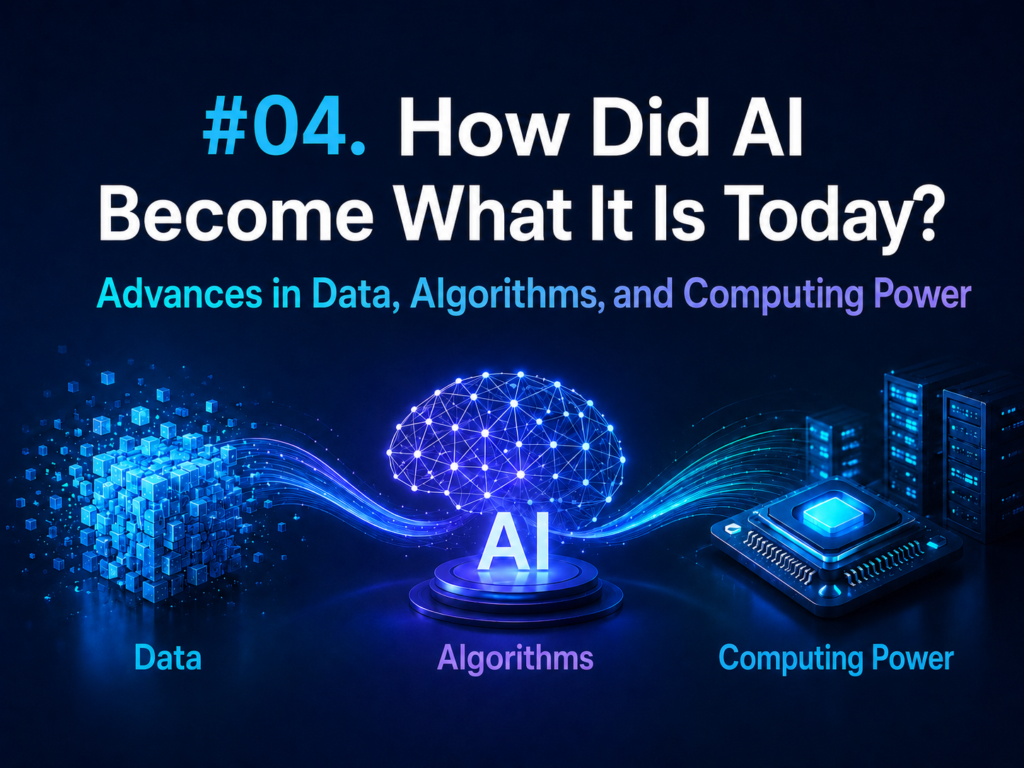
How Did AI Become What It Is Today?
AI did not develop overnight.
After the concept of AI was proposed in 1956, the field experienced two periods of stagnation known as the “AI winters.”
However, AI research began to advance again as data continued to accumulate, computer performance improved, and new algorithms emerged.
In particular, the widespread adoption of personal computers and the internet from the 1990s onward led to a rapid increase in digital data. During the 2010s, the expansion of smartphones and social media caused the amount of available data to grow explosively.
At the same time, the development of systems that could use GPUs for AI computation made it possible to complete training processes much faster than before. Tasks that had once taken several months could now be performed in far less time.
The emergence of new approaches such as deep learning and the Transformer architecture further accelerated AI development to an unprecedented degree.
| Period | Data | Algorithms | Computing Resources | Result |
|---|---|---|---|---|
| 1956 | – | The concept of artificial intelligence was proposed | – | AI research began |
| 1970s | Insufficient data | Research stagnated | Insufficient computer performance | First AI winter |
| 1986 | – | Backpropagation emerged, allowing neural networks to learn by correcting their own errors | – | The foundation for neural network research was established |
| Late 1980s–1990s | – | The limitations of rule-based AI, including expert systems, became apparent | Computer performance remained limited | Second AI winter |
| 1990s–2000s | Digital data increased with the spread of personal computers and the internet | – | CPU performance improved | The AI research environment improved |
| 2006 | – | – | CUDA established a foundation for using GPUs in AI computation | Large-scale AI computation became possible |
| 2009 | Large-scale training datasets such as ImageNet emerged | – | – | The AI training environment improved |
| 2010s | Digital data increased explosively with the spread of The volume of digital data surged with the spread of smartphones and social media. | Deep learning research became more active | GPU performance improved | AI performance grew rapidly |
| 2012 | Large-scale datasets were actively used | AlexNet demonstrated a major breakthrough in image recognition through deep learning | GPU use became widespread | AI research began to accelerate again. |
| 2017 | – | The Transformer architecture introduced a more efficient way to calculate relationships between words in context | GPU clusters became more widely used | The foundation for generative AI was established |
| 2022 | Vast amounts of internet data were used | – | Massive GPU clusters were used | Generative AI became mainstream. |
This timeline shows that AI did not become what it is today because of the advancement of a single technology.
It is the result of data, algorithms, and computing resources advancing together over a long period of time.
Will AI Continue to Advance?
In today’s AI industry, the importance of computing resources is also continuing to grow.
Training larger AI models and running them faster require high-performance hardware, including GPUs and specialized AI chips.
Physical AI, which connects AI with the real world through technologies such as robots and autonomous vehicles, is also receiving growing attention.
Future AI development will go beyond producing better answers.
AI is expected to become naturally integrated into a wide range of devices and services in the physical world, transforming both our daily lives and industries.
DANA NOTES Commentary
Many people believe that AI suddenly appeared within the past few years.
In reality, however, today’s AI is the result of about 70 years of research and trial and error since the concept was first proposed in 1956.
During its early history, During its early years, AI development was constrained by insufficient data and limited computing power. The field also experienced two AI winters, during which research progress slowed considerably.
Later, the spread of the internet and smartphones caused the amount of available data to increase dramatically. Computing environments based on GPUs became more powerful, while new algorithms such as deep learning and the Transformer architecture emerged.
Together, these developments gave rise to the AI systems we use today.
The most accurate way to understand modern AI is to recognize that it did not suddenly become intelligent. Its current capabilities emerged because data, algorithms, and computing resources advanced together.
DANA NOTES in One Sentence
Today’s AI is the result of data, algorithms, and computing resources advancing together over many years.