Recommended Reading
What This Article Covers
When using generative AI, you often hear comments like this:
“It’s really good at English, but its Korean still seems lacking.”
Many people have also received responses that sounded somewhat unnatural when asking questions in Korean or experienced speech recognition systems interpreting completely different words.
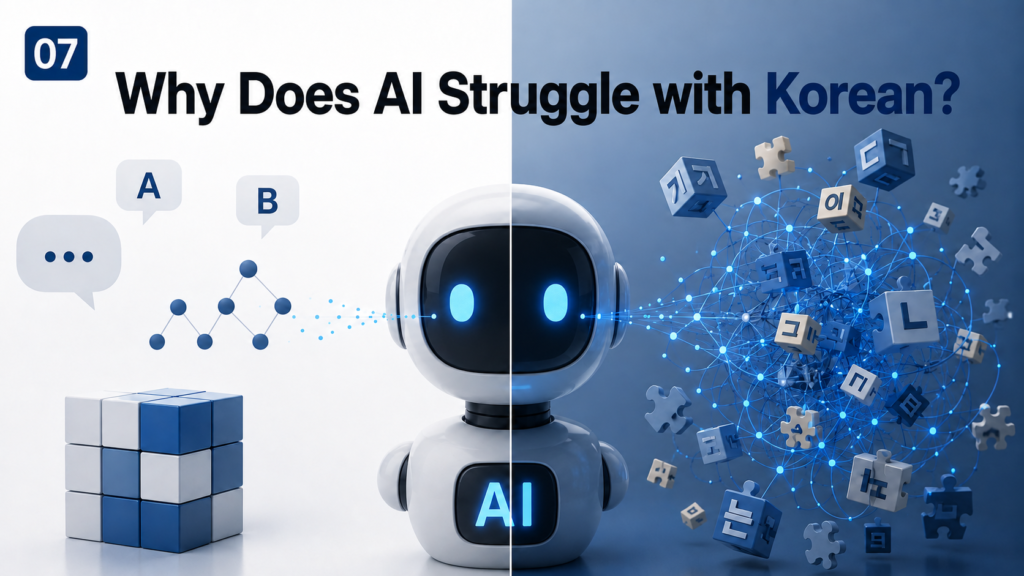
So, does AI really struggle with Korean?
To begin with the conclusion, this is true to some extent.
However, the reason is slightly different from what many people think.
It is commonly explained by saying, “It is because there is not enough Korean data,” but the actual reason is a little more complex.
What Matters to AI Is Not the “Amount of Material,” but “Data It Can Learn From”
Let us first examine the part that is most commonly misunderstood.
There is no shortage of Korean-language material itself.
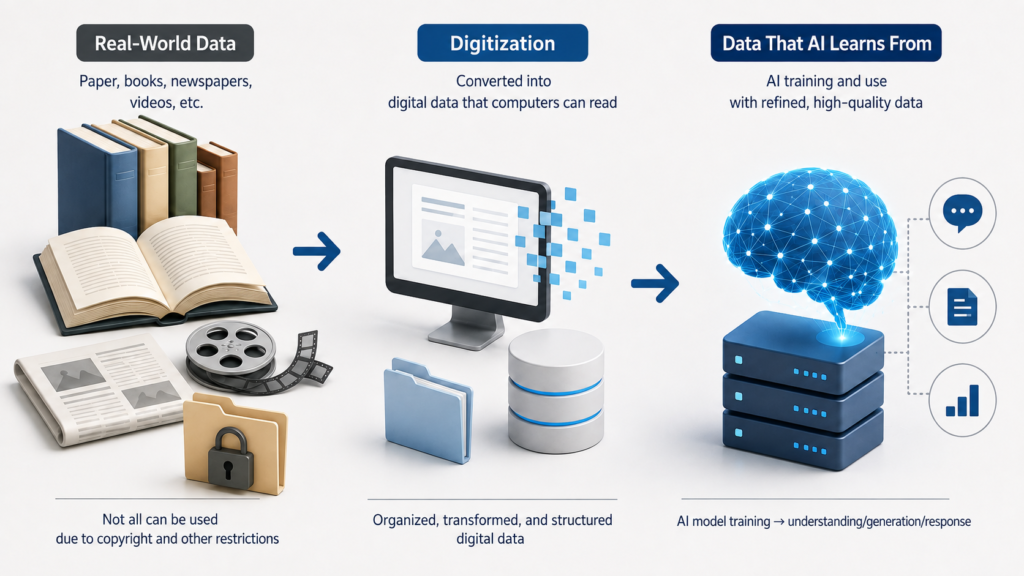
We have a vast amount of Korean-language material accumulated over many years, including books, newspapers, research papers, textbooks, and literary works.
However, what matters to AI is not whether the material exists, but whether it exists in a form that can be used for learning.
For AI to learn from material, it must be organized in digital form and structured so that computers can read it. Errors and duplication must also be removed, and the rights required to use the material for training must be secured.
There are many Korean-language blogs and posts on the internet, but there is also a considerable amount of duplicated content, short comments, writing with many typographical errors, and material that cannot be freely used because of copyright restrictions.
By contrast, systematically organized materials such as professional books, academic resources, and verified news articles are far more valuable for AI training.
Ultimately, AI performance is greatly influenced not simply by the amount of material available, but by how much high-quality digital data it has learned from.
Korean Gives AI Many More Possibilities to Calculate
Korean is a language with highly developed particles and verb-ending changes.
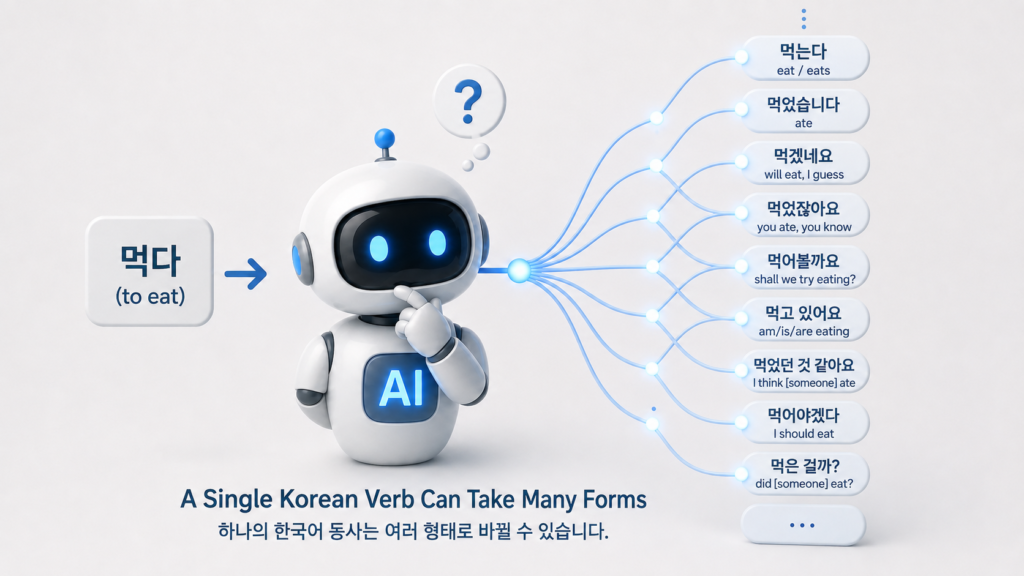
For example, even the single verb 먹다 (to eat) can take many different forms.
- 먹는다
- 먹었습니다
- 먹겠네요
- 먹었잖아요
- 먹어볼까요
People naturally understand that all of these expressions come from the same verb.
However, AI produces sentences in a slightly different way.
AI does not first understand a sentence and then recite a memorized answer. Based on the context so far, it continually calculates which word would be the most natural one to come next.
In Korean, changing just one particle or verb ending can alter the meaning and tone of a sentence, as well as the impression conveyed to the other person.
In other words, Korean is a language in which AI has a very large number of choices to calculate.
People Also Understand Language Through Context
Korean frequently omits the subject.
For example, simply looking at the sentence:
“먹었어.”
“I ate,” “You ate,” or “Someone ate.”
does not tell us who ate.
People also understand its meaning by considering the preceding conversation.
The same applies to AI.
It can produce the correct answer only by considering the previous context as well.
The difference is that people quickly determine meaning based on the experiences they have accumulated throughout their lives, whereas AI performs the calculation again based on the conversation so far whenever it receives a new question.
This is also why AI is more likely to make mistakes when the subject changes several times or when more information is omitted.
Why Korean Is Difficult for Foreign Learners and Why It Is Difficult for AI Are Slightly Different
Korean is not an easy language for foreign learners either.
However, the reason Korean is difficult for AI is slightly different from the reason it is difficult for foreign learners.
People learn language by understanding meaning and situations.
By contrast, AI calculates the expression most likely to come next based on the context entered so far.
In other words, people learn language by “understanding” it, while AI learns language by “calculating” it.
Korean Requires AI to Calculate Cultural Context as Well
Korean conversations often cannot be fully explained through grammar alone.
For example:
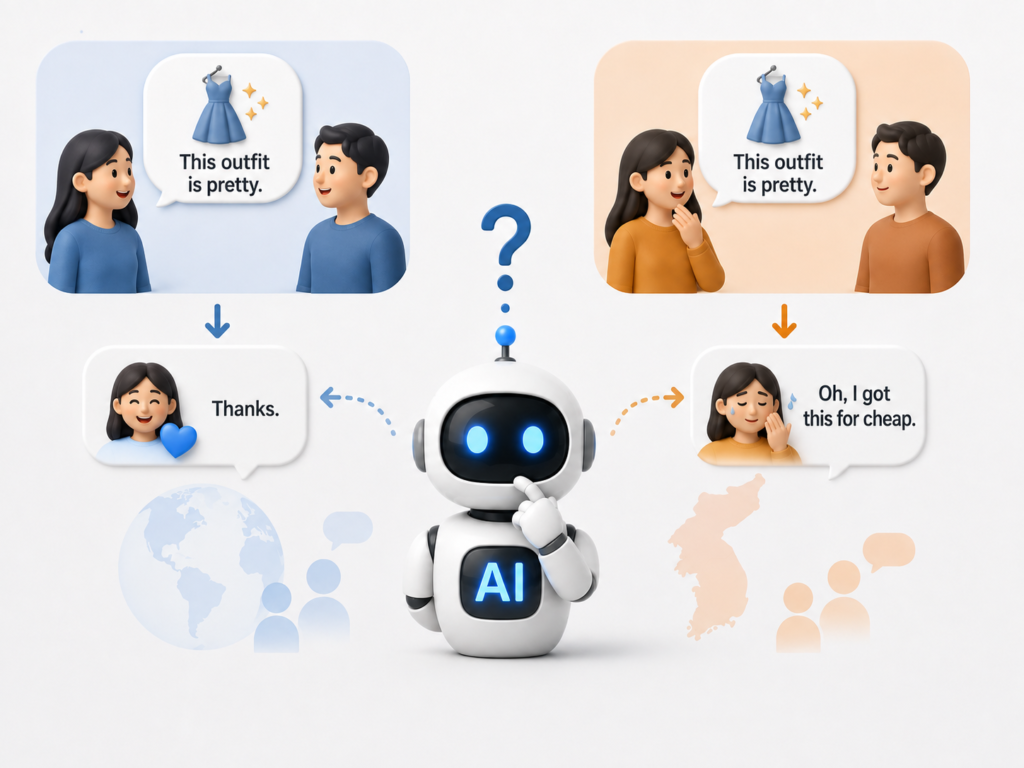
A: 이 옷 예쁘다.
A: This outfit is pretty.
In English-speaking cultures, people often respond directly:
B: 고마워.
B: Thank you.
By contrast, in Korea, responses like these are also common:
A: 이 옷 예쁘다.
A: This outfit is pretty.
B: 아, 이거 싸게 샀어.
B: Oh, I got this for cheap.
Or:
B: 네 옷이 더 예쁘다.
B: Your outfit is prettier.
Looking only at the sentences, these may not appear to be responses to a compliment.
However, we naturally understand the cultural meanings behind them, such as modesty or familiarity.
Because AI must consider this cultural context as well, Korean conversations can feel even more complex to it.
Why Koreans Are More Likely to Feel That AI Is Not Good at Korean
Koreans often encounter AI through speech recognition or translation.
Korean is particularly difficult for speech recognition because of final consonants and various pronunciation changes.
When particles, verb endings, honorifics, omissions, and cultural expressions are added, AI’s mistakes can sometimes be more noticeable in Korean than in other languages.
This makes it easy for many people to think, “AI is not good at Korean.”
However, this does not mean that AI dislikes Korean or is somehow specifically unable to understand it.
Recently, Korean companies and research institutions have steadily developed high-quality Korean-language data, while models optimized for Korean have also advanced, significantly improving performance.
Today’s generative AI demonstrates a very high level of performance in Korean as well. As more high-quality Korean-language data is developed, its performance will continue to improve.
DANA NOTES in One Line
AI struggles with Korean not simply because of the amount of Korean-language material available, but because differences in high-quality, trainable data and the language’s linguistic and cultural complexity work together.
In the Next Article
Even when the same question is asked in the same language, AI’s response may differ slightly each time.
In the next article, we will examine why the way a question is phrased and the preceding conversation affect the response, focusing on the roles of prompts and context.