Notice
This article is educational content designed to explain how AI works in an accessible way. The operating methods and features of individual AI services may differ slightly.
What This Article Covers
Why Does AI Give Different Answers to the Same Question?
As we explored in #03 How Does AI Find Answers?, AI generates answers by selecting the next word probabilistically. Then why can it give different answers to the same question? In this article, we will examine the reasons.
When using AI, you have probably had an experience like this at least once.
You may have asked the same question today that you asked yesterday and received a different answer. Or you may have entered the same question twice on the same day, only to find that the wording or examples differed slightly.
At first, you might wonder, “Was the AI wrong?” or “Was the previous answer correct and this one wrong?”
However, in most cases, this is not an error. It is a result of how AI works.
AI is not a program that stores correct answers in advance and retrieves them when needed. It combines the content of the question with the flow of the conversation and generates the answer it calculates to be the most appropriate for that question and context at that moment.
This is why the same question can produce slightly different answers depending on the situation.
The Way You Ask a Question Changes the Answer
A question or instruction entered into AI is called a prompt.
A prompt does not simply mean a single question. It includes the conditions given to AI, the desired format, and the level of explanation.
For example, compare the following two questions:
- “Recommend a diet meal plan.”
- “Recommend a one-week low-carbohydrate diet meal plan.”
These may look like similar questions to a person, but AI interprets them as different requests.
The first question leaves a very broad range of options, so AI can suggest various types of meal plans.
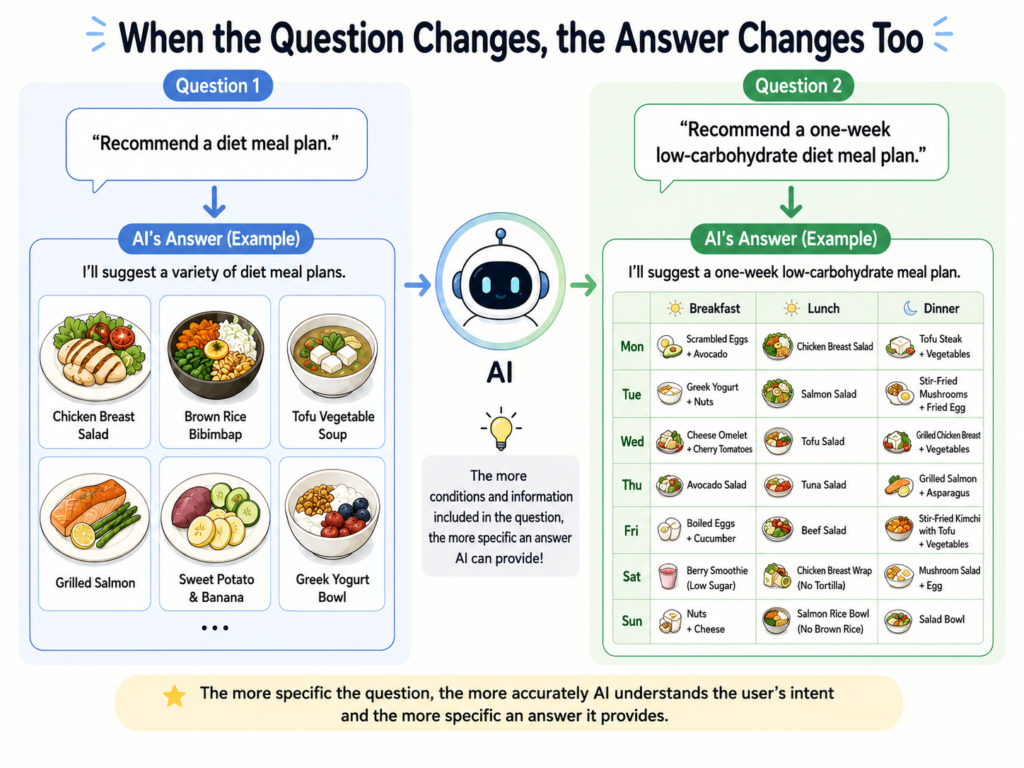
By contrast, the second question adds the condition of a low-carbohydrate diet and a period of one week, allowing AI to produce a much more specific answer.
Let us look at another example:
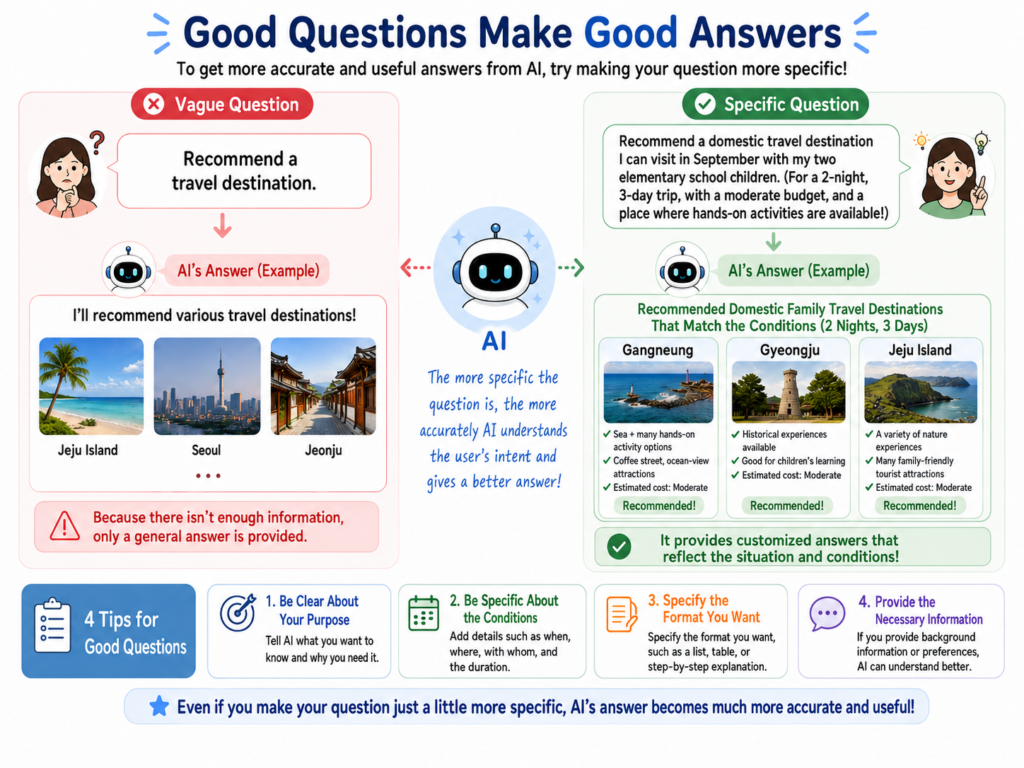
- “Recommend a travel destination.”
- “Recommend a domestic travel destination that I can visit with my two children in September.”
The second question adds information about the season, the people traveling, and the region. AI generates its answer by considering all of these conditions.
Ultimately, the more specific the question is, the closer AI can come to producing an answer that matches the user’s intention.
AI Also Refers to the Flow of the Conversation
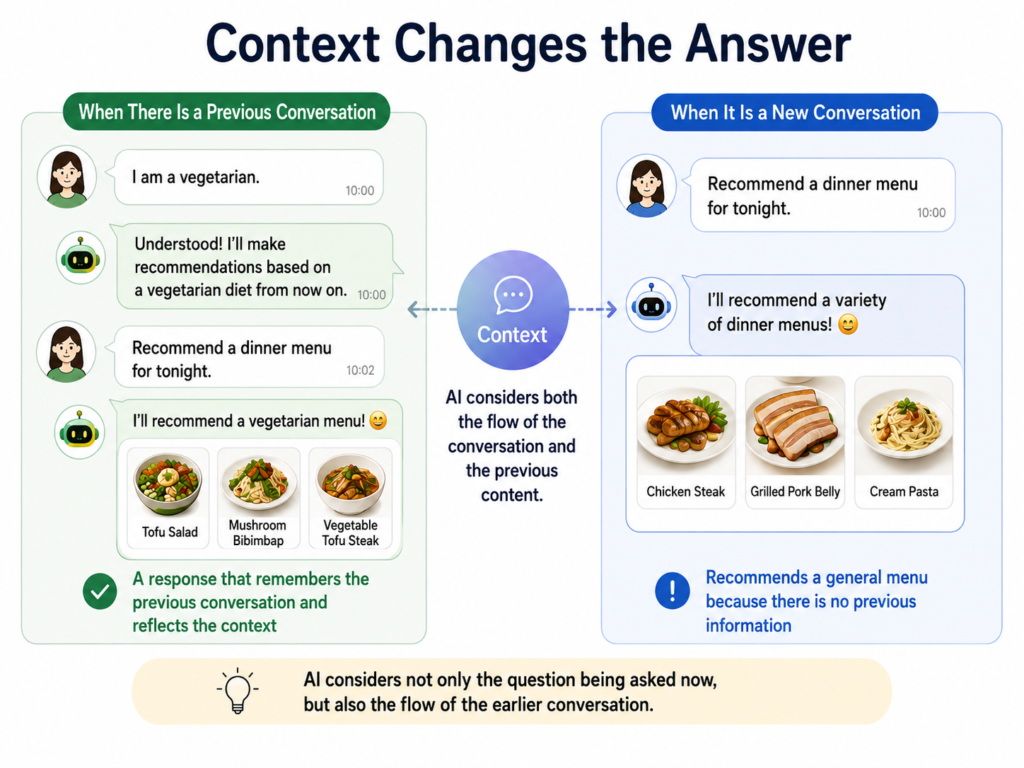
AI often considers not only the current question but also what was discussed earlier in the same conversation. This is called context.
Suppose you first say, “I am a vegetarian.”
If you later say, “Recommend something for dinner tonight,” AI will try to recommend a vegetarian meal even without further explanation.
However, when you start a new conversation and ask the same question, AI is more likely to recommend a general meal because it does not have the information that you are a vegetarian.
In this way, AI does not interpret only the single sentence currently entered. It generates an answer by considering the overall flow of the conversation.
Therefore, even when the same person asks the same question, the result can differ depending on what was discussed beforehand.
Why Answers Can Differ Slightly Even to the Same Question
There is one more reason.
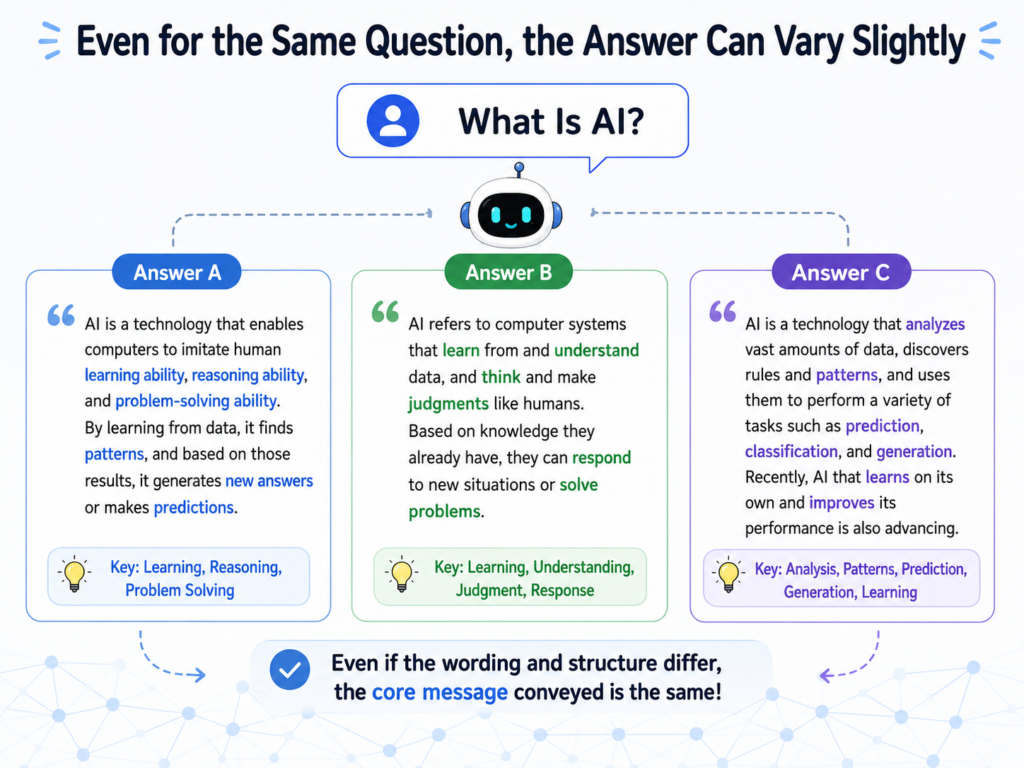
AI does not always select only one correct answer. It produces what it considers the most appropriate answer from among multiple possible expressions and sentences.
For example, when you enter the same question several times, the core content may remain similar, while the order of explanation or the examples may change.
This is not because AI is unstable. It is a result of its design, which is intended to create more natural and varied conversations.
If AI always repeated exactly the same sentence, it would feel less like a conversation with a person and more like a program that simply outputs a predetermined sentence.
In other words, AI can maintain the core meaning while varying the wording and structure slightly.
How Can You Get the Answer You Want?
Understanding this principle also changes how you use AI.
When you do not receive the answer you want, rather than immediately assuming that AI is wrong, it is helpful to first consider whether your question was specific enough.
By specifying the desired level of explanation, including the necessary conditions, and stating the format you want, you can help AI generate an answer that is much closer to your intention.
It is also helpful to provide necessary information in advance and continue asking questions within the previous conversation. This increases the likelihood that AI will understand the context more effectively and provide a consistent answer.
Conversely, when you need a variety of ideas, slightly changing the same question or trying it several times can also be a useful approach.
AI’s answer is not a fixed correct answer that it finds and displays. It is a result created from the question and context. Therefore, how effectively a person can use AI depends greatly not only on the AI itself, but also on the kinds of questions the user asks.
DANA NOTES in One Line
When AI gives different answers to the same question, it is usually not an error. The result changes depending on the prompt, the context, and which expression is selected from among multiple possibilities.
In the Next Article
So far, we have examined what AI is, how it creates answers, and what limitations it has.
Beginning with the next article, we will explore how AI has developed beyond language toward understanding images, audio, video, and even the physical world.
First, we will examine why AI technology began developing around language.