Disclaimer
This article is based on publicly available reports as of July 14, 2026. Semiconductor import and export regulations and national policies may change depending on international developments.
What This Article Covers
As the AI era advances, we often hear about the growing importance of semiconductors and GPUs.
However, simply possessing a large number of GPUs is not enough to operate AI services.
Thousands or even tens of thousands of GPUs must be installed, supplied with enormous amounts of electricity, kept cool, and operated reliably around the clock.
This requires an AI data center.
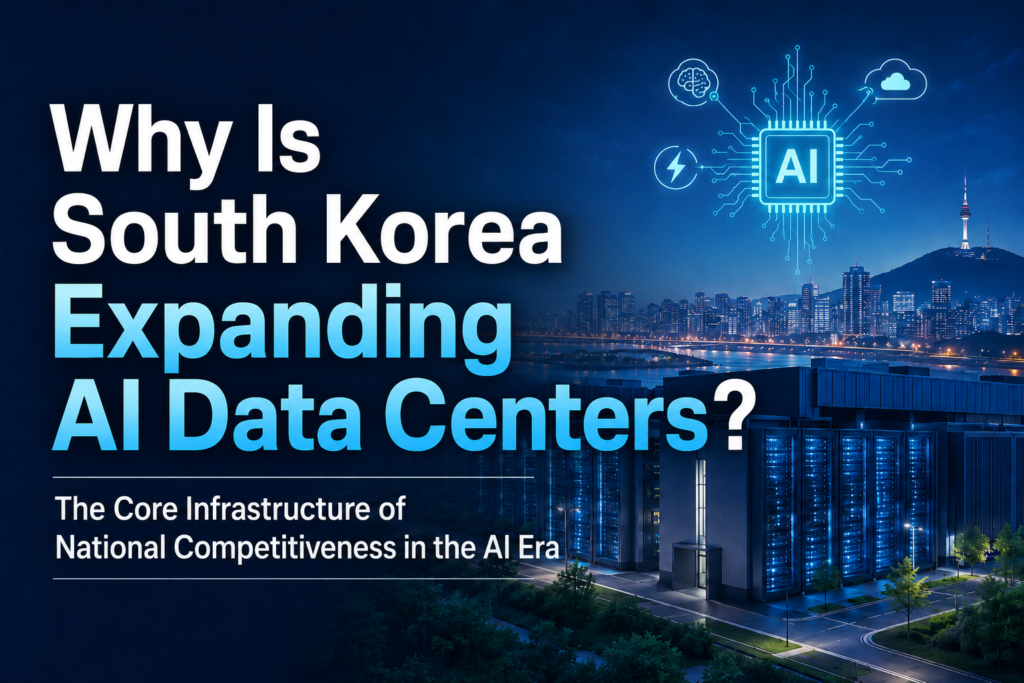
This is also why the construction of AI data centers has been accelerating across South Korea.
The country is not simply building more facilities to house servers. It is developing the national infrastructure required to operate AI services reliably in the years ahead.
As AI Advances, Data Centers Grow with It
The rise of generative AI has made data centers far more important than they were in the past.
AI systems perform enormous amounts of computation when answering questions or generating images.
This requires large numbers of GPUs to operate simultaneously, consuming significantly more electricity and requiring more advanced cooling systems than conventional servers.
According to reports, global data center electricity consumption is projected to rise from approximately 200 TWh in 2015 to more than 1,100 TWh by 2030.
AI’s share of total data center workloads is also expected to increase from 13 percent in 2025 to 29 percent in 2030.
In other words, as AI advances, both the number of GPUs and the data centers needed to operate them will inevitably increase.
Why South Korea Is Attracting Attention for AI Data Centers
Why, then, is South Korea receiving attention?
The article identifies the heavy concentration of population and economic activity in the Seoul metropolitan area as South Korea’s defining structural characteristic.
South Korea’s businesses, population, and users of digital services are heavily concentrated in and around Seoul.
In the future, AI demand is expected to shift increasingly from training enormous models toward inference services, which deliver rapid responses to actual users.
For services that require real-time responses—such as search engines, AI chatbots, financial services, and autonomous driving—the shorter the distance between the data center and the user, the faster the service can respond.
For this reason, AI data centers located in the Seoul metropolitan area are likely to become even more important.
In the AI Era, Electricity Matters More Than the Building
Many people assume that developing a data center is mainly a matter of constructing a building.
In reality, the most critical requirement in data center development is securing a reliable electricity supply.
AI data centers consume enormous amounts of electricity continuously over long periods—far more than ordinary buildings.
However, producing enough electricity at a power plant is not sufficient on its own.
Homes already consume electricity for daily life. Factories and industrial facilities require power for production, while hospitals, railways, telecommunications networks, and other essential infrastructure also depend on a continuous electricity supply.
When an AI data center is added to this system, a massive amount of additional power must be supplied.
It is not enough for the country’s total electricity generation capacity to be sufficient. The necessary transmission networks, substations, and other power infrastructure must also be capable of delivering the required amount of electricity reliably to the specific location where the data center will operate.
Because these electricity networks are a form of essential public infrastructure, it is not realistic for a private company to build them independently.
Expanding AI data centers therefore cannot be accomplished through corporate investment alone. It also requires national-level investment in power infrastructure and coordinated policy support.
In fact, the South Korean government is also developing institutional frameworks and expanding the infrastructure needed to support the AI data center industry.
The Rise of the “Power-Following” Model
These constraints are also changing how data center locations are selected.
In the past, developers generally chose an attractive site first and then arranged for electricity to be connected.
Today, that process is increasingly being reversed.
In the Seoul metropolitan area, companies submit many applications for electricity connections for new data centers, but only a small percentage receive approval.
This means that even an ideal site cannot support a data center if the necessary electricity cannot be supplied.
More recently, developers have begun identifying areas where sufficient electricity is available before deciding where to build data centers.
This approach is known as the power-following model.
In the AI era, access to a stable electricity supply has become more important than the land itself in determining where a data center can be built.
Data Centers That Have Already Secured Power Are Becoming More Valuable
Although new supply is difficult to develop, demand for AI infrastructure continues to grow.
As a result, the value of data centers that have already secured both suitable sites and electricity capacity is also increasing.
Data center vacancy rates in the Seoul metropolitan area are below 5 percent, and most new facilities secure tenants before construction is completed.
Average rental rates have also risen significantly in recent years.
This means that existing data centers are becoming increasingly scarce because there are not enough facilities available to meet the growing needs of AI companies.
More Industries Will Need AI Data Centers
The primary users of data centers in South Korea are currently global cloud service providers, or CSPs, and major domestic IT platform companies.
In the future, however, AI adoption is expected to expand across financial institutions, public agencies, sovereign AI projects, large corporate groups, and many other sectors.
AI data centers are therefore likely to evolve from facilities used mainly by a limited number of IT companies into core national infrastructure shared across nearly every industry.
DANA NOTES Commentary
Many people evaluate national AI competitiveness primarily by looking at how many GPUs or advanced semiconductors a country possesses.
However, real-world AI services cannot operate on GPUs alone.
AI services require data centers capable of operating those GPUs reliably, along with the supporting electricity networks, cooling systems, and telecommunications infrastructure.
Only when all of these elements are in place can AI services actually be delivered.
Because AI data centers consume enormous amounts of electricity, national competitiveness will increasingly depend not only on how many GPUs a country can secure, but also on whether it has built a stable power infrastructure.
South Korea is therefore expanding AI data centers not simply to construct more buildings, but to secure in advance the core national infrastructure required to operate in the AI era.
DANA NOTES in One Sentence
In the AI era, data centers and power infrastructure are as important as GPUs, and South Korea is expanding both to strengthen its national AI competitiveness.