Disclaimer
This article is based on publicly available reports as of July 14, 2026. Semiconductor export and import restrictions and national policies may change depending on international developments.
What This Article Covers
As the AI industry grows rapidly, NVIDIA’s AI chips are increasingly viewed not simply as computer components, but as critical infrastructure that can determine a country’s competitiveness.
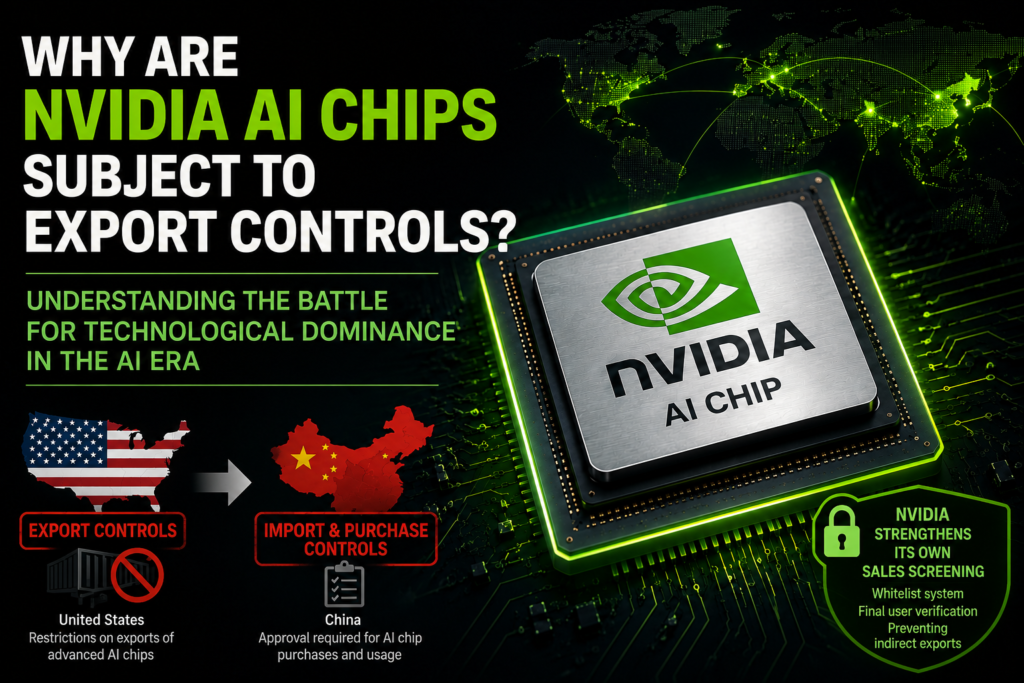
Recently, the United States has restricted exports of advanced AI chips to China, while China has also begun managing purchases of NVIDIA chips by domestic companies. NVIDIA has further strengthened its own screening procedures to prevent indirect exports, creating a structure in which a single AI chip transaction must pass through several layers of regulation.
Why, then, have NVIDIA’s AI chips become subject to such strict controls?
Why Are NVIDIA AI Chips Important?
NVIDIA’s AI chips are essential semiconductors used to train and run generative AI systems and large language models, or LLMs.
Developing an AI model requires repeatedly processing enormous amounts of data. Even after the model is deployed as a service, inference—the process of generating answers to user questions—must continue. These processes require high computing performance and the ability to process large volumes of data.
As a result, the ability to secure a stable supply of NVIDIA AI chips directly affects the speed of AI model development, data center operating capacity, and the competitiveness of AI services.
This is why AI chips are regarded not merely as electronic products, but as infrastructure that supports the entire AI industry.
1. The United States Is Restricting AI Chip Exports to China
The first layer of regulation is the export controls imposed by the U.S. government.
The United States restricts domestic companies from selling their latest advanced AI chips to China. Because NVIDIA is a U.S. company, it must comply with these export control rules.
The United States restricts AI chip exports because it views advanced AI computing capabilities as closely connected not only to industrial competitiveness but also to national security.
Securing large quantities of high-performance AI chips can accelerate the development of generative AI and data analytics technologies, as well as advanced research, cybersecurity, military technologies, and many other fields. The United States seeks to limit the use of these computing resources in the technological development of competing countries.
The United States currently restricts exports of the latest AI chips to China, while permitting only limited sales of certain previous-generation products.
In other words, the purpose of U.S. restrictions is to limit Chinese companies’ access to the most advanced AI computing resources.
2. China Is Also Managing Imports of NVIDIA AI Chips
Even when the United States allows a particular AI chip to be sold to China, Chinese companies cannot necessarily purchase it immediately.
The second layer of regulation is the import and purchasing controls imposed by the Chinese government.
The Chinese government is considering allowing certain major AI companies to purchase NVIDIA H200 chips on a limited basis. Companies would be required to report the number of chips they plan to purchase and their intended use, and then receive government approval.
This differs in nature from U.S. export controls.
The United States restricts exports to prevent its technology from being transferred to China. China, by contrast, manages imports of foreign AI chips from the perspective of its industrial policy and national security.
From China’s perspective, unlimited imports of NVIDIA chips could slow the growth of its domestic semiconductor industry and cause its AI infrastructure to become overly dependent on foreign companies.
Therefore, even products approved for sale by the United States can only be purchased after receiving approval from the Chinese government.
3. NVIDIA Is Strengthening Its Own Sales Screening
The third layer is NVIDIA’s own sales management process.
As U.S. export restrictions have continued, cases of AI chips being exported indirectly to Chinese companies through third countries such as Singapore and Malaysia have continued to occur.
In response, NVIDIA introduced a whitelist system under which AI chips are sold only to companies that pass strengthened screening procedures.
The company has also expanded procedures for confirming whether buyers operate data centers, reviewing contracts, and identifying the ultimate end users. To verify whether a company is conducting a legitimate business, NVIDIA may visit data centers in person or interview end users.
More than half of NVIDIA’s previous customers were reportedly excluded from eligibility as a result of the tighter screening process.
In other words, NVIDIA is no longer checking only the company that places the order. It is also verifying who will actually use the chips, where they will be used, and for what purpose.
Chinese AI Companies Are Developing Their Own AI Chips
As U.S. export restrictions and Chinese import controls continue simultaneously, Chinese AI companies are adopting new strategies to reduce their dependence on external supply chains.
DeepSeek, for example, is pursuing the development of its own AI inference chips.
Inference chips are semiconductors used when a trained AI model generates answers for actual users. As the number of AI service users increases, the amount of inference computation also rises. Securing proprietary chips can therefore reduce operating costs and make it possible to optimize performance for a company’s own AI models.
DeepSeek has previously used AI chips from NVIDIA and Huawei. However, as supply chain uncertainty grows, the company is expanding its strategy to include the development of its own semiconductors.
AI chips, however, cannot be completed through chip design alone.
Advanced foundry processes, HBM, packaging technologies, and a software ecosystem must all be available together. For this reason, commercialization is expected to require a considerable amount of time.
AI Competition Is Shifting from Models to Infrastructure
In the past, AI competition was primarily about building better AI models.
As generative AI spreads rapidly, however, the focus of competition is expanding beyond AI models to the entire AI infrastructure, including semiconductors, data centers, memory, electricity, and supply chains.
No matter how advanced an AI model may be, it is difficult to achieve real service competitiveness without securing the computing resources required to train and operate it.
The United States currently controls exports of advanced AI chips, China manages imports of foreign AI chips, and NVIDIA has strengthened its own sales screening procedures.
Competition surrounding AI chips is no longer simply an issue of product sales between individual companies. It has expanded into a competition over national industrial policy and technological leadership.
DANA NOTES Commentary
The regulations surrounding NVIDIA AI chips can be confusing when viewed as a single form of regulation.
First, the United States restricts exports to prevent its advanced AI technologies from being transferred to China.
China, by contrast, manages imports and purchases to control its dependence on NVIDIA chips and support the growth of its domestic semiconductor industry.
NVIDIA, meanwhile, is strengthening its own sales screening procedures—including a whitelist system, data center visits, and end-user verification—to comply with U.S. regulations.
In other words:
- The United States restricts sales.
- China manages purchases.
- NVIDIA verifies where the chips will actually be used.
A single AI chip is subject to these three layers of oversight because AI chips are no longer ordinary semiconductors. They have become strategic assets that can determine a country’s competitiveness in AI.
Competition in the AI era is rapidly expanding beyond the race to build better AI models. It is becoming a competition over who can secure and control AI infrastructure.
DANA NOTES in One Sentence
NVIDIA AI chip export controls represent a battle for technological dominance in the AI era, involving U.S. export controls, Chinese import management, and NVIDIA’s own sales screening procedures.