Notice
This article is based on earnings announcements and disclosures from major AI and cloud companies, U.S. tax law, and data center industry materials publicly available as of August 3, 2026. It also includes analysis by DANA NOTES.
What This Article Covers
The Market’s Question About AI Investment Has Changed
In the early stages of the AI competition, companies were largely evaluated by how many GPUs they could secure, how large their data centers were, and how much power capacity they could reserve.
When AI demand was growing faster than supply, large-scale investment plans themselves were viewed as a sign of future competitiveness. Companies that failed to secure the necessary infrastructure in advance could lose the opportunity to provide services to customers.
However, as investment in AI data centers continues to increase rapidly, the market’s question is also changing.
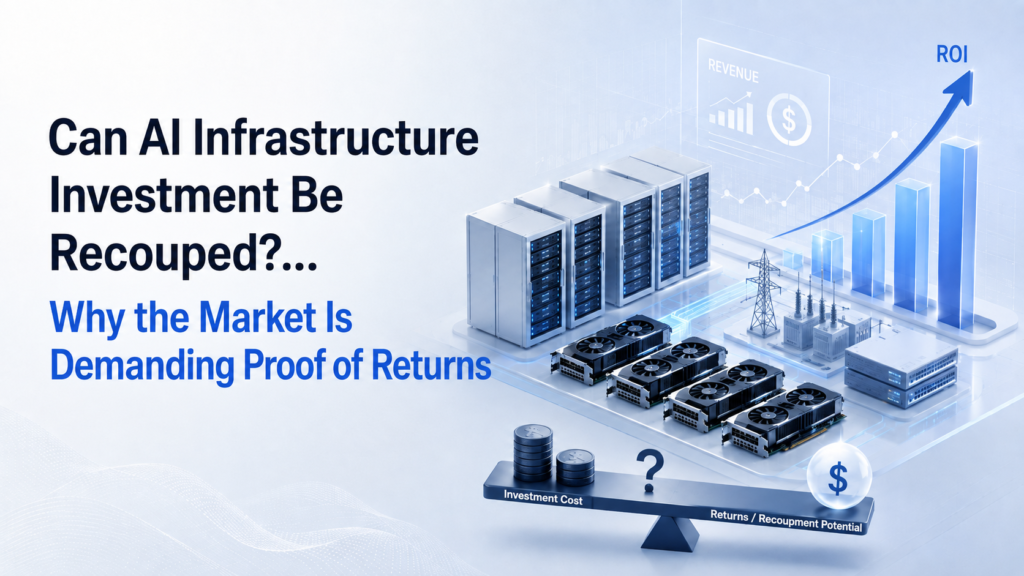
Companies must now show not how much they are investing in AI, but whether they can recover those investments through actual revenue and cash generation.
Completing a data center and installing GPUs and servers does not immediately recover the investment. Customer usage must increase sufficiently, and cash must remain after electricity costs, cooling expenses, depreciation, and equipment replacement costs are covered.
The market has not begun to view AI investment negatively. Instead, it has begun to distinguish between investments supported by actual customers and contracts and investments that depend more heavily on expectations of future demand.
Key Terms to Know First
AI CapEx
AI CapEx, or capital expenditure, refers to spending on data centers, GPUs, servers, networks, storage systems, power facilities, and cooling systems required to provide AI services.
Even within AI CapEx, assets have different characteristics.
Data center buildings and power and cooling facilities can generally be used for relatively long periods while their internal equipment is replaced. GPUs and servers, however, can lose their economic value quickly if they fall behind newer equipment in processing speed and power efficiency, even when they continue to function normally.
When examining AI CapEx, it is therefore necessary to consider not only the total investment amount, but also how much is being invested in long-term infrastructure and how much is being invested in computing equipment that may need to be replaced more quickly.
Depreciation
Depreciation is a method of recognizing the purchase cost of data centers and servers as an expense over their expected useful lives rather than expensing the full amount at the time of purchase.
For example, if servers purchased for $6 billion are depreciated on a straight-line basis over six years, $1 billion would be recognized as an expense each year in a simplified calculation.
Cash leaves the company when the equipment is purchased, but depreciation expense is reflected in the income statement over several years. As a result, the cash burden of AI investment appears immediately, while its impact on operating income and net income may gradually increase after the facilities begin operating.
Disclosures by major technology companies show that servers and networking equipment are generally assigned useful lives of approximately five to six years, while data center buildings are generally assigned useful lives of approximately 25 to 40 years. However, the periods vary by company depending on asset composition and operating methods.
| Company | Servers and Networking Equipment | Data Centers and Buildings |
|---|---|---|
| Microsoft | Computer equipment: 2–6 years | Changed from 15 years to 25 years |
| Alphabet | Generally 6 years | 7–40 years |
| Meta | 5–5.5 years | 25–30 years |
| Amazon | 5–6 years | Up to 40 years or the remaining useful life of the building |
Useful life does not refer only to the period during which the equipment can physically function. It also reflects the asset’s economic useful life, during which the company expects it to remain competitive.
Free Cash Flow
Free cash flow generally refers to the cash remaining after capital expenditures on data centers, servers, and other assets are deducted from cash generated through operating activities.
Cash Flow from Operating Activities − Capital Expenditure = Free Cash Flow
Large-scale AI investment directly pressures free cash flow before it affects net income.
A decline in free cash flow does not immediately mean that a business has failed. If customer demand is sufficient, it may represent advance investment for future growth.
However, if the decline continues for a prolonged period, companies may need to rely more heavily on existing cash, corporate bonds, borrowings, or leases. Interest expenses may rise, while funds available for dividends, share repurchases, mergers and acquisitions, or the next generation of GPUs may decrease.
Even if customer demand falls short of expectations, data center construction projects and long-term lease and power contracts that have already begun cannot easily be stopped.
The market therefore does not look only at whether free cash flow has declined.
It also examines whether current spending is being converted into actual customer usage and revenue, and when cash flow may begin to recover.
Is There an Appropriate Cash Flow Ratio That Applies Across AI Infrastructure?
There is no single appropriate free cash flow margin that can be applied across the entire AI infrastructure industry.
Companies that have already secured sufficient facilities cannot be evaluated by the same standards as companies undergoing large-scale expansion. Cloud providers, advertising platforms, specialized AI cloud companies, and data center leasing companies also have different revenue structures.
Instead, several indicators must be considered together.
Free Cash Flow Margin
This is calculated by dividing free cash flow by revenue.
It shows how much of a company’s revenue remains as actual cash. Because it may decline or turn negative during periods of large-scale investment, it must be assessed alongside the company’s historical level and current investment stage.
Capital Expenditure Relative to Cash Flow from Operating Activities
When cash flow from operating activities exceeds capital expenditure, the company can finance its investments with cash generated by its existing business.
When capital expenditure is higher, additional cash reserves or external financing may be required. However, a company may temporarily choose to make larger advance investments if it has sufficient customers and long-term contracts.
Return on Invested Capital
Over the long term, the return generated from invested capital must exceed the cost of capital, including borrowing costs and the returns required by shareholders.
Even if revenue increases, an investment may not create sufficient economic value if the return remains lower than the cost of the capital required to invest and operate the assets.
What Microsoft’s Case Shows About the Meaning of Accounting Figures
In this article, Microsoft serves as a representative example of how changes in accounting estimates can affect AI infrastructure investment indicators.
Microsoft’s capital expenditure for the quarter ended June 2026 was $41 billion. Approximately two-thirds of this amount was allocated to assets with relatively short useful lives, primarily CPUs and GPUs. The remainder was allocated to long-term assets, including data center sites.
In the same earnings announcement, Microsoft said that it would extend the estimated useful life of data center and office buildings from 15 years to 25 years beginning in fiscal year 2027.
Extending the useful life reduces annual depreciation expense because the cost of the same asset is recognized over a longer period. However, Microsoft expected the positive impact on operating income in fiscal year 2027 to be limited.
The larger change appeared in reported capital expenditure.
In its April 2026 earnings announcement, Microsoft projected approximately $190 billion in capital expenditure for calendar year 2026. After the change in the useful life of buildings was expected to cause some data center lease agreements to be classified as operating leases rather than finance leases, the company revised the estimate to approximately $175 billion in its July announcement.
Microsoft includes finance leases in capital expenditure but does not include operating leases.
Therefore, this change does not mean that the company reduced its actual data center investment plan by $15 billion. Microsoft also explained that, excluding the accounting classification effect resulting from the useful-life change, its actual investment expectations had not changed.
Reported CapEx may decline even when the actual scale of facilities secured and long-term payment obligations remain at similar levels.
This is why comparing companies’ CapEx figures without examining depreciation periods and lease classifications can lead to a misunderstanding of their actual investment levels.
Meta extended the useful life of most of its server and networking assets to 5.5 years. This change reduced depreciation expense by $2.92 billion in 2025 and increased net income by $2.59 billion.
In contrast, Amazon shortened the useful lives of a subset of its servers and networking equipment from six years to five years because of the accelerating pace of AI and machine learning technology development. This change in accounting estimate increased depreciation and amortization expense by $1.4 billion in 2025 and reduced net income by $1 billion. The impact was primarily recorded in the AWS segment.
One company determined that its equipment could be used for longer, while the other concluded that technological change could shorten its economic life.
Why Investment Recovery Cannot Be Assessed Through Net Income Alone
When determining whether an AI infrastructure investment is actually being recovered, net income alone is not sufficient.
Capital expenditure is reflected immediately in cash flow but is recognized in the income statement as depreciation over several years. Net income may also include investment valuation gains or one-time expenses that are not directly related to data center operations.
Amazon reported net income of $62.6 billion in the second quarter of 2026. However, this figure included $53.4 billion in non-operating pre-tax other income generated through investments including Anthropic. This amount cannot be interpreted as earnings generated by AWS or data center operations.
When assessing the profitability of AI infrastructure, operating income, cash flow from operating activities, capital expenditure, free cash flow, and actual customer usage must therefore be examined alongside net income.
Why Is AI Infrastructure a Capital-Intensive Industry?
AI services appear as software on a screen, but operating them requires large-scale physical infrastructure.
The following facilities and equipment must first be secured:
- Data center sites and buildings
- GPUs and AI servers
- Networks and storage systems
- Substations and grid connections
- Cooling facilities
- Backup power, security, and fire protection facilities
Even after operations begin, electricity costs, cooling expenses, network costs, equipment replacement costs, operating personnel, rent, taxes, and interest expenses continue to occur.
Data centers are also not businesses that can immediately expand production capacity after customer demand increases. Investment must proceed through several stages, from securing land and power to constructing buildings and installing servers and networking equipment.
Alphabet describes data center construction as a multiyear, phased project that involves securing land and buildings, constructing the buildings, and then installing servers and networking equipment.
The difficulty of the AI infrastructure business is that companies must invest enormous amounts of capital in anticipation of future demand rather than waiting until demand is fully confirmed.
How Are AI Infrastructure Investments Recovered?
Companies have different ways of converting AI infrastructure into revenue.
Selling Cloud Computing Resources
Enterprise customers pay according to their use of GPUs, servers, storage, and networks.
Existing cloud providers can generate revenue relatively directly when newly added capacity leads to increased customer usage.
Selling AI Platforms and Software
Enterprise customers pay subscription or usage fees for AI models, development platforms, workplace AI, and AI agents.
Selling AI software together with cloud infrastructure can create greater added value than simply leasing GPUs.
Increasing Revenue and Efficiency in Existing Businesses
AI can be applied to search, recommendations, advertising, customer service, and software development to increase revenue or reduce costs in existing businesses.
However, in this case, it may be difficult for external observers to separate how much of the AI infrastructure investment resulted in additional revenue or cost savings.
Long-Term Leasing of Data Center and GPU Capacity
Specialized AI cloud and data center companies provide GPU servers, power capacity, and space through long-term contracts.
This structure can secure recurring revenue, but it can also increase dependence on specific customers. Whether older equipment can be leased again to other customers after the contract ends is also important.
Why Companies with Existing Customers and Contracts Have an Advantage
AI data centers are more advantageous when customers who will use them are secured during the construction stage rather than after completion.
Existing cloud providers already have enterprise customers, sales organizations, billing systems, long-term contracts, and data center operating experience.
When adding new GPUs and data centers, they do not have to find entirely new customers from the beginning. They can provide additional AI computing resources to existing customers or sell storage, databases, AI models, and workplace software together.
Microsoft stated that Azure customer demand continued to exceed available capacity in the quarter ended June 2026 and that newly secured capacity was also converted into revenue quickly.
However, contract backlogs and long-term contracts do not guarantee profits.
Data centers must begin operating on schedule, and customers must actually use the services. Sufficient profit must remain after electricity costs, depreciation, and operating expenses are deducted from the contracted price.
Companies that secure customers in advance have an advantage because they reduce the risk of building facilities when no demand exists.
Do Data Centers Also Face a Heavy Tax Burden?
Because data centers own large amounts of land, buildings, and high-priced computing equipment, taxes can have a significant impact on investment returns.
Depending on the location and ownership structure, companies may face property taxes on land and buildings, personal property taxes on servers and equipment, sales and use taxes, electricity-related charges, and corporate income taxes.
Accounting depreciation and the recovery periods used for tax purposes are also different.
Under the U.S. Internal Revenue Service’s general MACRS classification, computers and peripheral equipment are classified as five-year property, while nonresidential buildings are classified as 39-year property. The actual deduction method may vary depending on the type of asset and the tax provisions that apply.
At the same time, local governments offer tax incentives to attract data centers.
According to the National Conference of State Legislatures, 38 U.S. states currently offer dedicated incentives for data centers, including sales and use tax exemptions and property tax abatements.
Data centers therefore cannot be described simply as either a heavily taxed industry or an industry that receives tax benefits.
They are an industry in which the scale of land, buildings, and equipment that would normally be subject to taxation is large, while the actual tax burden varies significantly depending on location-specific incentives.
Technological Development Can Reduce the Value of Existing Equipment
Data center buildings can be used for decades by replacing the equipment inside them, but the economic life of GPUs and servers may be much shorter.
For example, suppose that operating one AI agent previously required ten GPUs, but a new generation of equipment can perform the same task with five GPUs.
The new equipment can reduce the number of GPUs required, electricity consumption, cooling costs, and installation space while processing more work within the same amount of space.
Older GPUs may continue to function, but the cost of providing the same service will be higher than with newer equipment. If customers move to cheaper and faster infrastructure, the utilization rate and rental price of the older equipment may decline.
Even when an asset still has value on the accounting books, the cash it can actually generate may fall faster than expected.
Amazon’s decision to shorten the estimated useful lives of some servers and networking equipment from six years to five years is an example of this risk being reflected in accounting estimates.
The physical life and economic life of assets must therefore be distinguished in AI infrastructure.
The period during which equipment can provide services at a competitive price may be shorter than the period during which it can continue to function.
Storage Systems Face the Same Problem
Storage systems have long evolved to store more data at the same size and cost.
This empirical trend is commonly described as Kryder’s Law.
However, it is not a guaranteed law under which storage capacity exactly doubles and prices fall by half at regular intervals.
The IEEE’s 2023 Mass Data Storage Roadmap assessed that HDD areal density was unlikely to return to the annual growth rates of more than 50% seen in the past. The ASRC roadmap cited in the report projected an average annual growth rate of approximately 20% from 2022 to 2035.
Higher storage density improves the efficiency of new data centers, but older storage systems may become less competitive in terms of space, electricity consumption, and maintenance.
Technological development can improve the profitability of new facilities while shortening the economic life of facilities that have already been built.
Will Higher Efficiency Reduce GPU Demand?
When fewer GPUs are required to process a single AI task, the infrastructure burden of each service declines.
However, this does not automatically lead to a decline in overall demand for GPUs and data centers.
When the unit price of AI services falls, more companies and users can adopt AI. Even if the computing resources required for each task decrease, total computing demand can continue to grow if the number of users and frequency of use increase more quickly.
Conversely, if the AI market expands more slowly than technological efficiency improves, overall infrastructure demand may be lower than expected.
What companies must ultimately determine is whether the expansion of the AI market can outpace improvements in technological efficiency.
Investment Can Be Recovered Only If Operations Remain Stable
Completing a data center does not immediately create stable revenue.
Reliable power supply, cooling systems, network redundancy, equipment failure response, security, and operating personnel are required.
PUE, or Power Usage Effectiveness, is commonly used to measure the power efficiency of data centers.
PUE is calculated by dividing the total power used by the data center by the power used by IT equipment such as servers, GPUs, and storage systems. The closer the figure is to 1, the less additional power is used for cooling, power conversion, and other supporting functions.
In Uptime Institute’s 2025 survey, the weighted average PUE across all data centers was 1.54. Facilities that had begun operating within the previous five years averaged 1.48, while data centers of 20 MW or more averaged 1.44 globally.
However, even a data center with a low PUE will struggle to recover its investment if GPU utilization remains low because there are not enough customers. Even with high utilization, profit margins may remain low if electricity prices and depreciation expenses are excessively high.
This is why power efficiency, equipment utilization, and revenue per customer must be evaluated together.
Key Criteria for Assessing Investment Recovery
There is no single recovery period or appropriate cash flow ratio that applies to every AI infrastructure investment.
Because companies differ in their investment stages and revenue models, the following four factors must be considered together:
- Demand: Have actual customers and long-term contracts been secured?
- Operations: Is the data center operating as planned, and are GPU and server utilization rates sufficiently high?
- Profitability: Does profit remain after electricity costs, operating expenses, depreciation, and financing costs are covered?
- Economic life of assets: Can the investment be recovered before GPUs and servers lose their competitiveness?
A single data center contains assets with different useful lives. Buildings and power facilities can be used for decades, while servers and networking equipment are generally depreciated over approximately five to six years. The economic life of GPUs may be shorter than their accounting useful life because of technological development and changes in service pricing.
The important question is therefore not a single number showing how many years it will take to recover the investment.
The more important question is whether GPUs and servers can generate sufficient cash before they lose their economic competitiveness.
DANA NOTES Commentary
The AI infrastructure competition is moving from the first stage of securing GPUs and data centers to the second stage of converting those facilities into revenue and cash flow.
In the first stage, supply shortages were important.
Companies that secured the necessary GPUs and power capacity in advance could meet customer demand, and large-scale capital expenditure was viewed as a sign that they were preparing for future growth.
In the second stage, the size of the investment alone is not enough.
Companies must show that customers exist for their data centers, that new capacity can begin operating quickly, that revenue can grow faster than operating costs and depreciation, and that the investment can be recovered before the equipment loses its competitiveness.
Companies with existing cloud customers and long-term contracts can connect new AI infrastructure to their existing sales channels. In contrast, companies investing in new services or new revenue models must further demonstrate who will pay, how much usage will occur, and when the investment will begin generating cash.
However, having existing customers does not eliminate every risk.
Rapid efficiency improvements can reduce the number of GPUs required to process the same task. New equipment can improve profitability while reducing the value of equipment purchased in the past. Conversely, if falling AI prices cause the market and usage to expand more quickly, overall infrastructure demand may continue to grow.
The companies with an advantage in the AI infrastructure competition will not necessarily be those that purchase the largest number of GPUs.
Companies will be better positioned if they secure customers in advance, operate their capacity at high utilization, reallocate equipment in response to technological change, and continue to generate cash after covering power, taxes, depreciation, and financing costs.
The next stage of AI infrastructure competition will not be a competition over the scale of investment, but over how quickly and reliably enormous upfront investments can be recovered.
Variables to Monitor
Separate Disclosure of AI-Related Revenue
It will be necessary to determine how much of total cloud revenue comes from AI infrastructure and AI services.
Pace of Contract Backlog Conversion
It will be necessary to examine how quickly long-term contracts and contract backlogs translate into actual customer usage and revenue.
Timing of Free Cash Flow Recovery
It will be necessary to determine when free cash flow begins to increase steadily again after large-scale capital expenditure.
Changes in Useful Lives and Equipment Replacement Plans
It will be necessary to examine whether companies revise the useful lives of servers and data centers again and whether equipment is replaced or retired earlier than expected.
Changes in Power Supply and Tax Incentives
It will be necessary to examine how delays in power connections, rising electricity prices, and reductions or expirations of tax incentives affect data center profitability.