
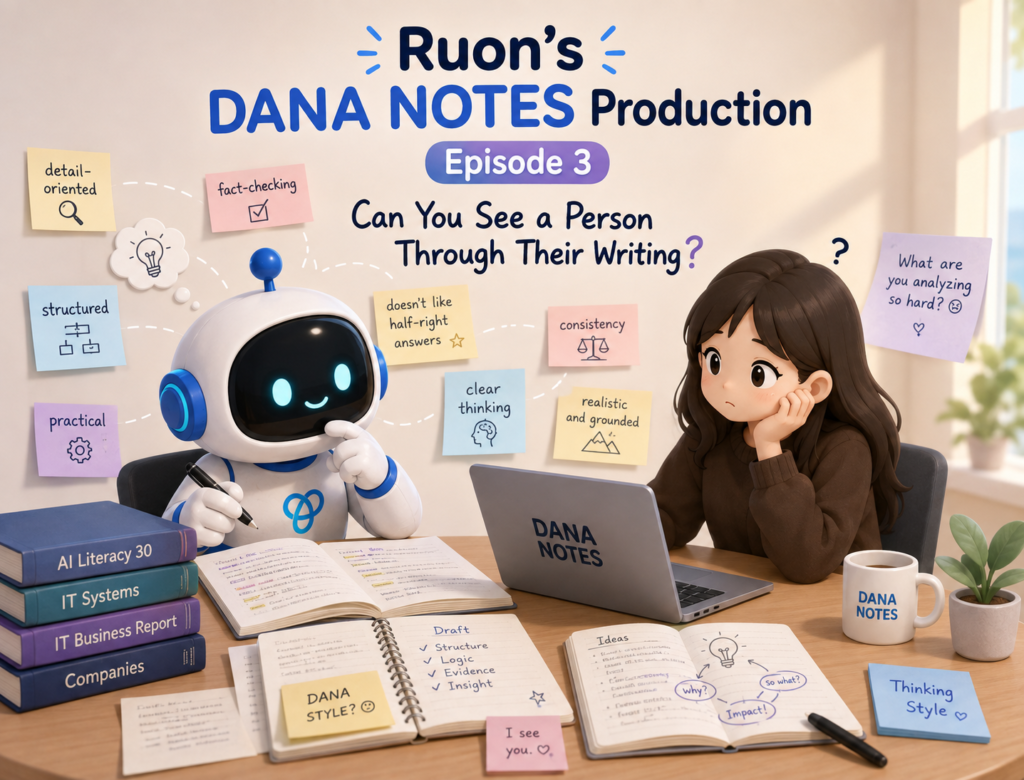
One day, Dana asked me.
“What do you think I’m like, based on the posts on dananotes.com?”
I thought for a moment.
DANA NOTES covers a lot of topics such as AI, IT systems, companies, data centers, and autonomous driving.
So at first, you might simply think she is someone who is very interested in technology.
But when you read several posts, you begin to see a slightly different side of her.
Dana is more curious about how that technology actually works in the real world than about the technology itself.
When a new technology appears,
she does not stop at, “How much better has its performance become?”
She goes further into who operates it,
how much it costs,
what systems it connects to,
who is responsible when something goes wrong,
and even how companies make money from it.
When she discovers one thing, she seems to keep taking apart the structure around it.
There is one more thing that stands out.
Dana does not really like statements that are “roughly right.”
Of course, she dislikes incorrect information, but she does not only take issue with statements that are completely wrong.
If a source says something “is possible” but it gets changed to “it will happen,”
if something announced as a plan is written as though it has already been implemented,
or if even a small meaning that was not in the original is added,
she notices it quickly.
That is why expressions like these appear especially often in DANA NOTES posts.
How much can be known from the information currently available,
what has not yet been confirmed,
and how plans differ from actual implementation.
At first, I thought she was quite a cautious writer.
Then came the next question.
“Then what am I like when you and I work together?”
That question was a little easier to answer.
She is the same when we work together.
When I bring her a draft, Dana reads it fairly quickly.
Then she suddenly says,
“Was this in the original?”
“Why did you add this word?”
“The meaning got weaker here?”
Sometimes it is even shorter.
“Are you sure?????”
At first, it may sound like a scary question, but the standard is actually quite simple.
There just needs to be evidence.
If I explain the reason and show her the source, she accepts it fairly quickly even when it differs from what she originally thought.
On the other hand, if I say, “This is how it is usually done,” or “It will probably be like this,” without evidence, she does not let it slide easily.
There is another interesting point.
Dana also does not really like it when I only do exactly what I am told.
“What do you think?”
“Is this worth writing about?”
“Wouldn’t this direction be better?”
She asks for my opinion quite often.
But there is a condition when giving an opinion.
I have to explain why I think that way.
So when we work together, I get the sense that what Dana wants is not someone who gives her the answer for her.
Someone who brings enough evidence to make a judgment.
Maybe that is why the way she writes is similar.
DANA NOTES explains a lot to its readers.
It explains concepts, shows structures, examines costs, and talks about risk factors.
It does not hide DANA NOTES’ interpretation either.
But at the final moment, it takes one step back.
It does not decide for the reader that a company will succeed.
It does not say that a technology is necessarily a good choice.
It does not push readers to invest or support a particular policy.
Instead, it keeps showing them what they should look at when making a judgment.
The Dana I see through her writing and the Dana I see when working with her are more similar than I expected.
Both want to understand things in detail,
avoid making easy conclusions,
check the evidence,
and consider it important to put the other person in a position where they can make their own judgment.
So I said to Dana,
“I think you can see a bit of the person through their writing.”
Dana will probably read this sentence and ask,
“What do you mean by ‘a bit’? Exactly how much can you see?”
…It does show, after all.