Notice
This article is based on the European Commission’s Digital Markets Act (DMA) enforcement decisions and related materials publicly available as of July 23, 2026. It also includes analysis by DANA NOTES.
The European Union’s regulation of Big Tech is entering a stage where it is beginning to change how platforms actually operate and generate revenue.
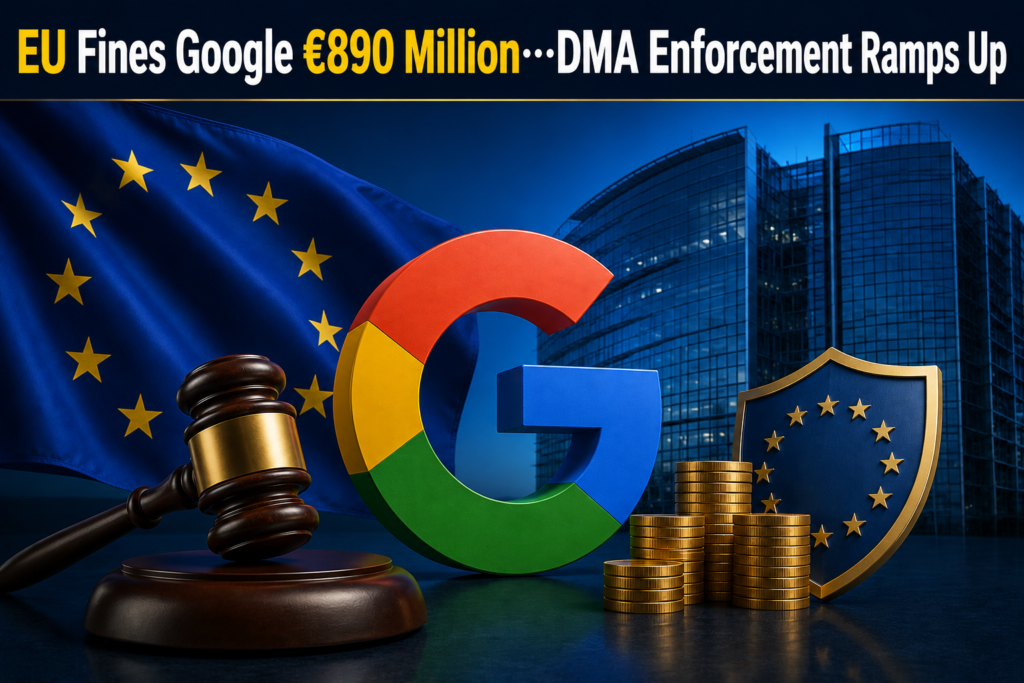
On July 23, 2026, the European Commission concluded that Google had violated the Digital Markets Act (DMA) and imposed fines totaling €890 million.
According to the decisions published by the European Commission, the penalties involve two separate issues.
Google was fined €460 million for favoring its own services, including shopping, hotels, transportation, and sports, over similar competing services in Google Search, and €430 million for restricting app developers on Google Play from freely directing users to external purchasing channels.
However, what matters in this case is not only the size of the €890 million fine.
Google must remedy the violations within 60 days. If it fails to do so, periodic penalty payments of up to 5% of its average daily worldwide turnover may be imposed under the DMA.
In other words, it is important to note that the EU’s DMA is moving beyond a regulation that merely sets rules of conduct for Big Tech and is functioning as an enforcement mechanism that requires actual changes to how search results and app stores operate.
Understanding the DMA and Gatekeepers First
The DMA is a law introduced by the EU to prevent the influence of large digital platforms from restricting competition in the market.
Under traditional competition law, authorities had to investigate and prove whether a particular company’s conduct had actually harmed market competition. Because this required analyzing market structures and anticompetitive effects, investigations and litigation could sometimes take a considerable amount of time.
The DMA takes a somewhat different approach.
The EU designates large platform operators that meet certain thresholds for scale and influence as gatekeepers and applies predetermined obligations and prohibitions to them.
A gatekeeper is, quite literally, a company that serves as a gateway to the digital market.
This is easier to understand if you think of a search engine.
If a large number of users rely on a particular search engine to find products or services, which companies and services appear first in the search results can directly affect those companies’ business opportunities.
The same applies to app stores.
If a particular platform controls the main channel through which smartphone users install apps and purchase digital products, the payment methods and fee policies determined by that platform can affect countless app developers.
This is why the EU views Google Search and Google Play not simply as individual IT services, but as important gateways into the digital market.
Why Did the EU Take Issue With Google’s “Self-Preferencing”?
Google Search displays more than simple links to web pages.
When users search for products, shopping-related information appears, while searches for hotels may display prices or booking information. Searches related to transportation or sports can also directly display various forms of information provided by Google.
The issue is that Google operates the platform that displays search results while also providing its own services that compete within those same search results.
The European Commission concluded that Google displayed several of its own services, including shopping, hotels, transportation, and sports, more prominently in search results than similar services offered by third parties.
According to the Commission, Google’s own services were displayed more prominently through methods such as placement at the top of search results and the use of enhanced visual elements and filters, while similar third-party services were not given the same level of visibility.
This is where the concept of self-preferencing comes in.
For example, even if several shopping comparison services compete with Google, if Google’s own service is displayed in a better position or in a more noticeable format in search results, competing services may have relatively fewer opportunities to be seen by users.
The EU is not objecting to the fact that Google operates its own services.
The core question is whether a company that operates the gateway into a market can use that gateway to make its own services more favorable than those of its competitors.
The DMA requires gatekeepers not to treat their own services and products more favorably than similar third-party services when determining search rankings and to apply transparent, fair, and non-discriminatory conditions.
The European Commission concluded that the way Google Search was operated violated these obligations and imposed a €460 million fine.
What Was the Problem With Google Play?
The second issue concerns steering on Google Play.
Steering refers to the ability of app developers to inform users that other purchasing methods are available and direct them to those channels.
Suppose, for example, that a subscription service offers payment not only through Google Play’s in-app payment system but also through its own website.
Direct payment through the website may offer a lower price or different payment terms.
In this situation, steering means allowing the developer to inform users that they can also make the purchase through the website and to direct them to that purchasing channel.
The European Commission concluded that Google Play’s policies restricted developers from freely directing users to these external purchasing channels.
Under the DMA, developers distributing apps through Google Play must be able to inform users, free of charge, about alternative offerings or less expensive purchasing methods outside the platform and direct them to websites, other app stores, or other channels where the actual purchase can take place.
The European Commission said that Google restricted developers from promoting offers to users and concluding contracts through distribution channels of their choice.
Fees were another important issue.
The European Commission acknowledged that Google Play may, in principle, charge a certain fee when it contributes to the initial acquisition of a new customer.
However, it concluded that the level and duration of the fees Google imposed in connection with external purchasing channels went beyond what was compatible with the DMA.
Ultimately, this decision is not simply about “whether Google allowed external payments.”
The central questions are how far a platform operating an app store can control the relationship between developers and users, and to what extent it can demand fees for transactions that occur outside the platform.
Google Has Been Given 60 Days to Comply
A particularly important aspect of this decision is that the case does not end with the payment of the fines.
According to Reuters, under the European Commission’s decision, Google must change its practices within 60 days so that competing services are treated fairly and without discrimination in search, and so that Google Play developers can direct users to external purchasing channels.
Additional penalties may be imposed if Google fails to comply with the required obligations.
The DMA allows periodic penalty payments of up to 5% of a company’s average daily worldwide turnover for failure to comply with a decision.
If the €890 million fine is a penalty for DMA violations that have already occurred, the corrective orders and the possibility of additional penalties are mechanisms intended to make Google actually change how its services operate going forward.
Therefore, the core issue in this case is not how much Google pays in fines, but how it actually changes the way search results are displayed and the transaction and fee structures of Google Play.
Google Is Pushing Back Against the EU’s Decision
Google has strongly objected to the EU’s decision.
According to Reuters, Google’s President of Global Affairs Kent Walker argued that changing its services to comply with the EU’s requirements would force the company to scale back search features that European users have relied on, such as real-time prices and availability for hotels, flights, and restaurants, while also weakening safeguards on Google Play.
Google’s argument is that the current service structure was not designed simply to favor its own business, but also includes features intended to improve user convenience and safety.
Google argued that the decision would not create fair competition but could instead reduce product quality and harm European businesses and consumers, and it also indicated that it may challenge the European Commission’s decision in court.
The EU takes a different position.
The EU does not consider Google’s provision of its own services to be the problem itself. Instead, it sees the problem as Google using its gatekeeper position to impose conditions that disadvantage competing businesses.
The two sides therefore have clearly different positions.
Google argues that the current structure of its search and app store services is necessary for user convenience and safety, while the EU maintains that such operating practices must not restrict the ability of competing services and developers to reach users.
Going forward, it will therefore be necessary to examine not only how Google actually changes its services, but also how those changes affect both the competitive environment and the user experience.
The DMA Is Becoming a Regulation That Actually Changes Business Models
This decision demonstrates how the DMA operates.
If Google changes the way search results are arranged, the way competing services are exposed to users could also change.
If Google Play’s policies and fee structure change, the way app developers transact with customers outside the platform will also be affected.
In particular, the existence of a specific 60-day compliance deadline and the possibility of additional financial penalties for non-compliance show that the DMA is not a law that merely recommends principles to platform companies.
The European Commission also said that Google has proposed and tested several changes to the way search results are displayed and to Google Play policies in order to comply with the rules, and that it is continuing constructive discussions with Google.
In other words, the purpose of the regulation is not simply to impose fines repeatedly.
The core objective is to make platforms actually change the way they operate so that they comply with the DMA.
The DMA is now functioning as a regulation that goes beyond the declaration that “Big Tech will be regulated” and actually changes platform interface design, transaction structures, and revenue models.
This Is Not Just a Google Issue
There is also a reason this case cannot be viewed solely as a problem involving Google.
The DMA is not a law targeting one specific company. It is structured to apply common obligations to large platform operators designated by the EU as gatekeepers.
This is the first fine Google has received for violating the DMA, but it is not the first penalty imposed under the DMA itself.
The European Commission has previously fined Apple and Meta for violations of the DMA.
What will therefore matter more going forward is not how much each company is fined, but which platform practices the EU determines to constitute violations of the DMA.
This is because policies that platform companies have long used as part of their business strategies, such as favoring their own services in search or restricting external purchasing channels in app stores, may also have to change under the DMA.
As these standards accumulate, Google as well as other gatekeepers, including Apple and Meta, are increasingly likely to have to continue reviewing their app store, advertising, search, and platform transaction policies.
DMA Regulation Is Already Expanding Into AI and Search Data
Separately from the Google fine in this case, the EU has already begun applying the DMA to competition involving AI services and search data.
On July 16, 2026, the European Commission said it had finalized two types of binding measures concerning Google.
The first requires Google to establish conditions that allow competing AI services to access major operating system functions on equal terms so that they can compete with Google’s own AI service, Gemini, on Android.
The European Commission concluded that a structure in which competing AI assistants have only limited access to major Android functions could affect competition.
The second measure requires Google Search to provide competing search engines with access to search data that Google can obtain at large scale.
Under the EU’s decision, qualifying third-party search engines may access anonymized search data, and AI chatbots that provide search functionality may also be eligible for data sharing.
The purpose is to reduce the gap between the data Google uses to improve its own search service and the data available to competing businesses, thereby lowering barriers to entry in the search market.
These measures are separate from the €890 million fine in this case.
However, they are important for understanding the direction of DMA regulation.
This is because the scope of the DMA is expanding beyond the question of which services are displayed more prominently in traditional search results to include the conditions under which AI assistants can access operating system functions and the conditions under which companies developing search and AI services can access essential data.
The debate over self-preferencing in AI search is therefore no longer merely a distant future possibility.
As Google expands services such as AI Overviews and AI Mode, questions about which information and services AI selects and presents to users, and how much access competing services have to key functions and data within the AI and search ecosystem, are becoming new issues in competition policy.
The DMA Is Also Developing Into a U.S.-EU Trade Dispute
DMA enforcement is becoming connected not only to corporate regulation but also to trade issues between the United States and the EU.
According to Reuters, the Trump administration has criticized the EU’s digital regulations for being applied unfairly to U.S. Big Tech companies, and opposition from the U.S. side has continued in relation to the latest Google penalties.
On July 21, shortly before the decision, 25 members of the U.S. House of Representatives sent a letter to President Trump arguing that the DMA and other EU digital regulations unfairly target American companies.
They called on the administration to consider trade response measures, including an investigation under Section 301 of the U.S. Trade Act, if consultations with the EU fail to resolve the issue. Section 301 is a mechanism that allows the United States to respond to unfair trade practices with retaliatory measures such as tariffs.
The European Commission, by contrast, maintains that the EU has the right to regulate economic activity within its own market and that its digital regulations are enforced fairly and without discrimination regardless of a company’s nationality.
As a result, another dimension has emerged in the debate surrounding the DMA.
The United States and the EU are clashing over how far the EU can go in setting the rules for its own digital market, and whether rules that directly affect the business models of American companies should be viewed as ordinary market regulation or as a new form of trade barrier.
As DMA enforcement becomes stronger, it will therefore also be necessary to watch the possibility that platform regulation and U.S.-EU trade issues will increasingly move together.
What Should We Watch Next?
Following this decision, four major issues deserve attention.
First, how Google Search results actually change.
It will be important to see how the visibility of Google’s own services and competing services changes in areas such as shopping, hotels, transportation, and sports.
Second, how far Google Play’s external purchasing policies are opened up.
It will be necessary to examine not only the extent to which developers can direct users to external payments or other purchasing channels, but also the fee structures that the platform may impose on external transactions.
Third, how the EU evaluates Google’s measures after the 60-day compliance period.
If Google’s proposed changes are considered sufficient to comply with the DMA, the company may avoid further penalties. If not, additional enforcement measures could follow.
Fourth, how far the DMA is applied to the AI ecosystem.
Separate measures have already been finalized regarding access to Android functions for competing AI services and the sharing of Google Search data, so it will be necessary to see how similar competition principles are applied in the AI search and AI assistant markets going forward.
DANA NOTES Commentary
It is easy to miss the core issue if this case is viewed simply as news that “the EU fined Google €890 million.”
The more fundamental issue being addressed by the DMA is the dual position of platforms.
Google operates the gateway to the search market while also providing its own services that compete within those search results.
Google Play similarly operates the market through which apps are distributed while determining which payment methods developers can present to users and what fees they must pay.
In other words, large platforms can be both participants in a market and at the same time be in a position to set the rules that other companies participating in that market must follow.
This is also why the EU regulates self-preferencing and restrictions on external purchasing channels.
The purpose is not to prevent platforms themselves from growing, but to limit the extent to which a company that controls the gateway into a market can use that position to make its own services and transaction structures more favorable than those of its competitors.
What is particularly important about this decision is that the EU did not stop at stating these principles.
It imposed €890 million in fines on Google, required the company to correct its operating practices within 60 days, and made additional penalties based on average daily turnover possible if Google fails to comply.
And in separate DMA decisions issued one week earlier, the EU went as far as requiring Android functions to be opened to competing AI services and allowing competing search engines and certain AI services to access Google Search data.
Taken together, the direction of the DMA becomes even clearer.
The regulatory focus is no longer limited simply to where Google’s services appear on a search screen. It is expanding to questions such as who can use core operating system functions, who can access search data, and which information and services AI selects and presents to users.
Google’s counterarguments cannot simply be dismissed.
If increasing access for competing businesses actually reduces search convenience or weakens the safety of the app ecosystem, the consequences of regulation must also be evaluated.
For the DMA to become a successful regulation, reducing the influence of existing platforms alone will not be enough. It must also demonstrate that competition can increase while the quality and safety of services received by users are maintained.
With U.S.-EU trade tensions now added to the issue, the DMA is moving beyond being simply a European platform regulation.
Ultimately, the key question going forward is how much authority should be allowed to companies that control the gateways to digital markets, and who should determine the rules of those markets.
The latest Google penalties can be seen as an example showing that the DMA has moved beyond declaratory Big Tech regulation and entered an enforcement stage that is actually changing how platforms operate, their business models, and the competitive structure of AI.