
Notice
This article was prepared based on OE Solutions’ official website and Korea Exchange disclosure materials publicly available as of August 17, 2026. It also includes analysis by DANA NOTES.
What This Article Covers
What Kind of Company Is OE Solutions?
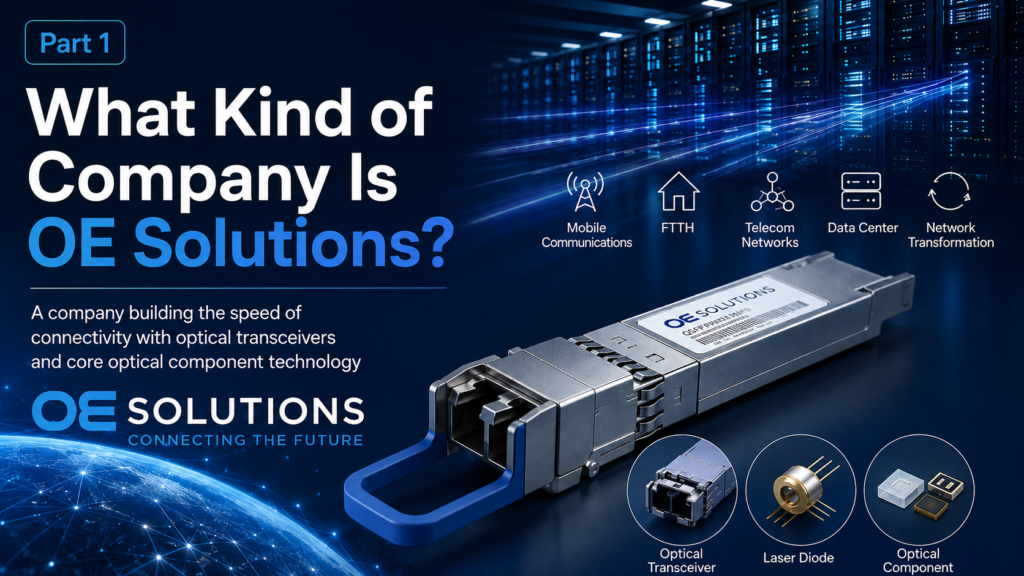
OE Solutions is a Korean optical communications company that develops and manufactures optical transceivers and core optical components used in optical communications. It was listed on the KOSDAQ market on February 27, 2014, and its stock code is 138080.
An optical transceiver is a device that converts electrical signals used by servers, network switches, telecommunications equipment, and other devices into optical signals and transmits them through optical fiber, then converts incoming optical signals back into electrical signals.
In data centers and telecommunications networks, this conversion process is required between network equipment and optical fiber in order to transmit data through optical fiber. OE Solutions operates its business around optical transceivers that perform this role. On its official website, the company identifies wireless fronthaul, fixed broadband, transport and interconnect, and network transformation as its main application areas.
| Category | Details |
|---|---|
| Company | OE Solutions Co., Ltd. |
| Listed Market | KOSDAQ |
| Stock Code | 138080 |
| Main Business | Development and manufacturing of optical transceivers and core optical components for optical communications |
| Main Products | Optical transceivers, PON/burst-mode transceivers, smart transceivers |
| Main Application Areas | Mobile networks, fixed broadband, telecommunications networks, data centers, and others |
| Business Model | B2B components and modules business targeting telecommunications and network equipment companies |
| Domestic Proprietary Technology | Development of core optical component technologies, including optical transceivers and laser diodes |
What Role Do Optical Transceivers Play?
Inside network equipment, data is often processed using electrical signals. In telecommunications networks and data centers, however, optical communications using optical fiber are widely used to transmit large amounts of data quickly.
The device that connects these two areas is the optical transceiver.
For example, if data is transmitted through optical fiber from one network switch to another in a data center, the optical transceiver on the transmitting side converts the electrical signal into an optical signal. After the data travels through the optical fiber, the optical transceiver on the receiving side converts the optical signal back into an electrical signal.
As the amount of data moving through networks increases and transmission speeds rise, optical transceivers must also be able to process larger amounts of data at higher speeds.
OE Solutions’ current official product list includes products ranging from lower-speed models to 50Gb/s, 100Gb/s, 200Gb/s, 400Gb/s, and 800Gb/s products, as well as 1.6Tb/s-class OSFP optical transceivers. Even among optical transceivers, different products are used depending on transmission speed, transmission distance, and the network environment in which they operate.
OE Solutions’ Main Business Areas
1. Optical Transceivers
Optical transceivers are OE Solutions’ core product line.
The company provides optical transceivers that can be used across various network segments, including metro and access networks, wired and wireless fronthaul, midhaul, and backhaul.
Optical transceivers are also used in mobile networks. In mobile networks such as 5G, large amounts of data move between radio equipment at base stations and other network equipment, so these sections can be connected using optical communications.
OE Solutions has built business experience with optical transceivers for these mobile networks, and its current product lineup is expanding into high-speed optical transceivers used in telecommunications networks and data centers. In its 2026 disclosure materials, the company also stated that it is pursuing the development and market entry of 200Gbps, 400Gbps, 800Gbps, and 1.6Tbps-class optical transceivers for data center servers.
2. PON and Burst-Mode Transceivers
PON (Passive Optical Network) is a method of connecting a telecommunications operator’s network to multiple subscribers using optical fiber. It is used in high-speed fixed broadband networks such as FTTH (Fiber To The Home).
OE Solutions also operates a product line of burst-mode optical transceivers used in this PON structure.
The company has also been mass-producing high-power 10G EPON OLT optical transceivers using its own laser diodes. This shows the structure through which the company is connecting its optical transceiver business with core optical component technology.
3. Smart Transceivers
Smart transceivers are products designed to perform some data-processing functions inside the transceiver in addition to basic optical signal transmission and reception.
OE Solutions provides a smart transceiver product line that supports functions such as protocol conversion, OAM (Operation, Administration and Maintenance), and synchronization bridging.
These products can be used when telecommunications operators operate existing and new networks together or gradually transition their network structure.
Expanding Its Business from Mobile Communications to Data Centers
To understand OE Solutions’ business, it is useful to look at which types of networks use optical transceivers.
The company’s official application areas include not only mobile fronthaul, but also fixed broadband, transport and interconnect, and network transformation. This is because optical transceivers are components used to connect multiple types of networks rather than components used for only one specific telecommunications service.
Recently, the company has also been expanding its product lineup for data centers and high-speed networks.
OE Solutions disclosed that it completed customer approval for a 100Gbps QSFP28 coherent optical transceiver capable of transmission over 120 km and has been supplying the product since 2025. For data center servers, the company is pursuing product development and market entry across speeds from 200Gbps to 1.6Tbps.
Its official product list also includes high-speed products such as 400Gb/s QSFP-DD and OSFP, 800Gb/s OSFP, and 1.6Tb/s OSFP.
Developing Core Optical Components Inside Optical Transceivers
Another part of OE Solutions’ business that should be examined is its core optical component technology used inside optical transceivers.
For an optical transceiver to convert an electrical signal into an optical signal, it needs a light source that generates light. One representative component used for this purpose is the laser diode (LD).
OE Solutions has developed not only optical transceivers but also laser diodes and related optical components as part of its own technology portfolio. The company has stated in its business reports that it has secured approximately 30 patents in Korea and overseas related to its proprietary Tunable Laser Chip technology.
The company is also expanding its development areas from telecommunications lasers to High Speed Lasers and High Power Lasers for data centers.
In 2026, it also introduced a 23dBm UHP Cooled ELSFP designed to supply an external light source for CPO (Co-Packaged Optics) environments. This product is an external laser module that supplies light to optical engines around a switch ASIC, and the company announced plans to begin providing customer samples in the third quarter of 2026.
The technology that began with optical transceivers is being connected to optical components and external light sources.
What Kind of Customers Does OE Solutions Sell Its Products To?
OE Solutions is closer to a B2B components company that supplies products to companies that manufacture telecommunications equipment and network systems than to a B2C company where general consumers purchase optical transceivers.
Optical transceivers must operate together with actual telecommunications equipment. Matching the size and connection format alone is not sufficient. They must meet the transmission speed, distance, wavelength, temperature conditions, network standards, and other requirements of the customer’s equipment.
For this reason, customer product approval and equipment qualification processes are important in the optical communications components business. OE Solutions also operates optical transceivers with different specifications for different network environments, including mobile communications, fixed telecommunications, and data centers. Its official product list shows that application ranges vary from connections of several hundred meters to long-distance transmission of more than 100 km.
OE Solutions’ revenue structure is therefore better understood as a supply-chain structure in which network equipment manufacturers’ equipment development and customer approval are connected with actual telecommunications and data center infrastructure investment and, in turn, component supply, rather than simply as a structure in which telecommunications operators or data centers directly purchase optical transceivers.
DANA NOTES Commentary
As AI infrastructure expands, the amount of data processed by GPUs and servers also increases. As computing equipment becomes more powerful, the networks that move data between servers and switches also require higher bandwidth. In this process, high-speed optical communication technologies such as 400G, 800G, and 1.6T become increasingly important.
Based on the technology it has accumulated through its existing optical transceiver business for mobile communications, OE Solutions is connecting its business areas to high-speed optical transceivers for data centers and external light sources for CPO. The fact that the company has actually introduced 400G, 800G, and 1.6T product lines as well as ELSFP shows that this direction is not limited to business plans alone.
Its in-house technology for core optical components such as laser diodes also deserves attention. As connection speeds in AI data centers increase, the performance of not only optical transceivers but also the optical components that generate and control light becomes more important.
However, the fact that a product has been developed and the fact that meaningful business has been secured in the data center market need to be evaluated separately. OE Solutions’ current high-speed data center product lines and CPO-related products show that the company is entering a new market, but whether actual customer approvals, mass production, and expanded supply follow will be a more important standard for evaluating business performance. The company has also disclosed that it is developing and promoting 1.6Tbps-class data center optical transceivers and pursuing market entry.
From this perspective, DANA NOTES views OE Solutions as a company through which we can examine what kinds of business opportunities Korean companies can create in the “connectivity” side of AI infrastructure rather than the “compute” side. It does not manufacture GPUs itself, but it possesses optical transceiver and core optical component technologies within the optical communications supply chain that must advance alongside the expansion of AI infrastructure.