What This Article Covers
How AI Acts in the Real World
The text AI, image AI, voice AI, video AI, and multimodal AI we have looked at so far have mostly been technologies that help people within computers or smartphones.
Their main role has been to understand information and make judgments, such as answering questions, analyzing images, understanding speech, or generating videos.
But Physical AI goes one step further.
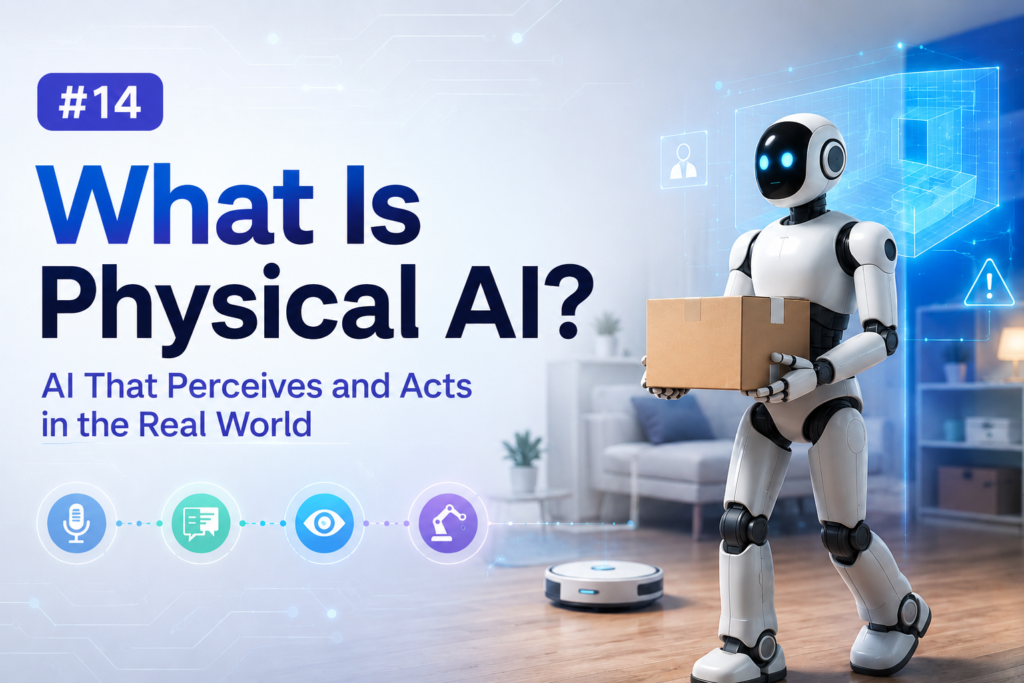
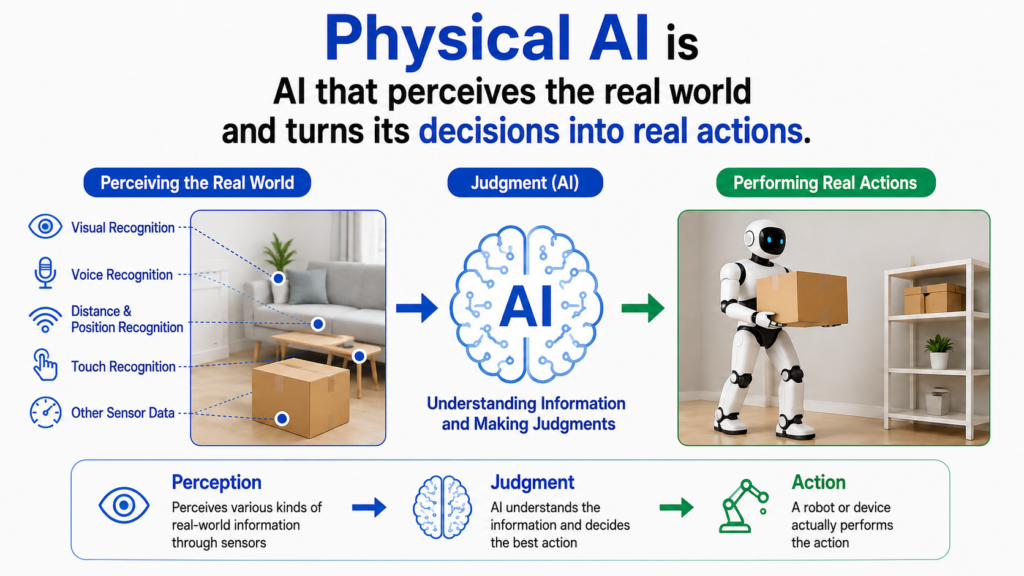
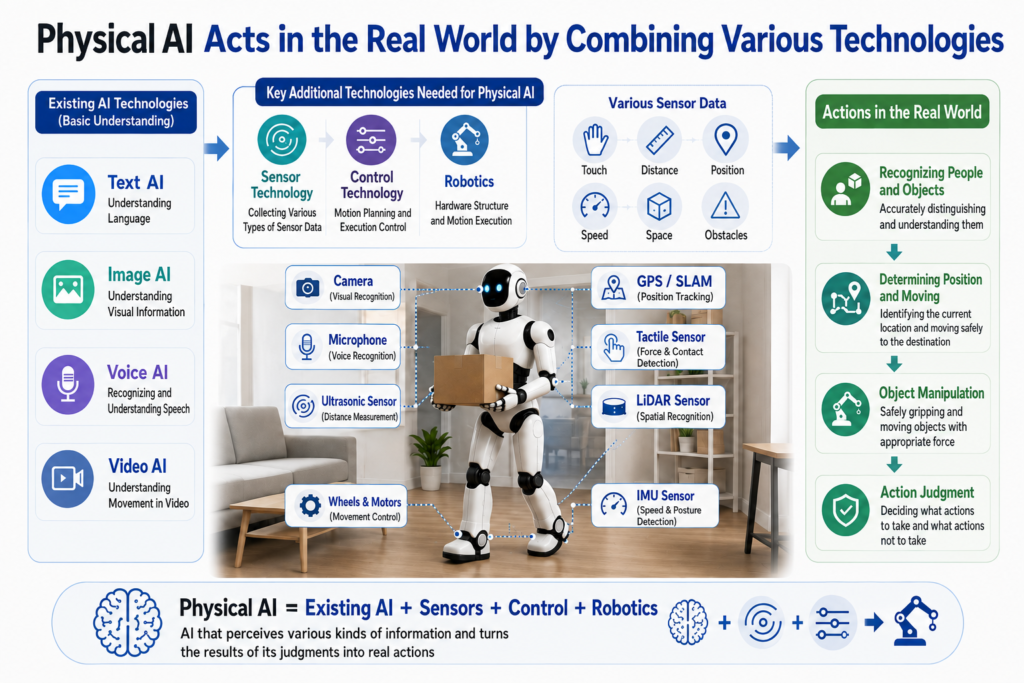
Physical AI is AI technology that perceives the real world and turns the results of its judgments into actual actions.
Simply put, AI that has helped people in the virtual world until now comes out into the real world and takes direct action.
Physical AI, the Complete Form of Multimodal AI
Earlier, we looked at multimodal AI.
Multimodal AI is AI that understands different forms of information together, such as text, images, audio, and video, and makes a single judgment based on them.
Physical AI goes one step further.
It also includes the stage of directly moving and acting in the real world based on the judgment made by multimodal AI.
For example, when a person says, “Take that box to the warehouse,” the following process takes place.
- Voice AI understands what the person says.
- Text AI analyzes the user’s intent.
- Image AI recognizes the location of the box and the surrounding environment.
- Multimodal AI understands multiple types of information together, such as audio and images, and determines what needs to be done.
- Physical AI uses that judgment to move the robot and actually carry the box.
In other words, Physical AI is completed when the various AI technologies we have learned about work together toward a single goal and the result leads to action in the real world.
Why Is Physical AI More Difficult?
In the real world, simply producing good answers is not enough.
To actually move, it must accurately distinguish between people and objects, determine its current location, and move safely to its destination. It must also determine how firmly it should hold an object, which actions are allowed, and which actions should not be performed.
To do this, it must process various types of sensor information in real time, including touch, distance, location, speed, and surrounding obstacles, in addition to text and images.
In other words, Physical AI is AI that can only be implemented by combining the AI technologies we have learned about so far with various other technologies, including sensor technology, control technology, and robotics.
A Representative Example of Physical AI Is the Humanoid Robot
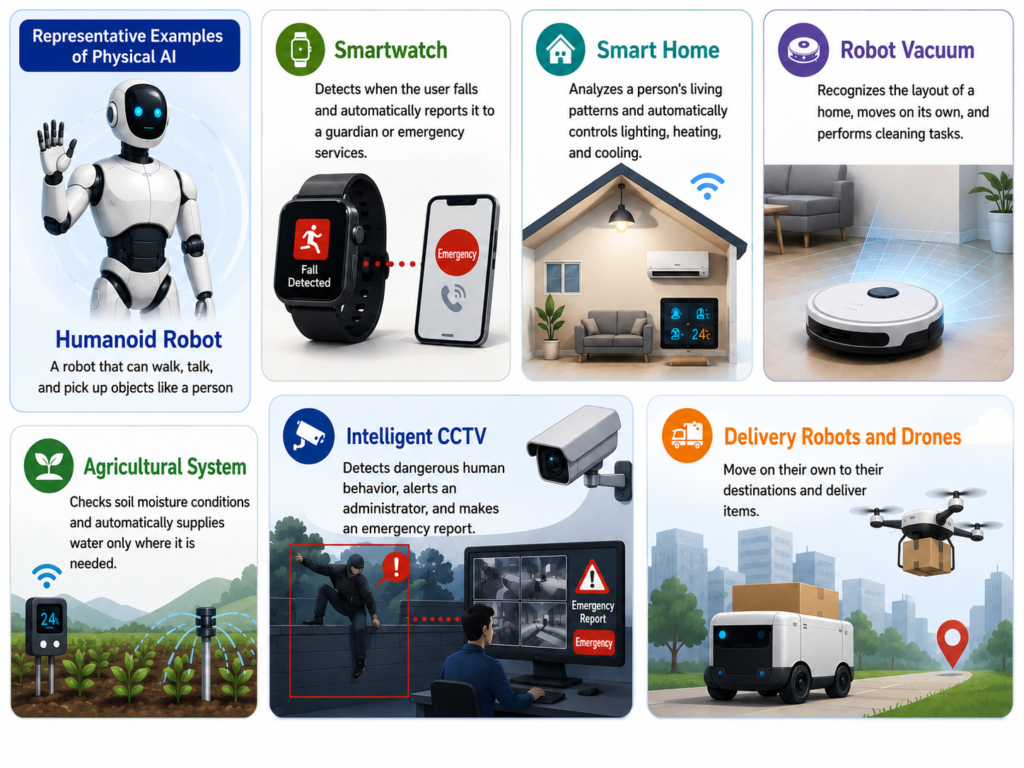
When many people think of Physical AI, the first thing that comes to mind is a humanoid robot that can walk, talk, and pick up objects like a person.
In fact, humanoid robots are the most representative example of Physical AI.
However, Physical AI does not refer only to humanoid robots.
It is already being used around us in many different forms.
- Smartwatches: Detect when the user falls and automatically report it to a guardian or emergency services.
- Smart homes: Analyze a person’s living patterns and automatically control lighting, heating, and cooling.
- Robot vacuum cleaners: Recognize the structure of a home, move on their own, and perform cleaning tasks.
- Agricultural systems: Check soil moisture conditions and automatically supply water only where it is needed.
- Intelligent CCTV: Detect abnormal behavior and alert an administrator or make an emergency report.
- Delivery robots and drones: Move to their destinations on their own and deliver items.
In this way, any system that perceives the real world, makes judgments on its own, and takes action can be considered an example of Physical AI, even if it does not look like a person.
DANA NOTES Commentary
Many people tend to think of Physical AI as technology that will dominate humans, as portrayed in movies or TV dramas. However, the purpose of Physical AI currently being researched is to perform dangerous or repetitive tasks on behalf of people and make human lives safer and more convenient.
For example, it is being used in a variety of areas to support tasks that are difficult or dangerous for people, such as carrying heavy objects, working in dangerous environments such as fires instead of humans, finding people who have fallen and cannot move and requesting rescue, or caring for elderly people who live alone.
Physical AI is technology developed to help people in the real world, and it will continue to develop as a key technology for improving human safety, convenience, and quality of life.
DANA NOTES in One Line
Physical AI uses various AI technologies to perceive the real world and perform actions to help people.