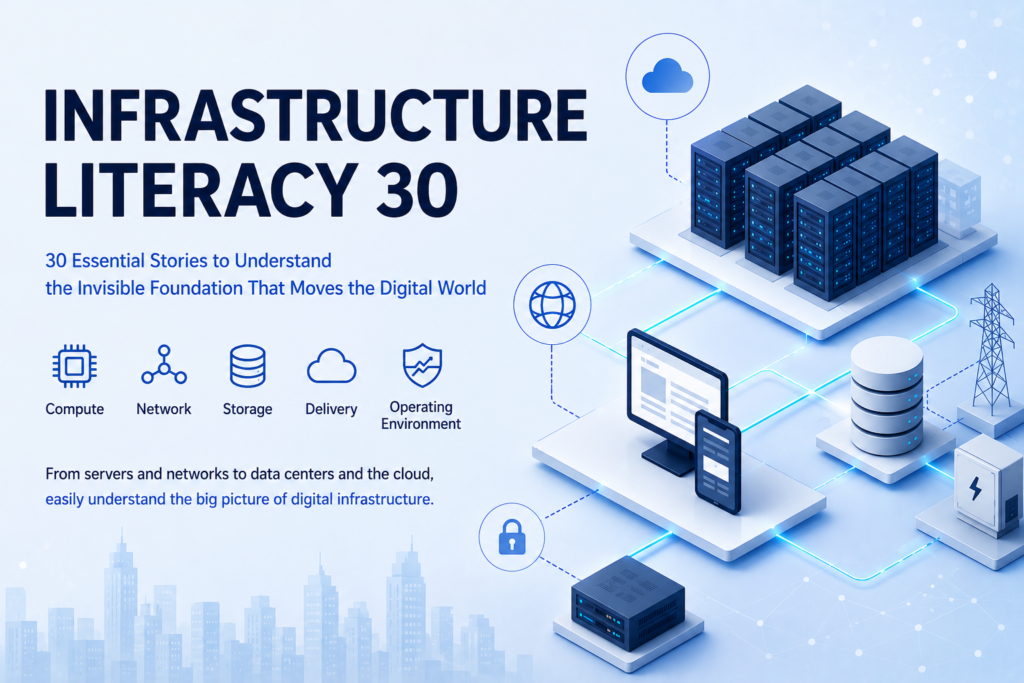
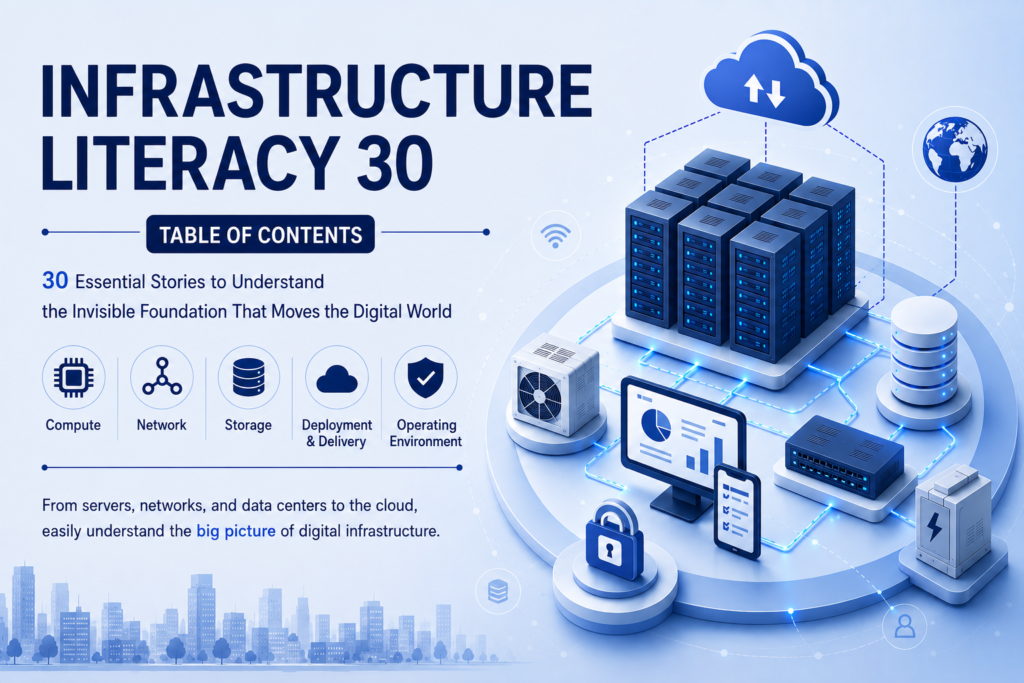
※ Infrastructure Literacy 30: Basic Level covers the overall structure and basic roles of digital infrastructure. Detailed semiconductor concepts and infrastructure security will continue in Infrastructure Literacy 30: Advanced Level.
PART 1. The Overall Picture of Digital Infrastructure
#01. What Is Infrastructure?
Infrastructure, foundational facilities, digital infrastructure
#02. Where Do Digital Services Operate?
Client, server, internet
#03. What Is Digital Infrastructure Made Of?
Computing, connectivity, storage, deployment and delivery, operating environment
#04. Why Isn’t Improving Just One Part of the Infrastructure Enough?
Bottlenecks and Balance
#05. How Does Infrastructure Change as the Number of Users Grows?
Traffic, Scaling, Distribution
#06. Why Do Digital Services Need Computing Equipment?
Computing, Computation, Processing
#07. What Is a Server?
Server, Service, 24/7 Operation
#08. Why Are Semiconductors Essential to Infrastructure?
Semiconductors, CPU, GPU
#09. How Can Servers Handle More Work?
Scale Up, Scale Out, Server Scaling
#10. How Do Multiple Servers Work Together?
Cluster, Distributed Processing
PART 3. Connecting Infrastructure
#11. Why Do We Need Networks?
Network, Communication
#12. How Is the Internet Connected?
LAN, WAN, Internet
#13. How Does Data Move?
Packet, Data Transmission
#14. Why Does Internet Speed Vary?
Bandwidth, Latency
#15. How Is the World’s Internet Connected?
Fiber-Optic Cables, Submarine Cables, Internet Backbone
PART 4. Storage Infrastructure
#16. What Do Digital Services Store?
Data, File, Log
#17. What Is the Difference Between Memory and Storage?
RAM, SSD, HDD
#18. Is Storage Space Only Located Inside a Single Server?
Local Storage, Shared Storage, Network Storage
#19. Why Are Servers and Storage Separated?
Computing, Storage, Separation of Roles
#20. Why Is Data Stored in Multiple Locations?
Backup, Replication
PART 5. Infrastructure for Deployment and Delivery
#21. Where Should Servers Be Located?
Server Room, Computer Room
#22. What Is a Data Center?
Data Center, Rack
#23. What Is the Cloud?
Cloud, Computing Resources
#24. Can the Cloud Exist Without Data Centers?
Physical Infrastructure, Data Center, Cloud Service
#25. Should Companies Own Their Infrastructure?
On-Premises, Cloud
PART 6. Operating Environment
#26. Why Do Servers Use So Much Electricity?
Power, Power Supply
#27. Why Do Servers Need Continuous Cooling?
Heat, Cooling
#28. How Can a Service Keep Running When One Component Fails?
Redundancy, High Availability, Failover
#29. How Are Failures Detected and Recovered From?
Monitoring, Alert, Incident Response
#30. How Does a Complete Digital Service Come Together?
Computing, Connectivity, Storage, Deployment & Delivery, Operating Environment