Notice
This article was written based on Uber’s announcements and related materials publicly available as of August 8, 2026. Some sections include DANA NOTES’ analysis.
What This Article Covers
Uber is once again investing heavily in robotaxis.
Uber has said that it plans to invest more than $10 billion in its robotaxi business over the next several years. This includes not only equity investments in autonomous driving companies but also funding to support vehicle acquisition and actual fleet operations.
But there is something unusual about this.
Uber currently works with multiple autonomous driving companies, but it is no longer a company that directly develops autonomous driving technology itself as it once did.
Uber did not give up on autonomous driving. It stepped away from the role of directly developing autonomous driving technology.
It is now seeking to expand its robotaxi business by using the ride-hailing platform and operational capabilities it has built over many years.
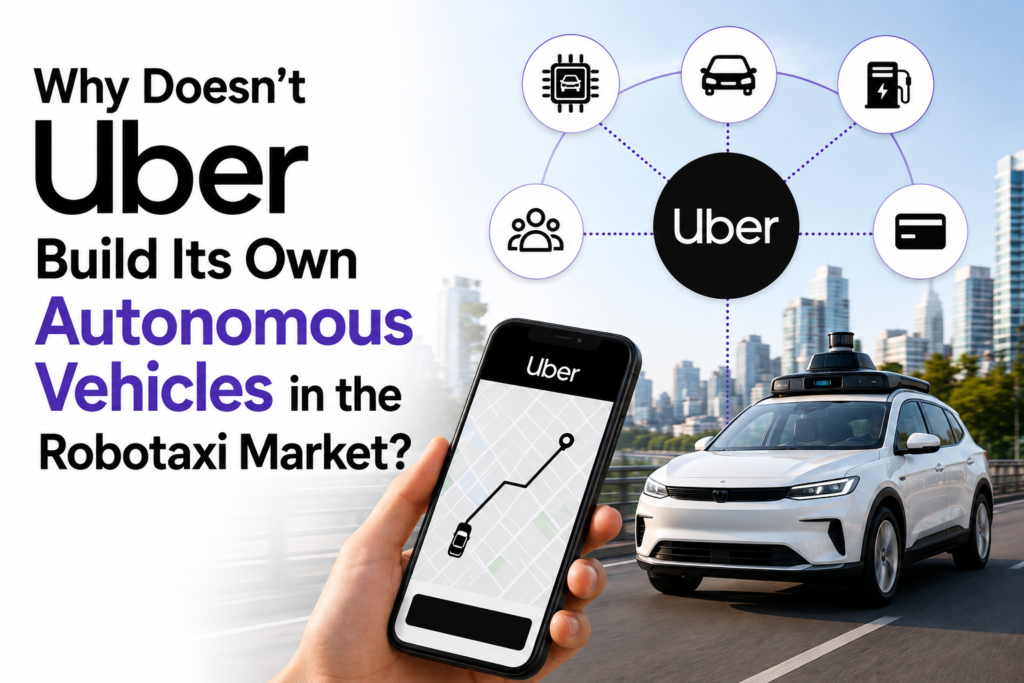
So why is Uber planning to invest more than $10 billion in robotaxis while not directly developing autonomous driving technology?
Uber Once Developed Autonomous Driving Technology Itself
Uber did not initially intend to play only the role of a platform.
In 2015, Uber entered autonomous driving technology development directly through its Advanced Technologies Group, or ATG. Autonomous vehicles could change the structure of the ride-hailing business itself, making the technology important to Uber as well.
However, directly developing autonomous driving technology was not easy.
It required enormous research and development costs, and the technology itself took time to develop. In 2018, an Uber autonomous test vehicle struck and killed a pedestrian in Arizona in the United States.
Eventually, in 2020, Uber decided to transfer ATG to autonomous driving technology company Aurora.
What is important here, however, is that Uber did not completely give up on the autonomous driving business itself.
When Uber transferred ATG to Aurora, it also invested $400 million in Aurora and entered into a strategic partnership. At the time, Uber presented a plan to connect Aurora’s autonomous driving technology to the Uber network in the future.
In other words, Uber stepped away from the role of directly developing autonomous driving technology, but it did not abandon its plan to connect autonomous vehicles to its platform.
Uber Changed Its Role, Not the Market
It is difficult to explain Uber’s current strategy if its change is viewed simply as an exit from the autonomous driving business.
What Uber gave up was closer to the role of directly developing autonomous driving technology and bearing the research and development costs and technological burden required to do so.
Instead, Uber began focusing on working with companies that specialize in autonomous driving technology and connecting their technology to actual services.
This direction has become increasingly clear.
Through Uber Autonomous Solutions, Uber has presented a business structure designed to help autonomous driving companies commercialize their technology in real markets.
Autonomous driving technology companies focus on software and autonomous driving system development, while Uber uses its existing platform to handle areas needed to expand actual services, including demand generation, rider experience, customer support, and fleet operations.
In other words, rather than directly building autonomous driving technology, Uber is focusing more on the platform and operational areas that connect autonomous driving technology to actual mobility services.
Robotaxis Cannot Operate on Autonomous Driving Technology Alone
When people think of robotaxis, the first thing that often comes to mind is a car that drives itself.
But completing autonomous driving technology does not immediately create a robotaxi service.
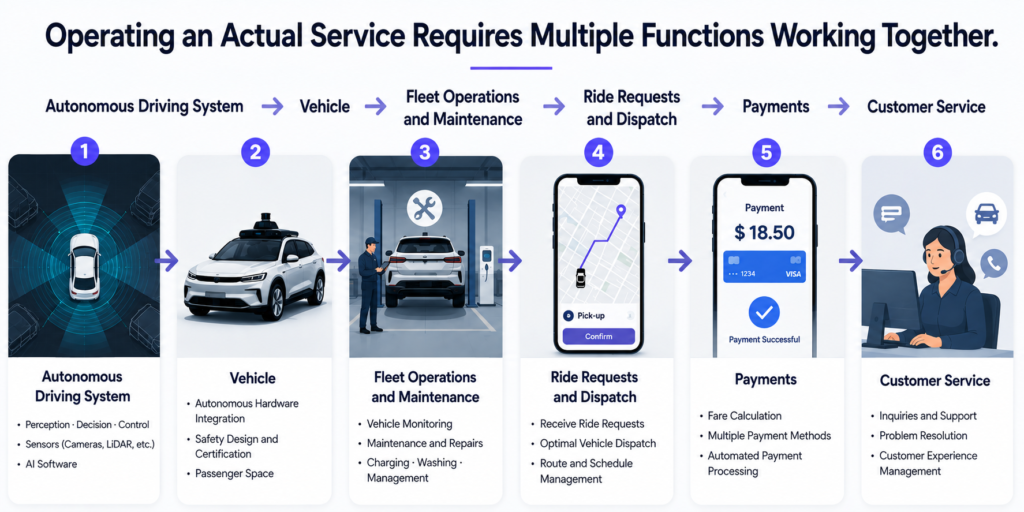
Several functions must work together to operate an actual service.
Autonomous driving system → Vehicle → Fleet operations and maintenance → Ride requests and dispatch → Payments → Customer service
The system must determine where vehicles should be located and connect rider requests with available vehicles.
Vehicles also need charging and maintenance. Customers need support when problems occur, and a payment system is required.
Developing autonomous driving technology and operating large numbers of vehicles in real cities while providing mobility services to riders are different problems.
This is exactly where Uber already has something valuable.
What Uber Has Is Demand and an Operational Network
Uber stepped away from directly developing autonomous driving technology, but it already operates a large-scale ride-hailing platform.
The Uber app has riders who need transportation, along with ride-request and dispatch systems that connect riders with vehicles.
It also has payment systems and customer support infrastructure. Uber has experience operating ride-hailing services across many countries and cities.
Even if some vehicles currently driven by people are replaced by autonomous vehicles in the future, these functions do not simply disappear.
Instead, Uber sees its role as something closer to this:
Autonomous driving companies build autonomous driving technology, while Uber connects that technology and those vehicles with actual riders.
Through Autonomous Solutions, Uber also identifies infrastructure, user experience, and fleet operations as key areas.
Rather than autonomous driving technology itself, Uber is bringing the platform and operational systems required to commercialize autonomous driving technology into its own business domain.
That Is Why Uber Works With Multiple Autonomous Driving Companies
Seen from this perspective, it becomes easier to understand why Uber works with multiple autonomous driving companies at the same time.
Instead of developing one specific autonomous driving technology itself, Uber is connecting technologies and vehicles developed by different companies to its own network.
Uber is working with Waymo in Austin and Atlanta in the United States. It is also expanding partnerships with other autonomous driving technology companies and automakers.
Under this structure, Uber does not need to build both the technology and the vehicles itself.
Companies specializing in autonomous driving technology can develop the technology, while automakers can supply the vehicles.
What Uber aims to provide is the connection between them and its own mobility platform and actual rider demand.
The $10 Billion Does Not Mean Autonomous Driving Technology Development Costs Alone
For this reason, Uber’s plan to invest more than $10 billion also needs to be viewed carefully.
It does not mean that Uber plans to rebuild a large in-house autonomous driving research organization and spend $10 billion directly on technology development.
Uber has said that its investment plans include equity investments in autonomous driving partners, financial support for fleet operations, and vehicle commitments.
Even when another company develops autonomous driving technology, capital, vehicles, and an operational foundation are still required to expand that technology into an actual robotaxi service.
Uber is investing in this process while seeking to expand the number of autonomous vehicles and partners that can operate on its platform.
Therefore, while the $10 billion figure may make it appear that Uber is returning to autonomous driving technology development, it is actually closer to an investment aimed at expanding the platform-focused strategy Uber has chosen.
It is also important to distinguish that this amount is not money that has already been spent, but an investment amount planned over the next several years.
The Platform-Focused Strategy Also Connects to Uber’s Existing Business
Uber can pursue this strategy because robotaxis are not a completely separate new service from its existing business.
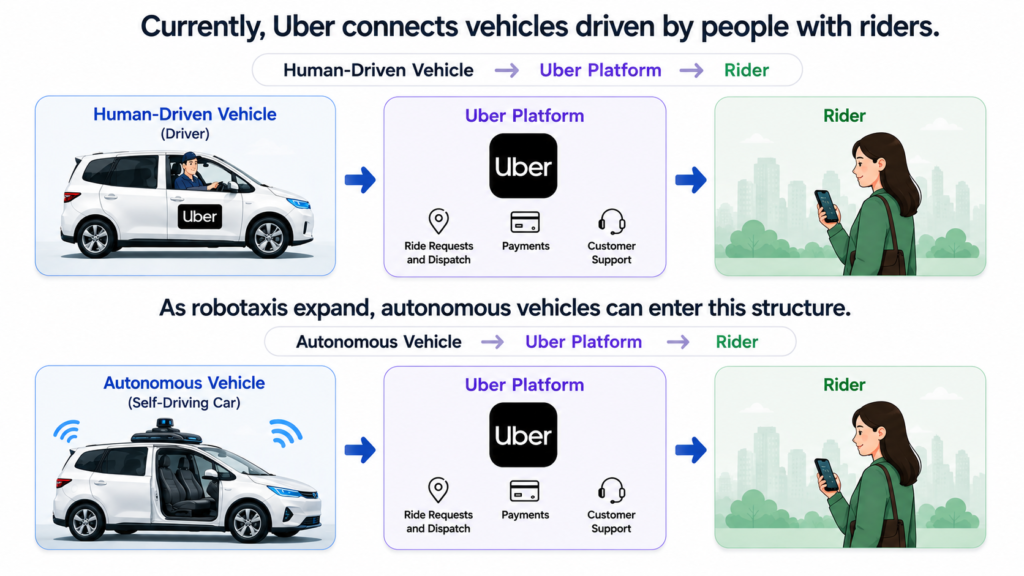
Today, Uber connects vehicles driven by people with riders.
Human-driven vehicle → Uber platform → Rider
As robotaxis expand, autonomous vehicles can enter this structure.
Autonomous vehicle → Uber platform → Rider
The entity driving the vehicle changes, but the platform still needs to receive ride requests, dispatch the appropriate vehicle, process payments, and support customers.
Uber also expects autonomous vehicles and existing driver-operated vehicles to operate together for the time being.
From Uber’s perspective, therefore, connecting a new type of vehicle to the platform it has already built is more naturally connected to its existing business than rebuilding autonomous driving technology from the beginning.
But a Robotaxi Platform Is Not Exactly the Same as Traditional Ride-Hailing
That does not mean Uber can simply keep its existing platform unchanged.
In today’s ride-hailing service, drivers bear a significant portion of the responsibility for owning and managing their vehicles.
Robotaxis can have a different structure.
Someone must acquire the vehicles, and they require maintenance, charging, and cleaning. Costs can also arise while vehicles are not in operation.
Operational systems are also needed to respond when accidents occur or when a vehicle has a problem.
The fact that Uber has included funding to support fleet operations and vehicle acquisition in its plan to invest more than $10 billion is also connected to this structure.
Therefore, the expansion of robotaxis does not mean Uber can automatically grow the business simply by maintaining its existing software platform.
How far Uber will go in taking on fleet operations and capital burdens while remaining a platform company will be an important issue going forward.
DANA NOTES Commentary — Uber Did Not Step Away From Robotaxis. It Moved to a Different Position
Looking at Uber’s direction over the past decade, the change is relatively clear.
In the past, Uber directly developed autonomous driving technology.
But it stepped away from the role of directly building autonomous driving systems while bearing enormous costs and technological development burdens.
Instead, it is investing in autonomous driving companies and moving toward connecting the vehicles and technologies they develop to Uber’s demand, dispatch, payment, and operational systems.
Therefore, rather than viewing Uber’s change as “giving up on autonomous driving,” it is more appropriate to see it as “moving from direct autonomous driving technology development to a role focused on platforms and commercialization support.”
The plan to invest more than $10 billion can also be viewed as an extension of that direction.
Instead of rebuilding autonomous driving technology itself, Uber is investing in the process through which autonomous driving technology and vehicles developed by other companies become actual mobility services.
What matters here is that not directly developing a technology does not necessarily mean moving away from the business built around that technology.
The role of a company that develops autonomous driving technology can be different from the role of a company that connects that technology to an actual service.
Uber has stepped back from autonomous driving technology development, but it is investing more actively in the process through which robotaxis are actually provided to riders.
In other words, Uber did not step away from robotaxis. It moved to a different position.
It is moving from the position of directly building autonomous driving technology to the position of a platform that connects autonomous driving technology and vehicles with riders, demand, and operational systems.
What to Watch Going Forward
There are still several areas to watch to see how far Uber’s strategy develops into an actual business.
First, it will be necessary to see how much of the planned investment of more than $10 billion is actually deployed over the next several years.
It will also be important to see how much capital is allocated respectively to equity investments in autonomous driving companies and to vehicle acquisition and operational support.
Another point to watch is how quickly the number of autonomous driving companies connected to the Uber platform and the number of cities with actual operations increase.
As the number of robotaxis grows, the scale of operating costs Uber bears for vehicle acquisition, maintenance, and charging will also be an important variable.
It will also be necessary to see how the structure in which traditional ride-hailing and robotaxis operate together actually affects Uber’s revenue and profitability.
Ultimately, what matters in Uber’s robotaxi strategy going forward is not whether Uber returns to directly developing autonomous driving technology.
The key question is how many autonomous vehicles Uber can connect to its platform without directly building the technology itself, and how efficiently it can operate them as actual mobility services.