What This Article Covers
What Is DX?
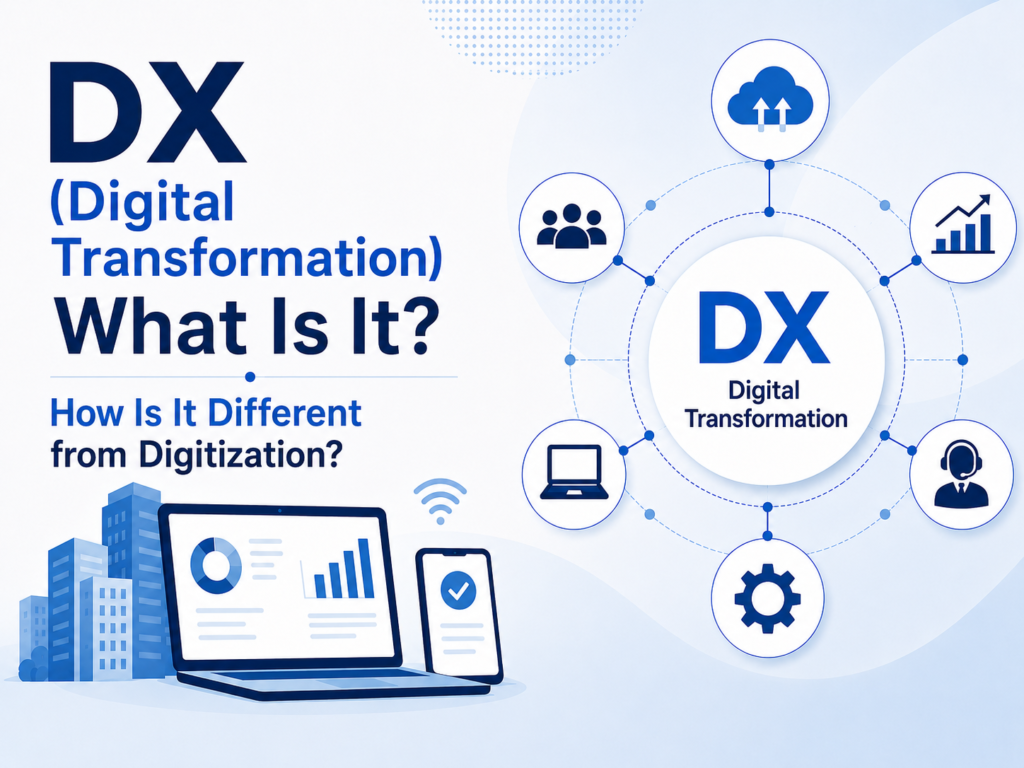
When reading recent IT news or articles about companies, you will often come across the term DX (Digital Transformation).
“Our company is pursuing DX.”
“We have established a dedicated DX organization.”
“We improved work efficiency through DX.”
Although the term is used in many different contexts, it is difficult to explain exactly what DX means.
Many people think DX simply means eliminating paper and using computers. However, that is closer to digitization.
DX involves a much broader change.
Moving work that people previously handled one step at a time offline into online systems, connecting those processes, and operating them faster and more efficiently—this is the core of DX.
How Is Digitization Different from DX?
To understand DX, you first need to understand how it differs from digitization.
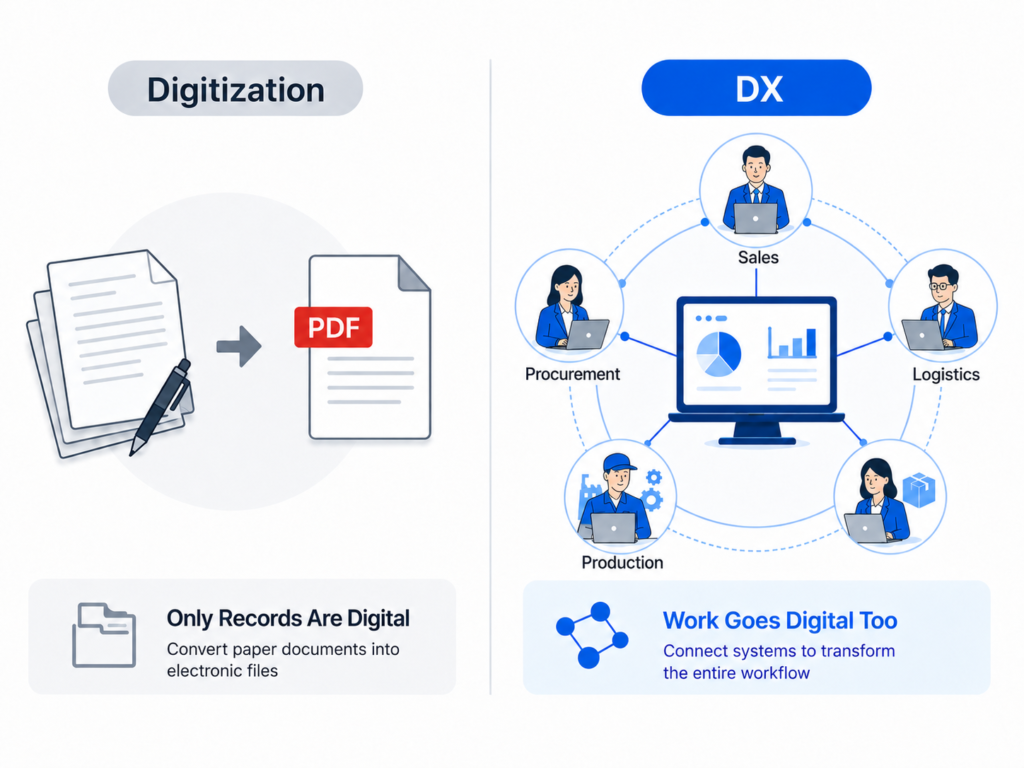
Digitization means converting analog information into digital form.
For example:
- Saving a paper contract as a PDF
- Scanning and storing paper documents
- Replacing handwritten accounting records with an Excel file
In these examples, only the method used to record information has changed. This is digitization.
DX, however, is not simply about converting documents into digital form.
It means redesigning the way work itself is carried out around digital systems.
For example, imagine a company where, after a customer places an order, an employee prepares an order form, checks inventory, contacts the purchasing team, receives approval from a manager, and then begins production.
During this process, several people must contact one another and check information manually. Information is often passed along through phone calls, emails, or messaging apps.
In a company that has undergone DX, the system checks inventory as soon as an order is received. When necessary, it creates a purchase request, requests approval, and automatically sends the required information to the relevant departments.
DX enables systems to continue processing work that people previously had to pass along and verify manually.
Why Do Companies Pursue DX?
Companies do not pursue DX simply to adopt the latest technologies.
The goal is to work faster, more accurately, and more efficiently.
When work is connected through a single system, employees do not need to enter the same information repeatedly. Information can also be shared more quickly between departments, and tasks that people previously performed repeatedly can be automated.
As a result, employees can focus on more important work, such as responding to customers and solving problems, rather than performing simple repetitive tasks.
The main benefits that companies expect from DX include:
- Automation of repetitive tasks
- Reduction of human error
- Faster work processing
- Stronger collaboration between departments
- Data-driven decision-making
- Lower operating costs
- Improved customer service quality
DX can therefore be understood not as the installation of new software, but as a strategy for improving work efficiency across the entire company.
What Actually Changes Through DX?
In a company that has undergone DX, the biggest change is the way work is handled.
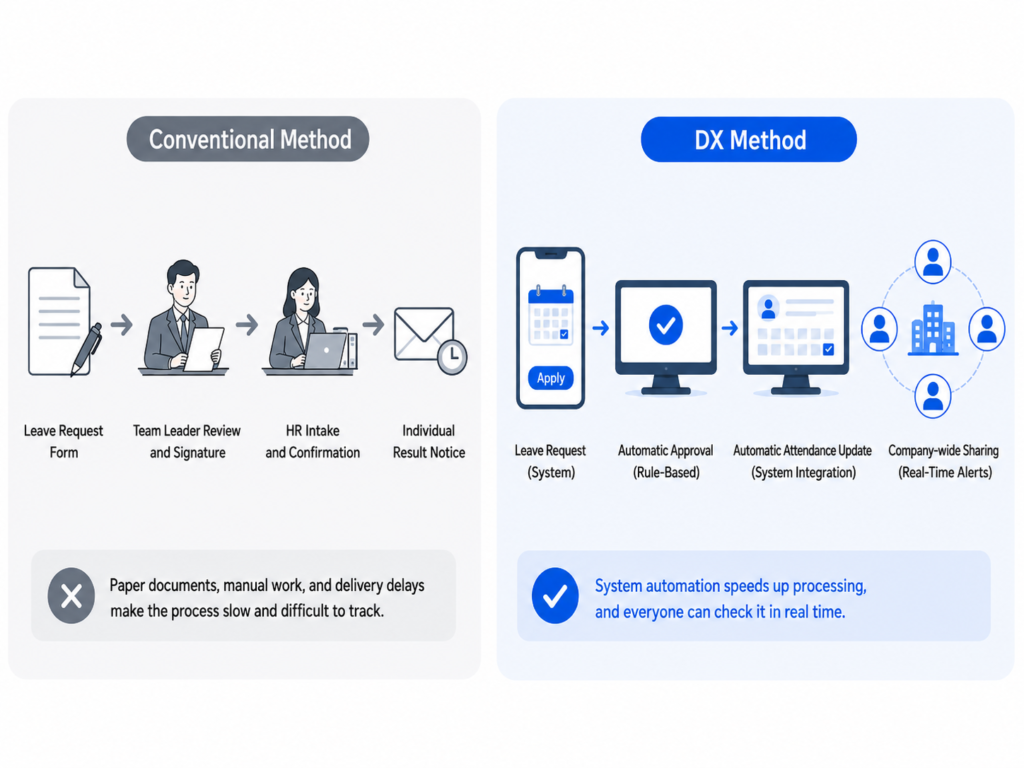
For example, consider the process of requesting leave.
In the past, an employee had to complete a leave request form and submit it to a manager. Once it was approved, the human resources team had to enter the information again into the time and attendance system. Other employees often had to check emails or messaging apps, or ask someone directly, to find out who was on leave.
In a company where DX has been implemented, an employee submits a leave request through the system, and the approval request is automatically sent to the appropriate manager. Once it is approved, the attendance records are automatically updated, and the leave information is also reflected in the company-wide calendar or organizational chart. Everyone can immediately see who is on leave without receiving a separate message.
Business trip requests, expense reimbursement, purchase requests, inventory management, and customer support can all be connected in the same way.
Employees do not need to contact several departments individually. The system delivers the required information and continues the next step of the process.
The core of DX is not eliminating paper. It is connecting, through systems, work that people previously handled one step at a time.
Technologies That Enable DX
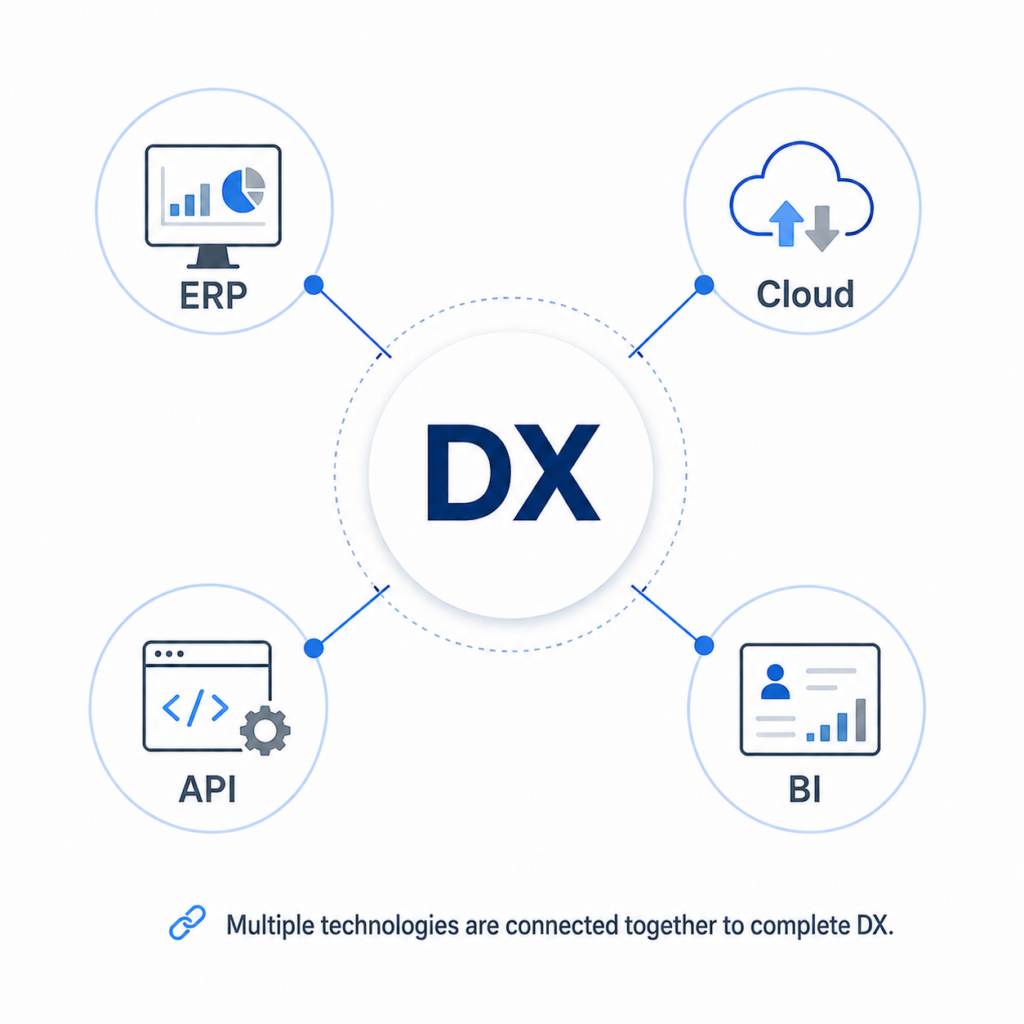
DX is not a single program or service.
Companies connect and automate their work by using several digital technologies together.
The main technologies include:
- ERP: Integrates accounting, human resources, production, purchasing, and other business functions into a single system.
- Cloud: Provides an environment where employees can access the same system and perform their work from anywhere.
- API: Connects different systems so that they can automatically exchange data.
- Data Analytics (BI): Analyzes and visualizes data accumulated during business processes to support decision-making.
As these technologies become connected, companies can operate their work more quickly and efficiently.
The most accurate way to understand DX is as a change created by multiple digital technologies working together, rather than as a single technology.
Pursuing DX Does Not Guarantee Success
DX is an important strategy pursued by many companies, but introducing a new system does not automatically guarantee success.
For example, even when a company has implemented the latest system, the way work is performed may not change significantly if employees continue to manage separate Excel files or exchange important information only through messaging apps and phone calls. The system has changed, but the actual work continues in the same way as before.
In addition, if a company introduces a new system while keeping all of its existing work procedures unchanged, employees may end up with more tasks, making the work even more complicated.
For this reason, companies consider redesigning work procedures and training employees to adapt to the new way of working to be just as important as introducing a new system.
The success of DX depends not on introducing an expensive system, but on naturally moving work that was previously performed offline into online systems and enabling everyone in the organization to adapt to the change.
DANA NOTES Summary
DX does not simply mean eliminating paper or using computers.
The core of DX is moving work that people previously handled one step at a time offline into online systems, connecting those processes, and operating them faster and more efficiently.
DX does not end with converting documents into digital form. Its essence is creating systems that automatically connect information and allow work to flow naturally from one step to the next.
For this reason, many companies today consider how to connect and automate their work more efficiently to be more important than simply introducing a new program.
DX is not the process of replacing paper with computers. It is the process of moving work that people previously handled one step at a time offline into online systems and connecting those processes.