What This Article Covers
ERP Is Not a Program; It Is a Management Innovation
When looking through job postings, you will often see terms such as SAP, Douzone, and Oracle ERP.
That is why many people think ERP is the name of a particular program or software product.
However, the essence of ERP is not a program.
ERP is an integrated management system that emerged to solve the management problems that arise as companies grow.
To understand ERP, we first need to examine what kinds of problems occur as a company grows.
Why Did ERP Emerge?
In a small company with around ten employees, the head of the company can directly understand most of the work being done.
However, as a company grows, its work begins to be divided into specialized areas such as sales, purchasing, production, finance, and human resources.
Each department develops its own expertise, but the information used by each department also becomes separated.
For example, the sales department may receive a customer order, but the production department may not learn about it until later, while the purchasing department may fail to prepare the necessary materials on time.
The finance department may also end up calculating sales and expenses only after all the work has been completed.
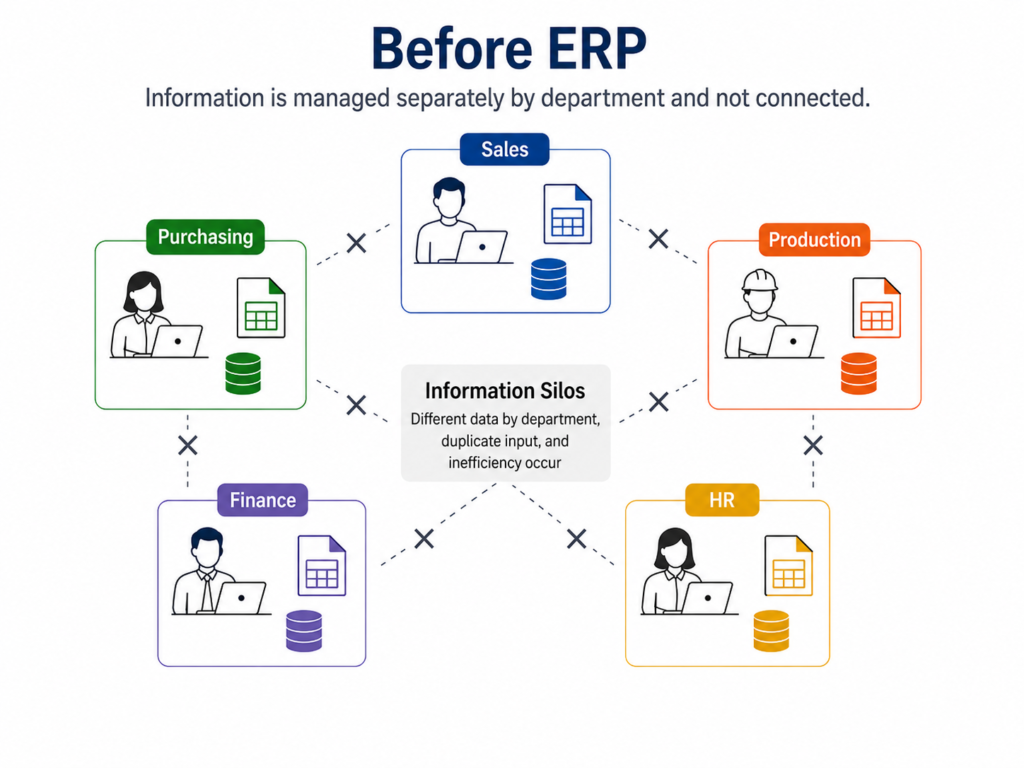
As a company grows, these inefficiencies become greater, and the company begins to see the need to connect the work of different departments into a single flow.
ERP emerged against this background.
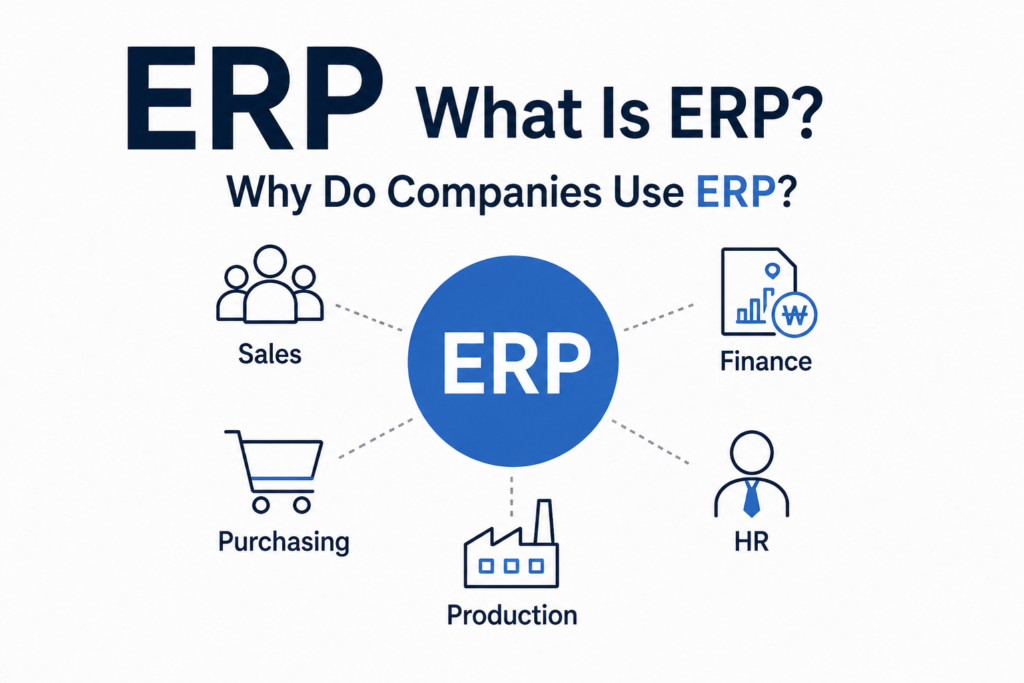
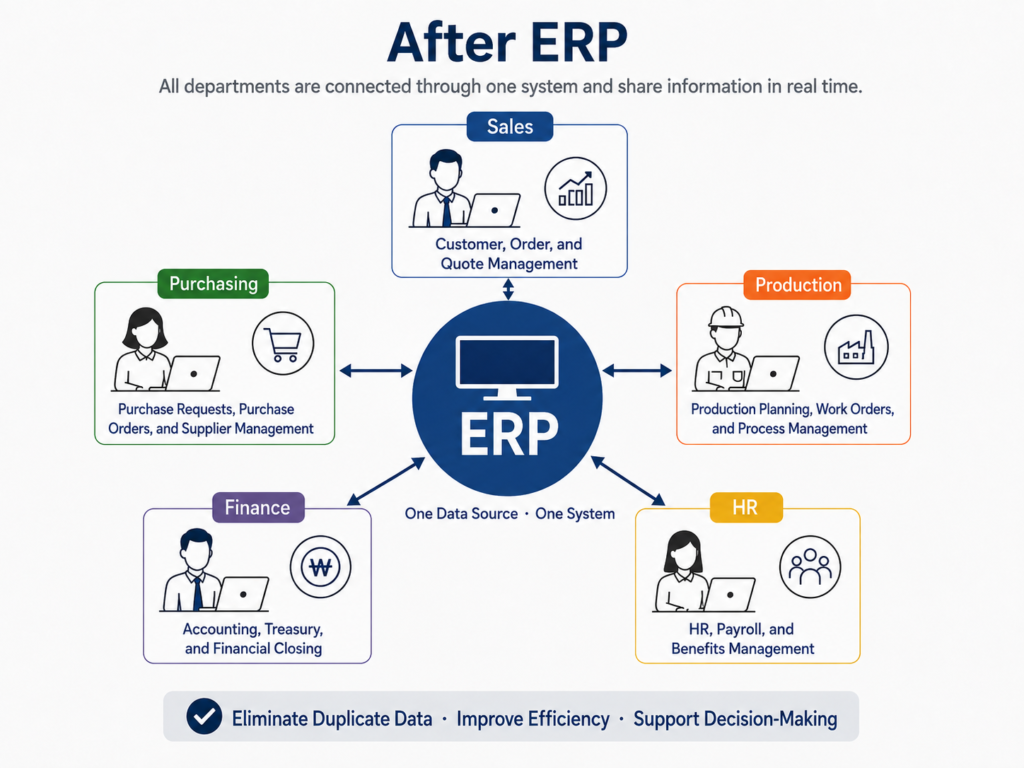
ERP is a system that integrates previously separated functions such as sales, purchasing, production, finance, and human resources into a single management process.
Why Was ERP Innovative?
Even before ERP, companies were already using various information systems.
Accounting was managed through accounting software, production through production systems, and human resources through HR systems.
Each system performed its own role well, but the systems were not connected to one another.
ERP was significant because it connected these separate systems into a single workflow.
For example, when a customer orders a product, the work that begins in the sales department continues naturally through inventory checks, purchasing, production, shipping, and accounting.
As multiple departments began using the same information throughout this process, efficiency and accuracy improved significantly.
ERP is regarded as a management innovation not because it created a new program, but because it introduced a new way of operating the entire company as a single process.
What Changes When a Company Implements ERP?
Implementing ERP does not simply mean adding another program.
A company standardizes its work procedures and redesigns how departments collaborate.
This brings about the following changes:
- Information can be shared more quickly between departments.
- The need to enter the same data multiple times is reduced.
- Work-related errors can be reduced.
- Management can quickly understand the overall status of the company.
- Faster decision-making can be supported.
The purpose of ERP goes beyond computerization. It is about improving the efficiency of company operations.
ERP Has Evolved Differently Across Industries
The basic concept of ERP is the same, but not every company uses ERP in the same form.
This is because companies in different industries have different work processes and require different functions.
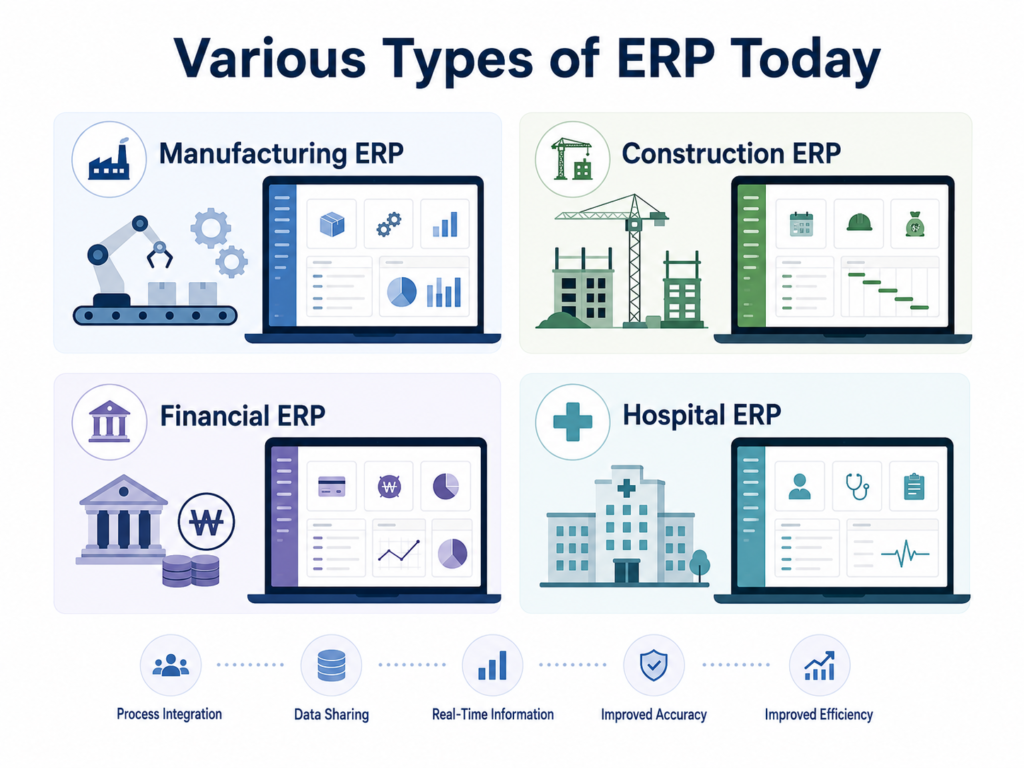
For example, production planning and inventory management are important in manufacturing, while construction companies focus on managing project progress and costs. Hospitals need to manage patient care and medical records, while financial companies must carefully manage core transaction systems and regulatory compliance.
Because of these differences, ERP has evolved to reflect the characteristics of each industry.
Today, various forms of ERP are used, including manufacturing ERP, construction ERP, financial ERP, and hospital ERP. Companies select and operate the ERP system that best fits their work environment.
DANA NOTES Summary
ERP is not simply software. It is an integrated management system that connects a company’s work into a single flow.
It emerged to resolve the information silos and operational inefficiencies that arise as companies grow, and it continues to serve as a core foundation for business operations across a wide range of industries.