
Notice
This article was written based on Comcast and Xfinity’s official materials and related publicly available information as of August 21, 2026. DANA NOTES’ analysis is also included.
Recommended Reading
What This Article Covers
Key Terms to Know
Wi-Fi Sensing — A technology that detects movement or changes in a space by analyzing how Wi-Fi signals change when people or objects move.
Opt-in — A method in which a service is activated only after the user directly agrees and turns the feature on.
Wi-Fi routers that connected the internet have begun detecting movement inside the home
U.S. telecommunications company Comcast provides the WiFi Motion feature to Xfinity internet customers.
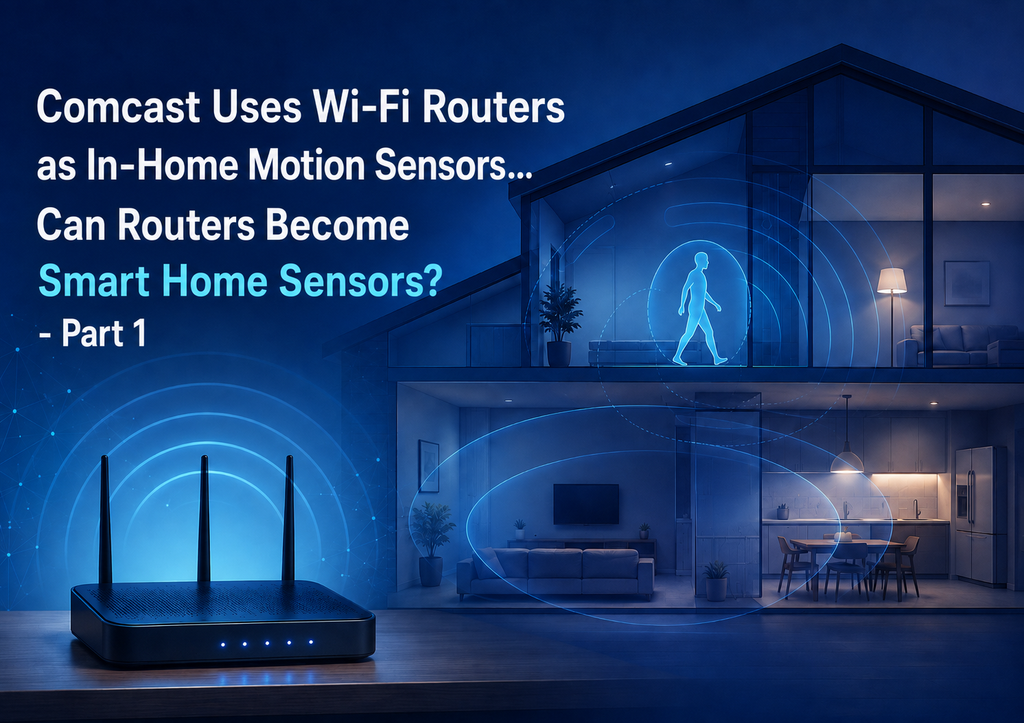
The structure of the feature is relatively simple. Wireless signals travel between an Xfinity Gateway and Wi-Fi devices already connected inside the home, and when a person moves through the space where those signals travel, the signal conditions also change. WiFi Motion analyzes these changes to detect movement.
Its structure differs from a camera recording video or a microphone recording sound. The Wi-Fi signals already established throughout the home for internet connectivity themselves become a means of detecting movement.
According to Xfinity’s current official support documentation, compatible Gateways such as the XB7, XB8, and XB10, as well as Wi-Fi Extenders, are supported. Users can combine one Gateway with up to three fixed Wi-Fi devices to create up to three motion detection areas. One detection area is formed between the Gateway and each device. Some XB7 models and others are excluded from support.
WiFi Motion is turned off by default. It uses an opt-in model, meaning users must activate the feature in the Xfinity app and agree to the relevant terms and privacy policy before using it.
How can Wi-Fi detect a person’s movement?
Wireless signals continuously travel between a Wi-Fi router and fixed Wi-Fi devices in the home, such as smart TVs and speakers.
Xfinity explains this in an easy-to-understand way as a structure in which an elliptical detection area is created between the Gateway and a connected device.
When a person passes through this area, the environment through which the signal travels changes. The person’s body and surrounding objects affect the path of the radio waves, causing changes in the wireless signal, and the system uses these changes to determine that movement has occurred.
For example, if the Gateway is in the living room and an always-on Wi-Fi device is in the kitchen, the space through which the signal travels between the two devices can be used as a motion detection area.
When movement is detected, the user can receive an alert through the Xfinity app, and the app also allows users to view motion events that occurred during the previous seven days.
However, the information currently provided by WiFi Motion does not identify a person’s exact location or identity. It indicates that movement was detected in the area configured around a particular connected device.
This distinction is important.
WiFi Motion’s current role is closer to a contactless sensor that detects whether activity has occurred in a space than to a video system that closely observes the inside of a home.
The role of the router is expanding from internet connectivity to spatial sensing
Wi-Fi routers have long been used as network devices that connect an internet line to multiple devices.
Recently, their role has gradually been expanding.
Xfinity Gateway already provides functions such as managing the user’s Wi-Fi environment, checking connected devices, parental controls, and responding to cyber threats. With the addition of WiFi Motion, physical movement inside the home has also begun to fall within the scope of what the Gateway can handle.
The key point in this change is that the structure does not necessarily require the installation of another dedicated sensor.
Users can utilize a compatible Gateway and fixed Wi-Fi devices already being used in the home. Network infrastructure installed to provide internet service takes on a new function through software and signal analysis.
This also has significance from the perspective of telecommunications companies.
While the main value of a Gateway previously lay in internet quality and network management, the application of Wi-Fi Sensing creates the possibility of using the same device to generate a new type of information about activity in a space and apply it to services.
Why Comcast is connecting WiFi Motion to the smart home
Comcast introduces WiFi Motion in the Smart Home section of the official Xfinity website.
For example, it presents a use case in which a detection area is set near the front door so that users can receive a motion alert when a child returns home from school.
The Xfinity app already provides functions to connect and control some smart home devices, including smart locks, thermostats, and lights.
When WiFi Motion is added to this structure, another type of information becomes available for use in the smart home.
A smart lock generates information that a door has opened, a temperature sensor measures indoor temperature, and a camera generates video.
Wi-Fi Sensing can generate information that movement has occurred in a space.
Smart home functions can therefore expand from remotely controlling connected devices to sensing conditions inside the home and responding to changes in those conditions.
Wi-Fi also has a different business characteristic from other sensors because it is already installed in many homes. Compared with installing new hardware from the beginning in every home when providing a new smart home service, services that can use existing network equipment have room to simplify installation and deployment.
WiFi Motion and home security services are currently treated separately
Comcast provides WiFi Motion within the smart home category while also clearly limiting the current role of the feature.
Xfinity states in its official guidance that WiFi Motion is not a home security service and is not a professional monitoring service.
Xfinity separately provides Xfinity Home, which includes cameras, live video, and professional monitoring. WiFi Motion is not currently offered as a product that guarantees the same level of safety functionality as that security service.
Detection performance is also affected by the residential environment.
The position of the Gateway and connected devices, the size and layout of the home, walls and building materials, and Wi-Fi signal strength can all affect the range in which movement can be detected. Comcast also does not guarantee WiFi Motion’s detection performance and advises users to test whether alerts are actually generated in the locations they want to monitor.
Therefore, WiFi Motion is currently best understood as a smart home feature that provides information about activity in a living space.
New personal information is created even without video
Wi-Fi Sensing has the characteristic of not generating camera video.
At the same time, new information is created about when movement occurs inside the home.
Users can view motion events in the Xfinity app, and Comcast explains that it does not itself monitor the motion or alerts generated by WiFi Motion.
However, Comcast’s WiFi Motion guidance also includes points that should be examined from a privacy perspective.
Comcast states that, as permitted by applicable law, it may provide information generated by WiFi Motion to third parties without additional notice in connection with law enforcement investigations or proceedings, disputes in which Comcast is a party, court orders, or subpoenas.
Comcast’s general privacy policy also explains that customer information may need to be provided to third parties in accordance with legal processes such as valid subpoenas, court orders, and search warrants.
Compared with a situation in which Wi-Fi is used only as a means of internet connectivity, this raises a new question.
When network equipment begins to detect movement in a space, the scope of information that telecommunications companies must manage can also include data generated through activity inside the home.
This is why the criteria for evaluating privacy in the smart home may also expand beyond camera video and audio information.
In the smart home, ‘what is collected’ becomes more important
As Wi-Fi Sensing expands, smart home companies and telecommunications companies need to design more clearly not only what information can technically be generated, but also what information is collected in actual services, how long it is retained, for what purposes it is used, and under what conditions it is provided.
Even from the same Wi-Fi signals, the types of information that can be generated may vary depending on the level of technology and the purpose of the service.
Comcast WiFi Motion currently provides relatively simple functions centered on motion events and detection areas. As Wi-Fi Sensing technology develops, more diverse spatial information, such as presence and activity patterns, may also be used in services.
As a result, the scope of data use and privacy management standards also become more important.
In particular, the home is a space where an individual’s daily patterns continuously appear more clearly than in workplaces or commercial spaces. Even if each piece of data generated by smart home sensors appears simple, when accumulated over a long period it can reveal patterns in daily schedules and the use of space.
As Wi-Fi becomes a smart home sensor, user consent, data retention, access rights, and conditions for third-party disclosure become key elements of service design alongside technical performance.
DANA NOTES Commentary
What deserves attention in Comcast’s WiFi Motion is not only the motion detection feature itself, but the fact that the role of network infrastructure already installed in homes is changing.
Home Gateways are already installed in many households to provide internet connectivity. If these devices can analyze Wi-Fi signals and detect movement in a space, telecommunications companies can provide some smart home functions that previously relied on separate sensors through existing network infrastructure.
This structure can also influence how companies enter the smart home market.
Until now, smart home services have often expanded by adding purpose-built devices such as cameras, door sensors, motion sensors, and temperature sensors. Wi-Fi Sensing shows a direction in which existing telecommunications equipment and connected devices can be used as new sensor resources.
Comcast’s current service begins within the limited scope of activity alerts. However, it is clear that the boundary between telecommunications networks and the smart home is becoming closer.
In the future, the competitiveness of telecommunications companies may be assessed not only by internet speed and network stability, but also by what kinds of everyday-life services they can build on top of network equipment already installed in homes.
At the same time, once information about activity inside the home is handled, privacy management also becomes part of service competitiveness. For Wi-Fi Sensing-based smart home services to expand, users need to be able to easily understand what data is generated and directly choose whether to activate the feature, while the scope of data use and disclosure also needs to be clearly defined.
Variables to Watch
The first is the expansion of supported equipment and the user base. WiFi Motion currently requires a compatible Xfinity Gateway and connected devices that meet certain conditions. It will be important to see whether the range of supported Gateways and Wi-Fi devices expands.
The second is improvements in detection accuracy and functionality. The current service does not provide a person’s exact location, and detection performance varies depending on the residential structure and signal environment. Whether Comcast improves detection areas and accuracy or adds new types of activity information will be an important variable.
The third is integration with Xfinity’s other smart home services. The platform role of the Gateway may change depending on how WiFi Motion connects beyond simple activity alerts with smart locks, lighting, security services, and other functions.
The fourth is privacy standards. It will be necessary to continue monitoring how retention periods, the scope of use, and third-party disclosure standards for information generated through Wi-Fi Sensing are defined as the service expands.
Comcast’s WiFi Motion provides a real-world example of how Wi-Fi routers can expand from connectivity devices into sensors that generate spatial information. In Part 2, we will take this technology one step further and examine whether Wi-Fi Sensing can be used for home care and senior care in residential environments where camera use may be burdensome.