
Notice
This article was written based on company official materials and related publicly available information as of August 21, 2026. DANA NOTES’ analysis is also included.
Recommended Reading
- Comcast Uses Wi-Fi Routers as In-Home Motion Sensors…Can Routers Become Smart Home Sensors? – Part 1
What This Article Covers
Key Terms to Know
Ambient Sensing — A method in which sensors placed in a living space continuously detect movement or environmental changes without requiring users to directly operate or wear a device.
CSI (Channel State Information) — Information that represents the state of a wireless signal as it travels between a Wi-Fi transmitter and receiver. When a person moves or the surrounding environment changes, CSI also changes, and these changes can be analyzed to identify presence or changes in activity.
Why Wi-Fi Sensing Connects to Home Care
In Part 1, we looked at Comcast’s WiFi Motion, which detects movement by using changes in signals between an Xfinity Gateway and Wi-Fi devices inside the home.
Comcast’s current service is close to a smart home feature that tells users whether movement has occurred within a specific detection area.
The applications of Wi-Fi Sensing technology can extend further.
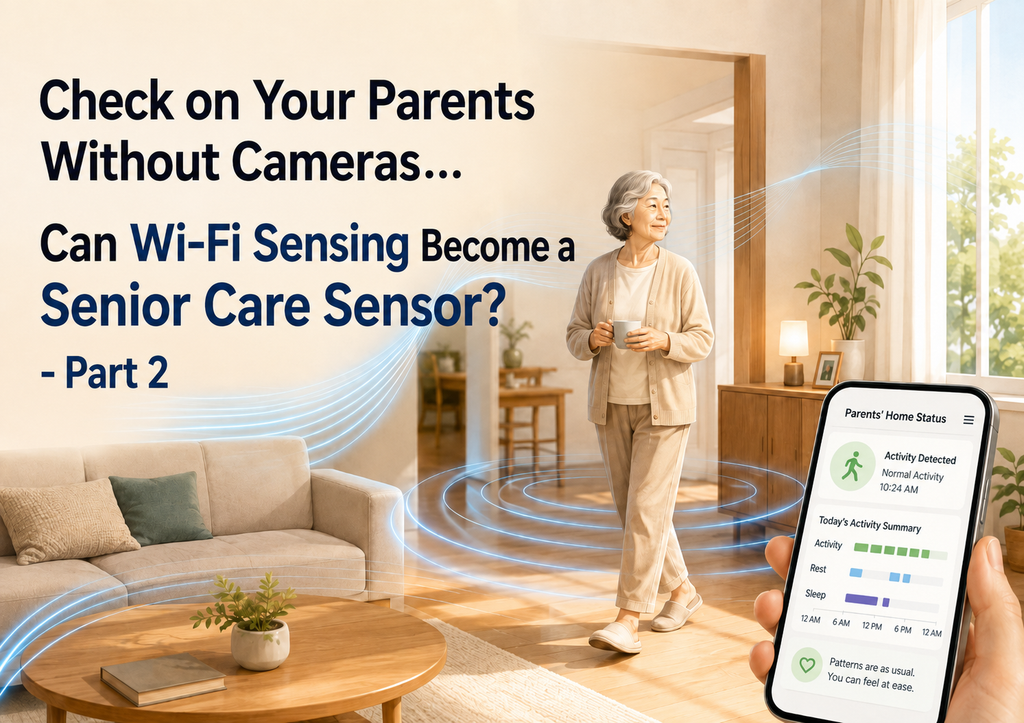
If it can continuously identify whether someone is at home, what times they are active, and how much their movement differs from their usual patterns, it can also be applied to home care services that monitor the daily condition of older adults living alone.
For example, if someone who normally starts activity around 7 a.m. remains inactive until late morning, nighttime movement suddenly increases significantly, or no activity appears in the living space for a certain period, this information can serve as a signal for a caregiver to check on the person’s condition.
In this case, the role of the sensor is closer to detecting changes from a person’s usual daily routine than closely observing the person at every moment.
Senior Care Requires Sensors That Can Be Used Continuously in Daily Life
Various types of sensors are already used in senior care.
Wearable devices can directly measure a user’s movement and biometric information, while cameras can provide detailed information about situations occurring within a space. Contactless methods such as radar and infrared sensors are also used.
In actual homes, whether a sensor can be used naturally over a long period of time, along with its accuracy, becomes an important condition.
Wearable devices require users to wear and charge them. Cameras require consideration of the user’s privacy when installed in bedrooms or everyday living spaces.
Wi-Fi Sensing can detect movement through wireless equipment installed in the living space without physical contact. Users do not need to wear a separate sensor every day, and the system does not need to continuously record video or audio.
In 2025, researchers at the University of Edinburgh also tested contactless biometric signal measurement using Wi-Fi CSI in the actual homes of participants aged 60 and older. The researchers examined the applicability of the technology while reflecting real-world conditions in older adults’ living spaces, including sensor placement, furniture arrangement, and human movement.
For services that support independent living among older adults, this type of contactless sensing can become an important option.
The Information Wi-Fi Can Detect Expands in Stages
Wi-Fi Sensing analyzes changes in wireless signals that occur when a person moves.
From a senior care perspective, the information that can currently be used can be divided into three broad stages.
1. Presence and Activity
The most basic area is identifying whether a person is present in a space and whether movement has occurred.
Information such as what time activity begins and whether movement has occurred during a certain period can be recorded.
Even this level of information can be used for routine check-ins on older adults who live alone.
2. Changes in Daily Patterns
When activity data is accumulated over a certain period, it can form a person’s usual daily routine.
As information such as wake-up time, daytime activity levels, nighttime movement, and movement during certain time periods accumulates, the current condition can be compared with the person’s usual pattern.
This stage is particularly important in senior care.
This is because changes in daily patterns accumulated over time, rather than a single movement event, can provide additional information for identifying unusual situations.
3. More Detailed Conditions Such as Breathing and Sleep
Research is also underway to analyze subtle movements such as breathing and sleep using Wi-Fi CSI.
In the University of Edinburgh researchers’ test in actual older adults’ homes, Wi-Fi CSI-based respiratory rate measurement showed potential, and respiratory rates measured in real homes showed a strong correlation with the reference device. In contrast, heart rate measurement was more strongly affected by human movement and environmental noise.
These results show that Wi-Fi Sensing has the potential to handle a wider range of information beyond motion detection, while also showing that the required accuracy and technological maturity differ depending on the type of information.
Wi-Fi Sensing-Based Home Care Products Are Also Emerging in Korea
In Korea, network equipment company HUMAX Networks has introduced products that apply Wi-Fi Sensing to home care.
HUMAX Networks’ Moni Pod is a smart home care solution that detects human movement through changes in indoor wireless signals and analyzes them using AI.
On its official website, the company describes the product as detecting movement without cameras, microphones, or wearable devices and as being suitable for family and senior care, including checking the daily routines and changes of parents living far away. It also presents plug-and-play installation as a product feature.
At ANGA COM 2026, HUMAX Networks also included its AI-based Wi-Fi Sensing solution, MONI Care, in its broadband and in-home solutions portfolio. ANGA COM is a European broadband, media, and connectivity event attended by network operators and equipment companies.
This case shows that Wi-Fi Sensing in Korea is moving beyond research technology and being connected to actual home care products and solutions for service providers.
At the same time, it is difficult to determine the overall level of commercialization in Korea’s senior care market based on the example of HUMAX Networks alone. How much these products are connected to actual services with telecommunications and home care providers will be a key measure of the size of the market.
The Ability to Integrate with Existing Residential Infrastructure Changes the Business Structure
When deploying senior care services, installation and maintenance structures are important alongside sensor performance.
Installing several types of dedicated equipment in each home requires separate hardware purchases, installation, and management.
Wi-Fi Sensing has the characteristic of being able to connect with wireless networks already widely used in homes.
There are approaches like Comcast’s, which use existing Gateways and connected devices, as well as approaches like Moni Pod, which add a small dedicated sensing device with simple installation.
This difference can also affect the actual business model.
Wi-Fi Sensing can be used for basic daily monitoring, while radar or additional sensors can be added in spaces that require a higher level of care.
For example, presence and daily patterns can be monitored throughout the home, while more precise sensors can be added in bathrooms or bedrooms where fall risks are higher.
In this structure, Wi-Fi Sensing can serve as a basic sensing layer that monitors changes in daily life throughout the home.
Fall Detection Requires a Higher Level of Validation for Commercial Use
Fall detection is one of the important functions in senior care.
Research is also underway to distinguish changes in posture and fall patterns using Wi-Fi signals. This approach learns changes in wireless signals that occur when a person’s body moves rapidly or their posture changes significantly.
What is technically possible and what can be used reliably in an actual care service require different levels of validation.
A review of fall detection and prediction technologies published in 2026 found that, among a total of 243 studies, more than half used simulated falls in laboratory environments, while 21 studies validated their systems with actual older adults in real-world or mixed environments. Evidence on long-term usability, integration into actual care workflows, and cost-effectiveness was also relatively limited.
In actual homes, various factors can affect sensing results, including lying down on a bed, picking something up from the floor, movement by multiple people, pets, and furniture placement.
Therefore, the practical use of Wi-Fi Sensing in senior care is to commercialize information that can be continuously monitored, such as presence and changes in activity, first, and expand fall and emergency detection together with sufficient validation in real-world environments.
The Response Structure After Detection Determines the Completeness of the Service
In senior care, a service is not complete simply because a sensor generates information.
When an unusual situation is detected, the service must also define who receives the information and what action follows.
For example, if a user who normally becomes active in the morning shows no movement for a certain period, the following process can be designed.
- The system detects a change that differs from the user’s usual daily pattern.
- It sends a status check alert to the user.
- If necessary, it delivers the situation to a caregiver.
- It assesses the level of risk using information from multiple sensors or additional checks.
- Depending on the service level, it connects to a care provider or emergency response system.
This is where network technology and care services meet.
Telecommunications equipment and sensing technology can generate and analyze data. Actual care also involves connections with caregivers, nursing facilities, home-visit care services, and emergency response systems.
Therefore, in the senior care market, what matters is not only the accuracy of an individual sensor but also whether detection → analysis → alert → confirmation → response can be operated as a single service.
Daily Pattern Data Also Requires Privacy Management
Wi-Fi Sensing can monitor living spaces without recording video or audio.
When a service operates over a long period, another type of daily-life data accumulates.
Information such as wake-up time, bedtime, nighttime activity, periods of prolonged inactivity, and daily activity levels can be recorded continuously.
This information reveals an individual’s daily habits, and in senior care it can also be interpreted in connection with health or care conditions.
Therefore, the following standards need to be defined together during the service design stage.
- What daily-life data is collected
- How much information is shown to caregivers
- How long the data is retained
- For what purposes the service provider analyzes it
- Under what conditions it is provided to third parties
In senior care in particular, a structure that clearly distinguishes the user’s own consent from a caregiver’s access rights is necessary.
The more privacy-conscious sensing technologies and clear data management standards are established together, the more favorable the conditions become for long-term service use.
DANA NOTES Commentary
What deserves attention in the senior care business of Wi-Fi Sensing is its ability to turn a person’s ‘usual routine’ into data.
Emergencies occur at specific moments, but people’s daily lives repeat every day. When everyday patterns such as wake-up time, activity levels, and nighttime movement accumulate over a certain period, they create a baseline that represents the user’s usual condition.
Once this baseline is established, the role of care services can also expand.
In addition to caregivers checking a situation after a problem occurs, they can also identify changes in daily life that differ from the person’s usual patterns in advance.
This also has business implications. Compared with products that end with the sale of a single sensor, a structure that continuously analyzes daily-life data and connects it with caregivers or care services can support ongoing home care services.
If Wi-Fi Sensing becomes established in senior care, the focus of competition can also expand from the performance of a single sensor hardware product toward providing data analysis, user experience, care integration, and operational reliability together.
Variables to Watch
The first is long-term accuracy in actual older adults’ living environments. In real homes, furniture placement, human movement, sensor positioning, and the surrounding environment continuously vary. In the University of Edinburgh study, respiratory rate measurement accuracy in actual homes was lower than in a controlled laboratory environment, while heart rate measurement was more strongly affected by environmental noise and movement.
The second is the level of real-world validation for fall and emergency detection. Fall-related sensing technologies are developing rapidly, but studies that have validated them over long periods with actual older adults still represent only a portion of the overall research. How much data can be accumulated on false positives, false negatives, and long-term use will be important.
The third is the combination of telecommunications and network services with care services. For Wi-Fi Sensing technology to expand into the actual market, telecommunications companies, network equipment companies, and home care and care service providers need to create actual products and services together. It will be necessary to see whether supply contracts, service launches, and subscriber growth continue in Korea and overseas.
The fourth is installation and service costs. The cost of deployment per household will vary depending on how much existing network equipment can be used and how many additional sensors are required. Whether economic feasibility can be secured in senior care facilities and ordinary homes can also affect the pace of adoption.
The fifth is privacy and access-right standards. As the use of daily-pattern and health-related information expands, clear management of user consent, caregiver permissions, data retention, and third-party disclosure standards becomes increasingly important.