
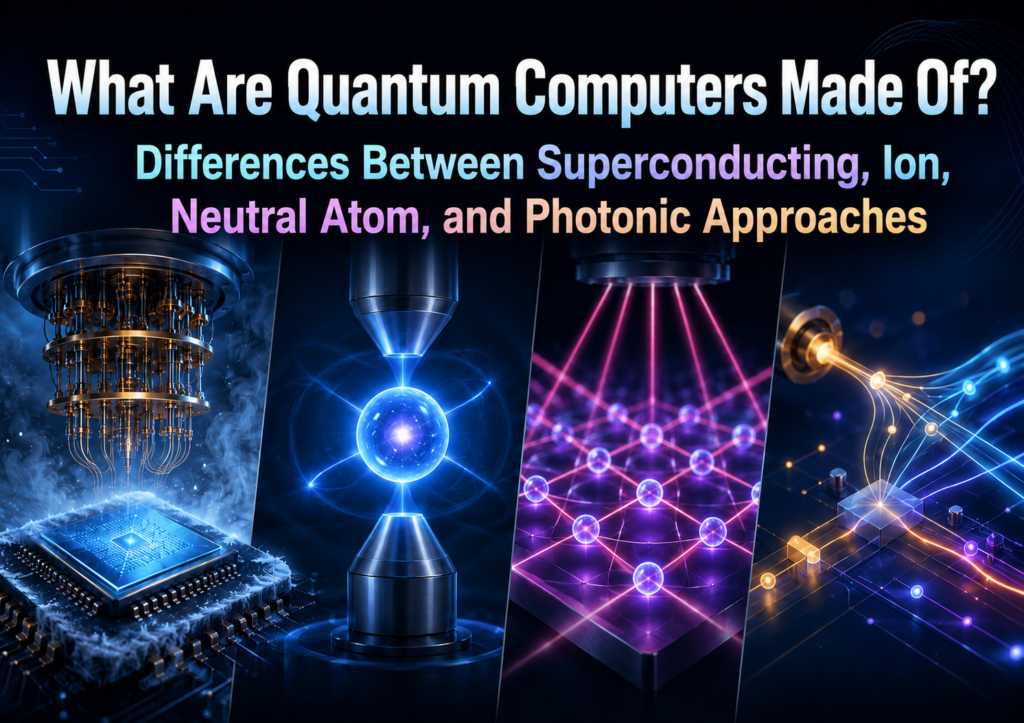
What This Article Covers
When you look at photos of quantum computers, the equipment can appear quite different.
Some systems feature large cooling equipment at the center, while others are equipped with multiple lasers and optical devices. Some quantum computers are also built around optical chips that transmit light.
Why do systems called quantum computers look so different?
To understand this, it helps to first look at how conventional computers handle information.
Conventional Computers Use Bits, While Quantum Computers Use Qubits
Conventional computers process information using electrical signals in semiconductor chips.
The basic unit used to handle information is the bit (Bit). Bits represent information using 0 and 1.
The PCs and smartphones we use, as well as corporate servers and data centers, operate based on this structure.
AI uses the same computing structure.
AI training and inference use devices such as GPUs and AI accelerators that can process large amounts of computation quickly. These devices also use electrical signals in semiconductor chips, and the basic unit of information remains the bit.
Quantum computers use a unit called the qubit (Qubit).
At first, it is enough to distinguish the roles of these two units.
- Bit (Bit): The basic unit used by conventional computers to handle information
- Qubit (Qubit): The basic unit used by quantum computers to handle quantum information
The detailed principles of how qubits process information are connected to quantum concepts such as superposition and entanglement. These can be explored separately at the next stage.
This article focuses on how qubits are physically implemented in actual hardware.
Quantum Computing Hardware Works Together with Conventional Computers
Current quantum computing systems use conventional computers and quantum computing hardware together.
A conventional computer runs the program and sends the necessary instructions, while the quantum computing hardware performs the computation. After the computation is completed and the result is measured, the conventional computer receives and processes the result.
The structure can be expressed simply as follows.
Conventional computer → Quantum computing hardware → Conventional computer
For this reason, actual quantum computers include conventional servers, control equipment, and various peripheral devices connected around the quantum computing hardware.
The structure of the equipment changes depending on which physical system is used to implement the qubits inside the quantum computing hardware.
The major approaches currently include superconducting, ion, neutral atom, and photonic systems.
1. Superconducting Approach — Using Circuits Cooled to Extremely Low Temperatures
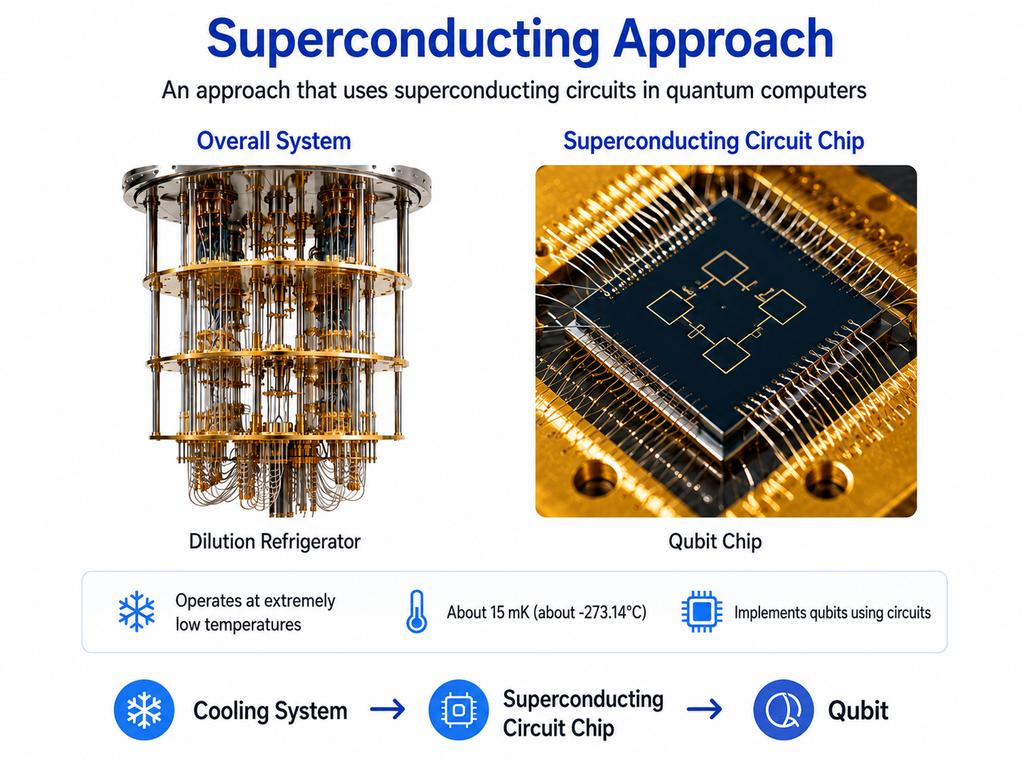
The superconducting approach creates qubits using specialized electrical circuits.
Superconducting materials exhibit special electrical properties when cooled to extremely low temperatures. Quantum computers use circuits in this environment and precisely control their states for computation.
This is why superconducting quantum computers are equipped with powerful cooling systems.
IBM’s superconducting quantum chip testing environment cools the temperature to approximately 15 millikelvin (mK). Converted to Celsius, this is about −273.14°C. It is very close to absolute zero, which is −273.15°C.
The large metallic structures seen in photographs are cooling systems that create this ultra-low-temperature environment. The quantum chip that performs the actual computation is located inside.
IBM and Google are among the companies developing superconducting quantum computers.
An easy way to remember it is:
Superconducting approach = Using circuits in an environment close to −273°C
2. Ion Approach — Using Electrically Charged Atoms
The ion approach uses atoms.
Atoms contain electrons. When electrons are removed or added, the atom as a whole acquires an electrical charge. This is called an ion.
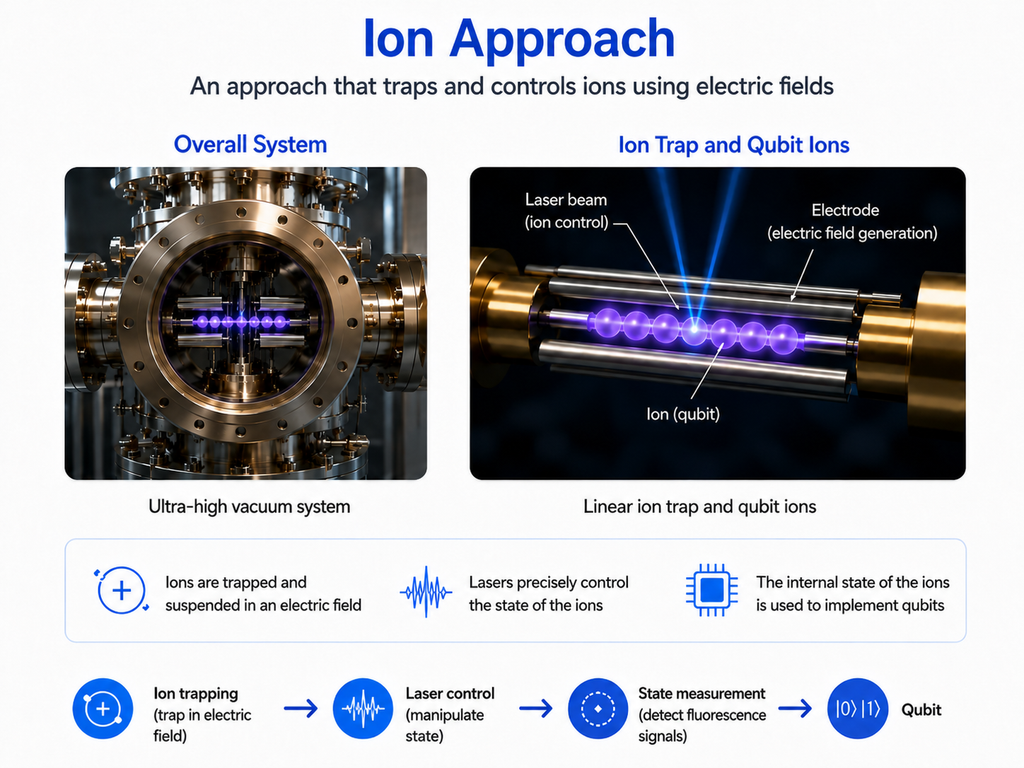
Ion quantum computers hold ions in a specific space and use their states as qubits.
Because ions carry an electrical charge, electric fields can be used to control their positions. Lasers or microwaves are then used to precisely control the states of the ions.
For this reason, ion-based systems use vacuum equipment, devices that hold the ions, lasers, and control equipment.
Atoms of the same type have highly consistent fundamental physical properties. The ion approach uses these atomic properties to maintain quantum information for long periods and control it with high precision.
NIST studies trapped-ion quantum computing with long quantum-state retention times and high-precision control as important characteristics.
IonQ and Quantinuum are among the companies developing ion-based quantum computers.
An easy way to remember it is:
Ion approach = Using electrically charged atoms held in place
3. Neutral Atom Approach — Using Lasers to Trap and Arrange Atoms
The neutral atom approach also uses atoms.
A neutral atom is an atom whose overall electrical state is balanced.
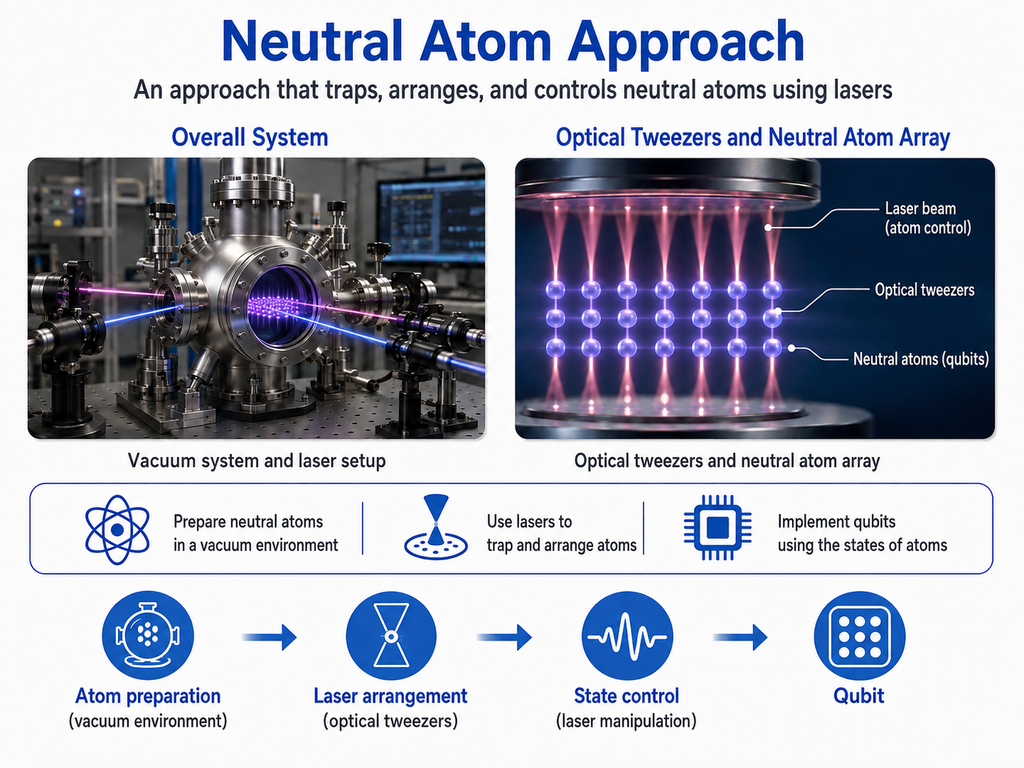
In the neutral atom approach, highly focused lasers are used to trap atoms one by one.
This technology is called optical tweezers (Optical Tweezers).
It can be understood as using light to pick up atoms and place them in desired positions, much like using tweezers to pick up small objects.
Quantum computers use the states of these arranged atoms as qubits.
QuEra is developing neutral atom quantum computers that use optical tweezers to trap and arrange individual atoms. Pasqal also uses lasers to trap and control rubidium atoms.
For this reason, vacuum equipment, multiple lasers, and optical devices play important roles in neutral atom systems.
An easy way to remember it is:
Neutral atom approach = Using lasers to trap and arrange atoms
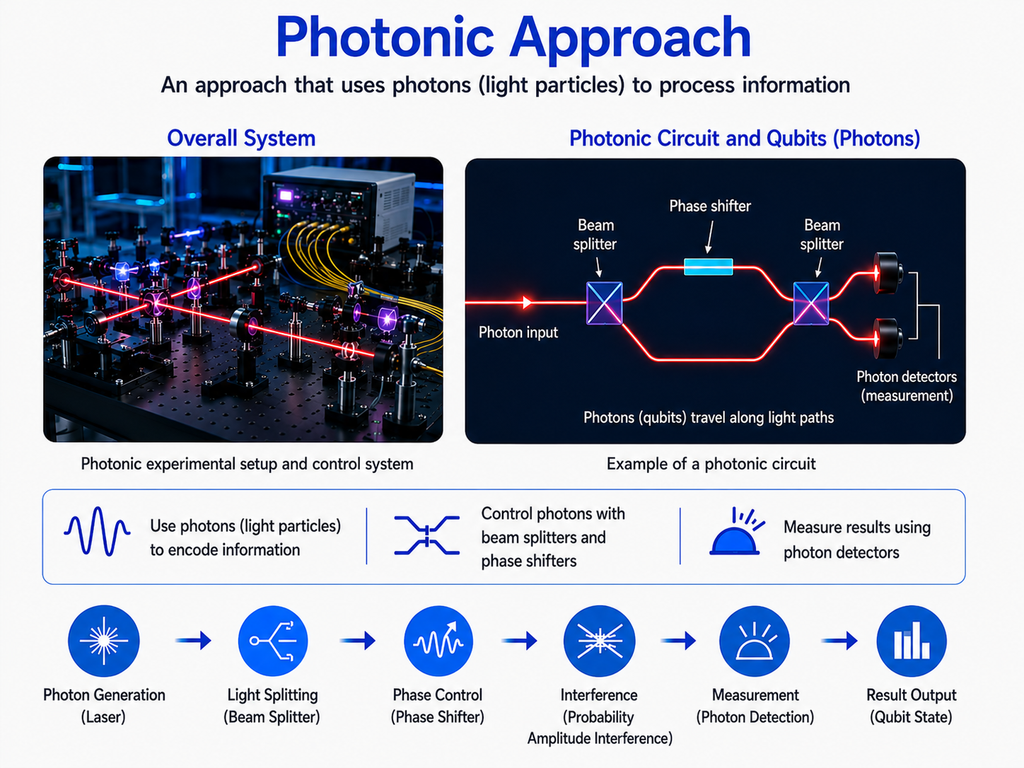
4. Photonic Approach — Using Light
The photonic approach uses light.
The particles that make up light are called photons.
Photonic quantum computers store quantum information in the states of photons and perform computations by moving and controlling light.
For this reason, the hardware is also built around light.
The system uses devices that generate photons, paths through which light travels, devices that control the direction of light, and detectors that measure the final state.
PsiQuantum uses single photons and is developing an approach that controls photons inside chips using silicon photonics (Silicon Photonics) technology developed in the communications and data center industries.
Photons are also well suited to being transmitted to other locations through optical fiber. This characteristic also connects naturally with architectures that link multiple quantum chips or devices.
Depending on the implementation, photonic systems can also use cooling technologies for certain components such as photon detectors.
An easy way to remember it is:
Photonic approach = Generating, moving, and controlling light
The Four Approaches Can Be Distinguished Like This
| Approach | What It Uses | Main Equipment | Easy Way to Remember |
|---|---|---|---|
| Superconducting | Specialized electrical circuits | Quantum chips, ultra-low-temperature cooling systems | Circuits cooled to extremely low temperatures |
| Ion | Electrically charged atoms | Vacuum equipment, ion-trapping devices, lasers | Using electrically charged atoms held in place |
| Neutral atom | Electrically neutral atoms | Vacuum equipment, lasers, optical devices | Using lasers to trap and arrange atoms |
| Photonic | Photons, the particles of light | Optical chips, optical fiber, photon detectors | Moving and controlling light |
All four approaches use qubits to process quantum information.
As the physical systems used to implement qubits differ, the required equipment and overall system architecture also change.
This is why cooling systems are prominent in photos of superconducting quantum computers, while lasers and vacuum equipment frequently appear in ion and neutral atom systems. In photonic systems, optical chips and equipment for transmitting light play central roles.
What Are the Advantages and Challenges of the Four Approaches?
Each approach uses different physical properties.
These differences also affect how quantum computers can be scaled and precisely controlled.
Superconducting Approach
Advantages
The superconducting approach can create qubits as circuits on small chips. It connects well with technologies developed by industries that have long designed and manufactured electronic circuits, and the operations required for computation are relatively fast.
Technical Challenges
The system must continuously maintain an ultra-low-temperature environment close to −273°C.
As the number of qubits increases, the number of wires and control devices connected inside the cooling system also increases. Cooling and wiring architectures that can stably control more qubits within a single system therefore become important.
Ion Approach
Advantages
Atoms of the same type have highly consistent fundamental physical properties.
Ions can maintain quantum information for long periods and have characteristics that support high-precision control of individual ion states.
Technical Challenges
Equipment is required to precisely trap and control each ion.
As the system grows, technologies for moving many ions to desired positions and operating multiple control devices together become increasingly important.
Neutral Atom Approach
Advantages
Optical tweezers can arrange many atoms into a defined structure.
The ability to move atoms to desired positions and configure their arrangement is also a characteristic of the neutral atom approach. This architecture can be used in approaches aimed at arranging large numbers of qubits.
Technical Challenges
Many atoms must be held stably at desired positions, and the state of each atom must be controlled accurately.
The precision of lasers and optical equipment, the accuracy of atomic control during computation, and repeatability affect the performance of the overall system.
Photonic Approach
Advantages
Photons can travel through optical fiber.
The approach can use optical technologies and silicon photonics technologies already widely used in the communications industry, and it is also well suited to architectures that connect multiple chips or quantum systems.
Technical Challenges
Photons can be lost while traveling.
Technologies for generating the required photons accurately, delivering them along the desired paths, and detecting them correctly at the end are important. PsiQuantum is also developing optical coupling and optical switching technologies that reduce photon loss as key technologies for implementing large-scale photonic quantum computers.
Why Are Quantum Computers Being Developed?
The development of computers has continued in the direction of processing more information more quickly.
Companies perform large amounts of computation to discover new materials, analyze financial markets, calculate logistics routes, and predict complex systems. As the amount of data and the number of conditions involved in a calculation increase, the number of cases that conventional computers need to process also grows rapidly.
Quantum computers have the potential to perform certain types of problems much faster than conventional computers. Research is being conducted in areas such as quantum system simulation, some optimization problems, and cryptography-related computations. NIST explains that quantum computers have the potential to perform these specialized problems much more efficiently than conventional computers.
From the perspective of companies and countries, computing speed can be directly connected to the time required to obtain results.
Even with the same data, if complex calculations can be completed more quickly, it may become possible to explore drug and new-material candidates faster, find efficient routes among many options more quickly, or handle problems that were previously difficult to calculate.
The ability to secure large amounts of information and quickly turn that information into meaningful results can become a source of competitiveness for companies and countries. This possibility is one of the reasons why companies such as Google and IBM, as well as many countries, are investing in the development of quantum computers.
Why Are Multiple Approaches Being Developed at the Same Time?
The quantum computing industry is currently advancing multiple physical approaches at the same time while evaluating which architectures are suitable for large-scale quantum computers.
The superconducting approach uses chip-based circuits and fast control.
The ion approach uses the consistent properties of atoms and high control precision.
The neutral atom approach uses an architecture that can arrange and move many atoms.
The photonic approach uses the transmission properties of light and technologies from optical communications and optical semiconductors.
Because each approach has strengths in different areas, companies are also choosing different development directions.
As quantum computers grow in scale, computational accuracy, control methods, connection architecture, cooling and optical equipment, and methods for scaling the system become important alongside the number of qubits.
For this reason, when reading news about quantum computers, it is useful to check the number of qubits together with:
“Which approach does this company use to build its qubits?”
IBM and Google are developing ultra-low-temperature cooling technologies, IonQ and Quantinuum are advancing ion-control technologies, QuEra and Pasqal are developing atom-arrangement technologies, and PsiQuantum is focusing on optical chips and photonic interconnection technologies because of the physical approaches each company has chosen.
DANA NOTES in One Line
Quantum computers implement qubits, the basic unit of quantum information, using superconducting circuits, ions, neutral atoms, photons, and other physical systems, and the equipment, advantages, and methods for scaling the system differ depending on the physical approach used.