Recommended Reading
What This Article Covers
Earlier, we looked at the background behind the emergence of big data and how the range and types of data that could be analyzed expanded significantly.
Then what did these changes actually make possible?
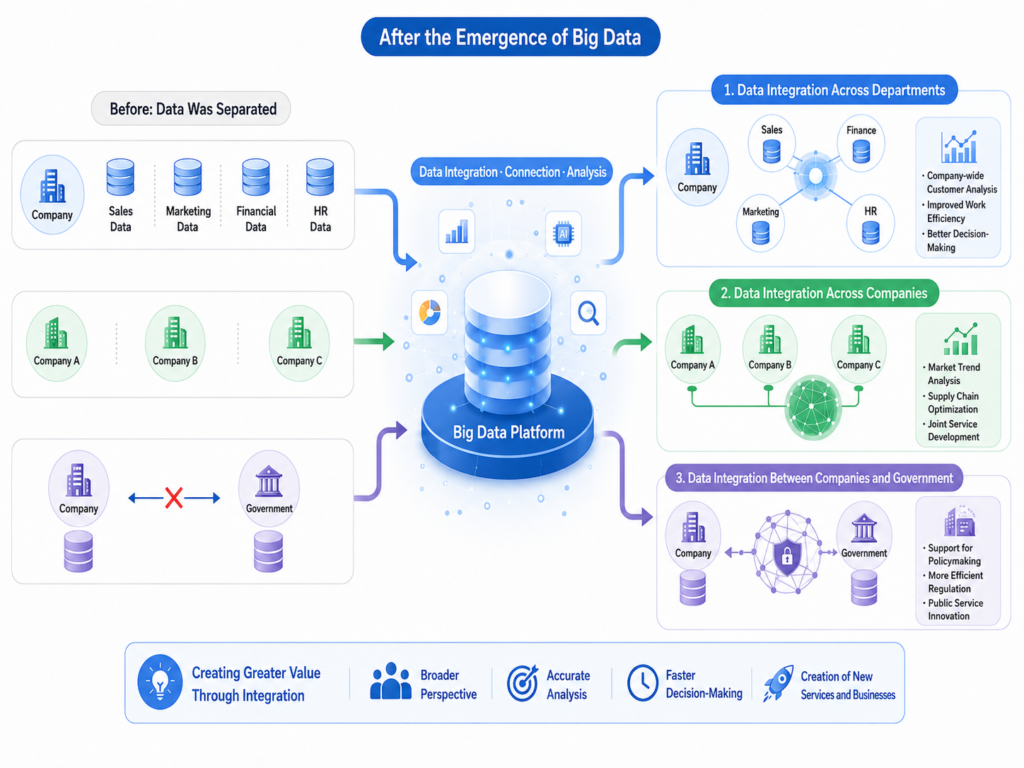
The biggest change brought by big data was not that it created new methods of analysis, but that it created an environment where diverse data that had previously been difficult to use together could be connected and used more efficiently.
It Became Possible to Connect Data from Multiple Systems
Even before the emergence of big data, companies used data to perform various analyses.
However, data was often managed separately by department and by system, and using different data together required a great deal of time and cost.
For example, customer management systems, order systems, inventory systems, and website access logs were often managed in separate systems.
To use these data together, a process was needed to gather and connect data from multiple systems.
In a big data environment, it became possible to connect these different data as a single subject of analysis and use them together.
| Before Big Data | After Big Data |
|---|---|
| Department-level data | Company-wide data |
| System-specific data | Data from multiple systems |
| Organization-specific data | Data across organizations |
In other words, an environment was created where data could be used by connecting it together rather than using each dataset separately.
It Became Possible to Process and Analyze More Data
With the emergence of big data, it became possible to process and analyze far more data than before.
In the past, limitations in storage capacity, processing performance, time, and cost made it difficult to use all available data. As a result, only selected portions of data were often used.
In a big data environment, however, it became possible to store much more data, process it into the required form, and then use it for analysis.
To use an analogy, if data from 1 to 20 could be used in the past, it is now similar to being able to use data from 1 to 70 together.
Of course, these numbers are not actual figures.
The key point is that an environment was created where far more data than before could be used together.
It Became Possible to Use Different Types of Data Together
In a big data environment, not only the amount of data but also the types of data that can be used have become much more diverse.
For example, structured data such as sales volume and inventory, as well as different forms of data such as customer inquiries, documents, web logs, images, and audio, can be used together.
When various types of data are used together rather than using only one type of data, the same phenomenon can be examined from multiple perspectives, allowing for broader analysis.
This ability to use different types of data together is also one of the important changes brought by big data.
It Became Possible to Use Data More Quickly
Today, data is continuously generated in real time.
Online shopping order records, website visit records, card payment records, traffic volume, and various other types of data are being created continuously.
In a big data environment, it became possible to collect and store this data faster than before, process it into the required form, and use it for analysis.
As a result, companies and organizations can understand situations more quickly and make decisions based on the latest data.
3V and 5V: Representative Concepts for Explaining Big Data
The concept most commonly used to explain the characteristics of big data is the 3Vs.
| Item | Meaning |
|---|---|
| Volume (Data Volume) | Very large amounts of data can be handled. |
| Velocity (Data Generation and Processing Speed) | Data can be collected and processed quickly for use. |
| Variety (Data Diversity) | Different types of data can be used together. |
Later, as data quality and the value of using data became important, the concept was expanded to the 5Vs.
| Item | Meaning |
|---|---|
| Volume (Data Volume) | Amount of data |
| Velocity (Data Generation and Processing Speed) | Speed at which data is processed |
| Variety (Data Diversity) | Diversity of data types |
| Veracity (Data Reliability) | Accuracy and quality of data |
| Value (Data Value) | Value that can be obtained from data |
If the 3Vs explain the basic characteristics of big data, the 5Vs can be understood as a concept that also considers how trustworthy the data is and what actual value can be created from it.
Big Data Is Also Used Around Us
Big data is used in a wide range of fields.
What these uses have in common is that they all collect and connect vast amounts of data and use it for analysis.
Representative examples include:
- Website visitor data analysis using Google Analytics
- Search trend analysis using search query data
- Consumer pattern analysis using card spending data
- Road congestion analysis using traffic data
- Weather change analysis using weather data
- Improvement of public services using public data
The areas of use are different, but they all share the same characteristic of creating new value by using diverse data together.
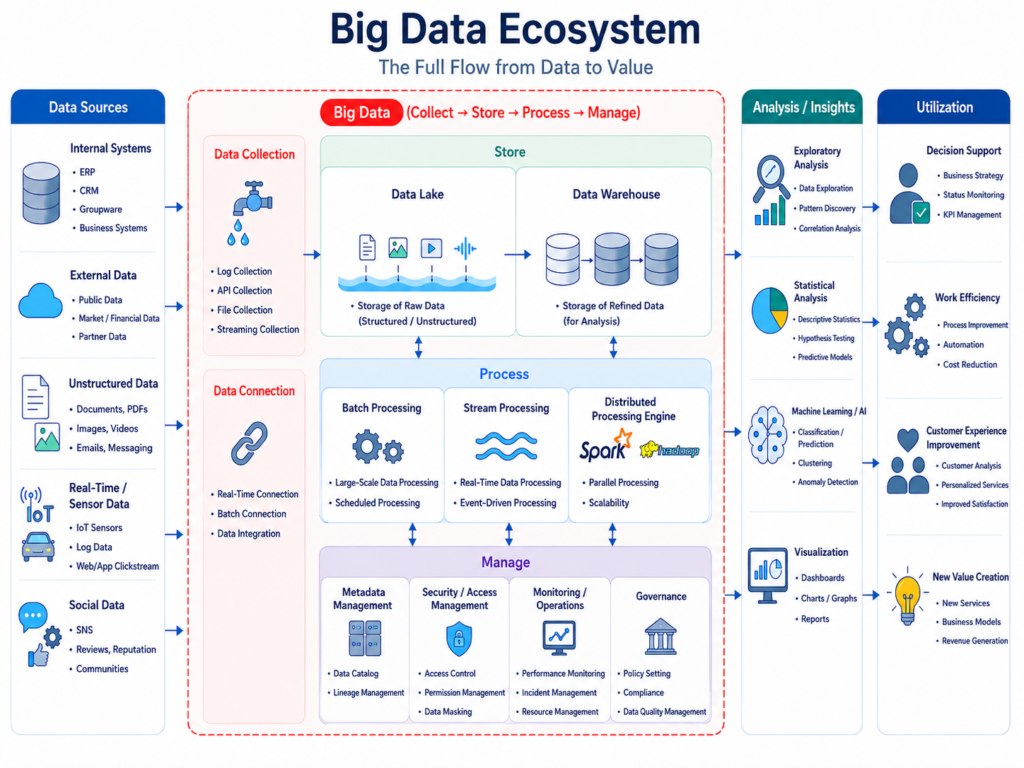
Big Data Is Not a Single Technology, but a Data Utilization Environment
Some people think of big data as the name of a single program or technology.
However, big data does not refer to one specific technology.
It refers to a data utilization environment that makes it possible to collect data (Collect), store it (Store), connect and integrate different data (Integrate), process it into the required form (Process), analyze it (Analyze), and use it (Utilize).
In other words, it is more accurate to understand big data not simply as storing large amounts of data, but as an environment that supports the entire process needed to use data effectively.
Conclusion
Big data is not a technology that emerged to replace existing data analysis.
Existing analysis has also continued to produce sufficiently meaningful results in various fields.
However, big data created an environment where data that had previously been difficult to use together could be connected, more data could be processed and analyzed, and different types of data could be used together.
This data utilization environment later became the foundation for the development of various data platforms and data processing technologies, and has become an important foundation that makes today’s data-driven society possible.
DANA NOTES in One Line
Big data is not a single technology, but a data utilization environment that makes it possible to collect and store data, connect and integrate it, process and analyze it, and put it to use.